LED Road Flare Buyer's Guide: Government, Wholesale & Brand Sourcing by Profile (2026)
JUMP TO SECTION
- Find Your Buyer Profile
- Deployment: How Many Flares & Where
- Equipment Comparison: Flares vs. Alternatives
- Reading Specs: Lumens, IP Rating, Magnet Strength
- Compliance: DOT, MUTCD, CE, ECE R65
- Supplier Reality: MOQ, Lead Times, OEM
- Cold Weather & Field Performance
- FAQ
- Request a Sample
Introduction
Over the years, we've seen fleet operators purchase LED road flares based solely on lumen ratings, only to discover that battery performance became the real limitation during winter deployments. In road safety applications, selecting the right flare is rarely about choosing the brightest product — it's about choosing the right product for the intended environment and user profile.
Government agencies, private-label brands, wholesalers, and fleet operators all evaluate LED road flares differently. Understanding your buyer profile is the first step toward making the right sourcing decision.
This guide covers the full sourcing picture: buyer profiles, deployment standards, product comparisons, specifications, compliance requirements, and supplier expectations — everything you need to evaluate LED road flares before placing an order.

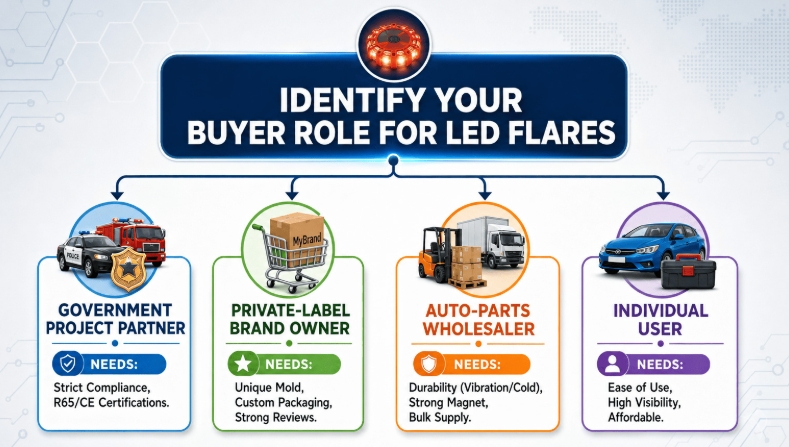
Find Your Buyer Profile
The most common sourcing mistake is applying the wrong buyer logic. A brand owner chasing certifications they don't need. A wholesaler requesting custom tooling on a standard product. Before evaluating any spec, identify where you sit in the market.
| Buyer Tier | Who They Sell To | Key Focus | What "Good" Means |
|---|---|---|---|
| 1. Project Partner | Government, Police, Fire Depts. | Compliance, Reliability | ECE R65 / DOT certified, stable long-term supply |
| 2. Brand Owner | End-users on Amazon, DTC sites | Branding, Differentiation | Custom packaging, unique mold, strong field performance |
| 3. Auto-Parts Wholesaler | Tow companies, repair shops, fleets | Durability, Reorder Reliability | Strong magnet, cold-weather battery, consistent stock |
| 4. Individual / Fleet User | Themselves, drivers, field crews | Ease of use, Visibility | Simple deployment, 1-mile visibility, affordable |
Each tier has a different definition of a failed purchase. A brand owner's failure is a bad Amazon review. A government partner's failure is a rejected tender. A wholesaler's failure is a product that dies in a cold winter.
Once you've identified your tier, the rest of this guide becomes a filter — not a menu.
Deployment — How Many Flares Do You Need & Where Do They Go?
Before evaluating products, understand how they'll actually be used in the field. Deployment quantity, spacing, and pattern all affect which product configuration makes sense.
The standard FMCSA emergency deployment for a stopped commercial vehicle uses three warning devices, placed at:
- ~10 feet from the vehicle (traffic side)
- ~100 feet behind the vehicle
- ~300 feet behind the vehicle (or at the crest of a hill)
On high-speed highways (65+ mph), advance warning distance should extend further. For work zone applications, MUTCD Part 6 governs placement within lane closure tapers and transition zones.
Quantity by use case:
- Personal vehicle / emergency kit: 3–4 flares minimum
- Commercial truck / fleet vehicle: 6–8 flares (covers both breakdown and secondary marking)
- Work zone / lane closure: 8–12+ flares depending on taper length
- Multi-vehicle convoy or construction site: Bulk deployment, often 20+ units with sequential sync
Deployment patterns matter as much as quantity. A straight line of independently flashing flares communicates "hazard ahead." A sequentially flashing line communicates direction — guiding drivers into the open lane before they reach the taper.
→ For a detailed deployment calculator and scenario guide, read: How Many Road Flares Do I Need? A Deployment Guide for Drivers & Fleet Professionals
LED Road Flares vs. Alternative Warning Equipment
LED road flares are not always the right tool. Understanding when alternatives outperform them is part of making a smart sourcing decision.
LED Road Flares vs. Reflective Cones
Reflective cones are passive — they require ambient light or vehicle headlights to be visible. LED road flares are active light sources visible in complete darkness, fog, and rain. For nighttime or low-visibility deployments, LED flares outperform cones. For daytime lane management on a well-lit road, cones may be sufficient and more cost-effective.
→ Full comparison: Reflective Cone vs LED Warning Light: Which Is Better for Traffic Safety?
LED Road Flares vs. Traffic Cone Lights
Traffic cone lights mount on top of standard traffic cones, combining the physical barrier function of a cone with active lighting. LED road flares are standalone — more portable and easier to deploy on bare road surfaces, vehicle bodies (via magnet), or guardrails. For long-duration work zones, cone lights offer a more stable setup. For mobile or emergency scenarios, road flares win on speed and flexibility.
→ Full comparison: LED Traffic Cone Lights vs. Road Flares: Which One Do You Actually Need?
LED Road Flares vs. Arrow Boards
Arrow boards direct traffic flow across large distances — they're fixed or vehicle-mounted and require power infrastructure. LED road flares handle close-range hazard marking and can be deployed in under two minutes with no setup. They serve different functions and are often used together, not instead of each other.
→ Full comparison: LED Flares vs Arrow Boards: Key Differences & Best Use Cases for Work Zones
Sequential vs. Non-Sequential LED Road Flares
Standard LED flares flash independently. Sequential flares sync together and flash in a directional sweep, creating a runway-style effect that guides drivers into the correct lane. For lane closure tapers, sequential is operationally superior. For personal emergency kits, standard flares are sufficient.
→ Full guide: Sequential vs. Non-Sequential LED Road Flares: Differences, Uses & Buying Guide
Wireless Sequential Warning Lights vs. Cone-Mounted Systems
For road crews managing active lane closures, wireless sequential warning lights offer the highest-visibility directional guidance — often replacing cone-light systems entirely on high-speed corridors. This comparison is especially relevant for contractors upgrading from older cone-based systems.
→ Full comparison: Wireless Sequential Warning Lights vs Cones: 5 Reasons Road Crews Are Upgrading Safety Systems
How to Read LED Road Flare Specs {#specs}
Spec sheets are a starting point, not the full story. Here's how to interpret the numbers that actually matter.
Lumens vs. Real-World Visibility
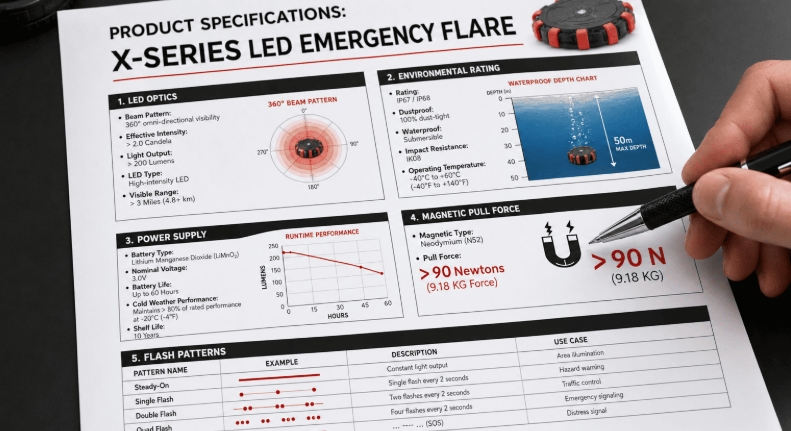
Everyone asks for lumen count. Almost no one asks about beam pattern. A flare with a well-engineered reflector and wide-angle lens can be visible at greater distance than a higher-lumen unit with a narrow or glare-prone beam. When evaluating visibility claims, ask for the visibility distance at rated flash mode, not just the LED chip output.
IP Ratings: What They Actually Mean
- IP65: Protected against water jets from any direction. Suitable for rain, road spray.
- IP67: Submersible to 1 meter for 30 minutes. Handles puddles, heavy rain, and temporary flooding.
- IP68: Rated for prolonged submersion beyond 1 meter. Rarely necessary for road applications; relevant for flooding-prone environments.
For 95% of road safety applications, IP67 is the practical minimum. The more important durability question is whether the seal degrades after repeated impacts — ask for drop-test data alongside the IP rating.
Magnet Pull Force
The minimum for any vehicle-mounted application is 35 lbs (16 kg). For highway use or heavy commercial vehicles with textured or painted surfaces, specify 50 lbs or above. Painted steel reduces grip by 20–30% versus bare metal. If your end-users are tow operators or DOT crews, test the magnet on the actual vehicle type before finalizing.
Battery Chemistry
| Battery Type | Cold Weather Performance | Best For |
|---|---|---|
| Alkaline | Loses 20–30% capacity at 32°F; fails below -4°F | Mild climates, short deployments |
| Lithium | Stable to -40°F / -40°C | Canada, northern Europe, high altitude |
| Li-ion Rechargeable | Moderate cold tolerance; requires charging protocol | Fleet use with controlled storage |
For buyers in cold climate markets, lithium chemistry is non-negotiable. Always request the battery spec sheet, not just the operating temperature range.
Flash Modes
More modes is not better — the right modes are better. Minimum useful configuration for professional use:
- Steady-on (static hazard marking)
- Slow flash (advance warning zone)
- Fast flash (active incident scene)
- Sequential mode (lane taper / directional guidance)
For government or emergency vehicle applications, verify that flash frequency (flashes per minute) meets any jurisdiction-specific requirements. MUTCD specifies 50–110 fpm for Type A and Type C warning lights.
Run Time
On long overnight construction shifts (10–12 hours), run time directly determines whether your equipment lasts the shift. Fast flash modes consume significantly more power than slow or steady modes. Verify run time per mode, not a single averaged figure.
Compliance — DOT, MUTCD, CE & ECE R65
Compliance requirements vary significantly by market, buyer tier, and application. This section maps the key frameworks.
United States: FMCSA & MUTCD
FMCSA (49 CFR Part 392.22) governs warning devices for commercial motor vehicles stopped on highways. The standard requirement is three bidirectional reflective triangles, fusees, or liquid-burning flares, deployed within 10 minutes. Most LED road flares currently qualify as supplementary devices — they extend the safety zone but do not replace the required primary devices unless the specific product holds an FMCSA exemption.
MUTCD (11th Edition, December 2023) governs work zone traffic control device performance. Key specifications: amber color for construction zones, flash rate 50–110 fpm, adequate advance visibility based on posted speed. MUTCD compliance is self-certified by manufacturers — there is no government product registry. Always request specific standard references and third-party test documentation.
→ For the full DOT/MUTCD compliance breakdown: LED Road Flares for Highway Construction: DOT Compliance & Equipment Standards
European Market: CE & ECE R65
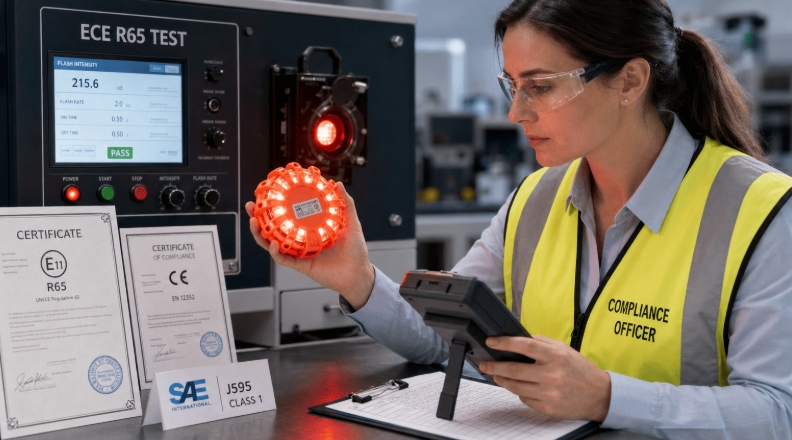
CE marking is required for general market access across EU member states. It confirms the product meets EU safety, health, and environmental requirements — a baseline for any European buyer.
ECE R65 is the critical certification for government, police, fire, and emergency vehicle applications in Europe. Without ECE R65, a product cannot be legally deployed on emergency vehicles in most EU member states. For German, French, or Dutch government tenders, request full ECE R65 documentation before sampling.
For non-emergency commercial applications (fleet vehicles, tow operators, construction crews) in Europe, CE is typically sufficient. For anything touching government or emergency response, ECE R65 is non-negotiable.
Matching Compliance to Buyer Profile
| Buyer Tier | US Market | European Market |
|---|---|---|
| Government / Emergency | FMCSA exemption status + MUTCD | ECE R65 + CE |
| Fleet / Commercial | MUTCD supplementary | CE |
| Brand Owner (Amazon/DTC) | FCC (electronics) + basic DOT labeling | CE |
| Wholesaler | MUTCD supplementary | CE |
Selling a non-compliant product into the government channel is not a minor issue — it results in returned orders, disqualification from future tenders, and reputational damage that is difficult to recover from.
Secondary Crash Risk & The Case for Upgrading Warning Systems
Secondary crashes — collisions that occur at or near the site of an existing incident — account for a significant percentage of highway fatalities. The period between when a vehicle stops and when warning devices are fully deployed is the highest-risk window.
Modern LED warning systems, particularly sequential flare configurations, directly address this problem by establishing a visible safety corridor faster and at greater advance distance than traditional warning devices.
→ For the full analysis: How Secondary Crash Risk Is Reshaping Roadside Warning Equipment Procurement
→ On the operational case for sequential systems: Sequential Warning Lights: How Smart Flare Systems Reduce Secondary Road Accidents
Application-Specific Considerations
First Responders & Emergency Scene Management
For police, fire, and EMS teams, the primary requirement is speed of deployment combined with ECE R65 or equivalent certification. Arrow warning lights are frequently used alongside road flares to establish scene perimeter and direct traffic away from an incident.
→ Full guide: The First Responder's Kit: Why Portable Arrow Lights are Essential for Emergency Scene Management
Road Crews & Highway Construction
Work zone crews need equipment that handles shift-length deployments, functions in rain and darkness, and provides clear directional guidance for lane closures. Sequential flare systems or arrow boards are typically specified for active lane closure tapers; standard flares handle perimeter marking.
→ For equipment comparison in a work zone context: Common Traffic Safety Equipment Explained
Supplier Reality — MOQ, Lead Times & OEM Customization
Understanding a supplier's operational constraints prevents the most common sourcing surprises.

MOQ: What's Real vs. What's Listed
The listed MOQ typically applies to standard, off-the-shelf models. Custom requirements change everything:
- Logo + packaging only (private label): Lower MOQ threshold, shorter lead time
- Custom shell color: Requires injection mold purge — MOQ typically 1,000–3,000 units minimum
- New mold / unique design: Tooling cost (often several thousand USD) + 60–90 day minimum lead time for design, prototyping, and testing
Lead Times by Order Type
| Order Type | Typical Lead Time |
|---|---|
| Standard model, in-stock | 15–25 days |
| Standard model + logo/packaging | 30–45 days after sample approval |
| Custom color variant | Add 10–15 days for production setup |
| New mold development | 60–90 days minimum |
Build buffer into all timelines if your customer requires approval at each stage.
Exclusivity & Stocking Agreements
Suppliers can offer regional exclusivity, but only when backed by committed order volume. A supplier who offers exclusivity without a volume commitment is either inexperienced or not honoring it with other buyers. Stocking agreements (supplier holds inventory for priority fulfillment) require proven sales history — typically 3+ successful reorder cycles.
Payment Terms
Net-30 terms are earned, not standard. New buyers should expect a deposit requirement, typically 30–50% upfront. Payment terms expand as a track record of on-time payment develops over multiple orders.
Cold Weather & Field Performance Testing
Lab certifications tell you a product was tested once under controlled conditions. Field performance tells you whether it works in the actual deployment environment.
Before committing to a bulk order for cold-climate markets:
- Request samples and test in actual temperature conditions — not just the spec sheet range
- Test magnet on the actual vehicle surface (painted steel, textured bumper, aluminum body)
- Run the unit through a full shift cycle — deploy, run for 8–10 hours, recover, recharge, redeploy
- Drop test on asphalt — if a tow operator drops it from hip height onto a road shoulder, does it survive?
- Verify seal integrity after impact — IP ratings are tested on undamaged units; a cracked housing no longer holds the rated IP seal
For brand owners, a product that fails in the field produces bad reviews that damage sales long after the original order. Always test before scaling.
Frequently Asked Questions
Q1: I'm sourcing for a government tender in Europe. Which certifications are non-negotiable?
ECE R65 is the baseline for EU government and emergency vehicle applications. CE marking is required for general market access. Request full certification documents before sampling — not after.
Q2: What magnet pull force do I actually need for fleet vehicles?
Minimum 35 lbs (16 kg) for any vehicle-mounted application. For highway or heavy commercial vehicles, spec 50 lbs or above. Painted steel reduces grip by 20–30% vs. bare metal.
Q3: What's the real MOQ for a custom color or private label?
Private label (logo + packaging) can typically be done at lower volumes. Custom shell colors require a production run to justify purging the injection mold — typically 1,000–3,000 units minimum. New mold design adds tooling cost and 60–90 days of lead time.
Q4: How do I verify cold-weather performance before committing to bulk?
Ask for the battery spec sheet — specifically the chemistry type and rated capacity at -4°F (-20°C) and -40°F (-40°C). Alkaline batteries fail significantly below freezing. Lithium chemistry maintains performance down to -40°F/-40°C. Request a sample test before bulk orders for cold-climate markets.
Q5: How long does a typical OEM order take from sample approval to delivery?
Standard models with logo and packaging changes: 30–45 days. Custom color variants: add 10–15 days. New mold development: 60–90 days minimum. Build in buffer if your customer requires approval at each stage.
Q6: IP67 vs IP68 — does it matter for road use?
For 95% of road applications, IP67 is sufficient. IP68 becomes relevant near flooding zones or in compartments that regularly collect standing water. More important: ask for drop-test data alongside the IP rating — seal integrity after impact matters more than the lab-tested submersion rating.
Q7: Are LED road flares DOT approved?
There is no universal DOT approval for all LED road flares in the US. FMCSA regulates warning devices for commercial vehicles (49 CFR 392.22); most LED flares currently qualify as supplementary devices. MUTCD compliance is self-certified by manufacturers. Always request specific compliance documentation before bulk procurement.
Q8: What is the difference between LED road flares and traditional pyrotechnic flares?
Traditional flares use pyrotechnic materials — bright but create fire hazards, produce toxic smoke, and have limited burn time (typically 15–30 minutes). LED flares are reusable, flameless, waterproof, and suitable for extended deployment. For most fleet, towing, and roadside safety applications, LED road flares have become the preferred solution.
Q9: How many road flares should be placed behind a vehicle?
Three warning devices are the standard FMCSA minimum for stopped commercial vehicles. On high-speed highways, greater spacing is required. For work zones, MUTCD Part 6 governs placement within lane closure tapers.
→ For a detailed deployment guide: How Many Road Flares Do I Need?
Request a Sample or Quote
We manufacture all three product lines below and offer free samples for qualified buyers.
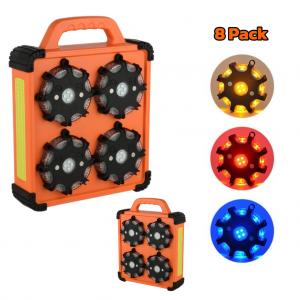
Traffic Cone Light Set (8-Pack)