Portable Arrow Safety Light vs LED Arrow Board: Which One Actually Fits Your Operation
Portable Arrow Safety Light vs LED Arrow Board: Which One Actually Fits Your Operation
A portable arrow safety light is unit-level, rechargeable, and deploys in under 10 seconds. An LED arrow board is trailer-mounted, generator-powered, and engineered for static highway closures. Same arrow pattern — entirely different deployment logic. If your decision comes down to road speed, closure duration, or fleet configuration, this comparison covers all three.
Jump to:
- What's the Real Difference?
- Side-by-Side Comparison
- When an LED Arrow Board Is the Right Call
- When a Portable Arrow Safety Light Is the Right Call
- Decision Matrix
- Why Mounting Flexibility Matters
- OEM & Wholesale Options
- FAQ
What's the Real Difference Between a Portable Arrow Safety Light and an LED Arrow Board?
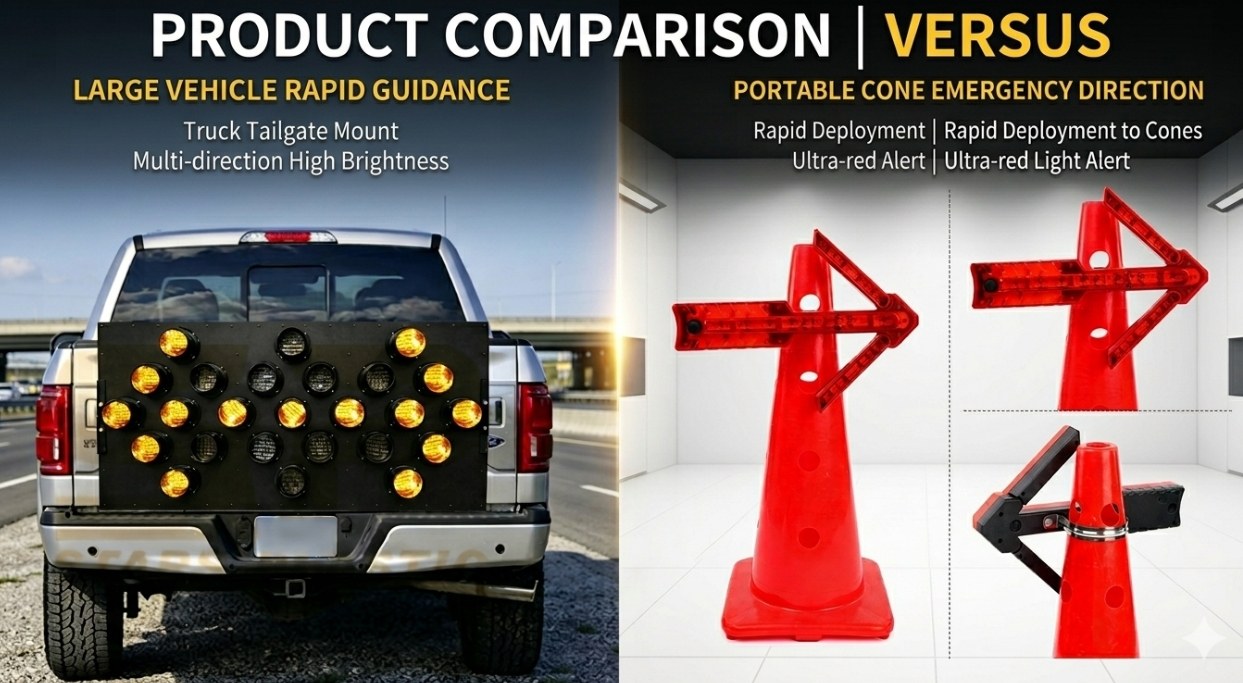
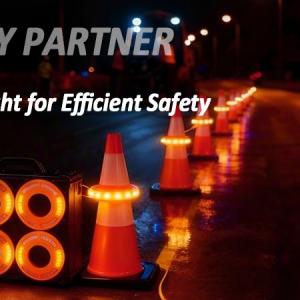
An LED arrow board is infrastructure. Trailer-mounted, generator or vehicle-powered, and built for static lane closures on high-speed corridors — the kind of setup that stays in place for days and serves high-volume traffic at highway speeds.
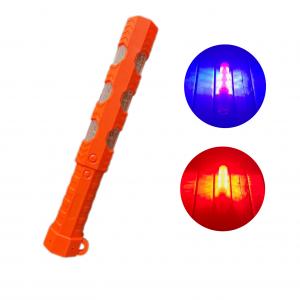
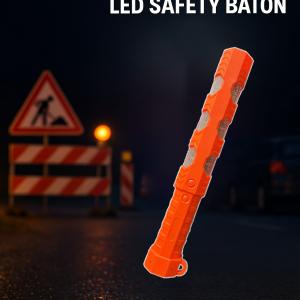
A portable arrow safety light is field equipment. Unit-level, rechargeable via Type-C, and built for rapid deployment in short-duration or mobile situations where a trailer is impractical or unavailable.
The decision comes down to two questions: How long is this closure? And what speed is the road?
Side-by-Side Comparison
| Feature | Portable Arrow Safety Light | LED Arrow Board |
|---|---|---|
| Unit cost | ~$14-18 per unit | $2,000–8,000+ per board |
| Ongoing costs | Near-zero (Type-C charge only) | Generator fuel, towing vehicle, maintenance |
| Power source | Type-C rechargeable | Generator / vehicle power |
| Deployment time | Under 10 seconds | 20–40 minutes |
| Operators required | 1 person | Typically 2–3 |
| Mounting options | Magnetic / cone-mount / suction cup | Trailer only |
| Waterproofing | IPX4 (splash-resistant) | Varies by model |
| Visibility range | Up to 1.5 km in darkness | Up to 1.5–3 km |
| Power output | 16W | 50W–300W+ |
| Battery life (chasing mode) | 18 hours | N/A (plugged in) |
| Best for | Short-duration / mobile / incident response | Long-term / static / high-speed highway |
| MOQ for OEM | 200 units | Custom quote |
While an arrow board requires ongoing generator fuel, a dedicated towing vehicle, and scheduled maintenance, a portable arrow safety light operates with near-zero overhead beyond charging. For fleet procurement managers calculating total cost of ownership across a deployment year, this gap compounds significantly.
When an LED Arrow Board Is the Right Call
There are deployments where an arrow board is not just preferred — it is the required option.
The Manual on Uniform Traffic Control Devices (MUTCD), a federal standard administered and enforced by the Federal Highway Administration (FHWA), specifies arrow board requirements for Type C closures on roads with posted speeds above 65 mph. In those environments, a full arrow board delivering 300W or more across a 48" × 96" panel is the enforceable requirement — though specific implementation standards vary by state. Always verify with your local DOT before specifying equipment for a contracted closure.
Arrow boards make clear operational sense in these scenarios:
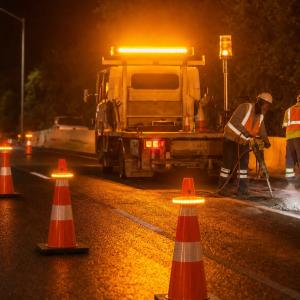
Multi-day resurfacing and repaving projects where crews return to the same closure configuration daily. The setup cost amortizes across a week or more of shifts, and the board's higher output keeps workers visible across all weather conditions.
Bridge inspection and structural work on interstate corridors, where lanes must remain closed for extended periods and traffic management is integrated with a broader incident command structure.
Large-scale lane reconfiguration on urban expressways, where an arrow board's cab-controllable operation is necessary for crews managing multiple closure points simultaneously.
State DOT and municipal highway contracts where equipment specifications are written into the bid requirements. In these cases, portable units may serve as supplemental signaling, but the primary specification is set before the job starts.
If your operation fits any of these profiles, spec an arrow board. The upfront cost is justified by the deployment duration, the regulatory environment, and the operational complexity involved.
When a Portable Arrow Safety Light Is the Right Call
A first responder, tow operator, or utility crew needs an active warning signal in place before traffic reaches them — not after a 40-minute trailer setup. A portable arrow safety light mounted magnetically to a vehicle's rear panel takes under 10 seconds. That gap between zero visibility and active warning is where incident risk concentrates.
Portable arrow lights are the operationally correct choice in these conditions:
Incident response and emergency scenes where setup speed is a safety variable. First responders, fire departments, and tow operators working off the shoulder for under four hours gain nothing from an arrow board and lose significant response time deploying one.
Short-duration maintenance work — pothole patching, sign installation, guardrail repair — on secondary roads where the closure window is measured in hours and a trailer-mounted board would spend more time in transit than in use.
Mixed-fleet vehicle operations where not every vehicle has a tow hitch or the clearance to pull a trailer. A portable unit gives every vehicle in the fleet a deployable warning signal regardless of configuration.
Brand buyers supplying direct-to-consumer channels where end users include private vehicle owners, volunteer emergency response teams, off-road recovery operators, and property maintenance crews — buyers who need a unit that fits in a gear bag, charges from any USB-C source, and deploys in under a minute.
Decision Matrix
| Deployment Scenario | Road Speed | Duration | Recommended Equipment |
|---|---|---|---|
| Highway resurfacing / repaving | 65+ mph | Multi-day | LED Arrow Board |
| Bridge inspection / structural work | 65+ mph | Multi-day | LED Arrow Board |
| State DOT contracted lane closure | 65+ mph | Any | LED Arrow Board (spec required) |
| Urban expressway reconfiguration | 45–65 mph | Multi-day | LED Arrow Board |
| Incident response / tow operation | Any | Under 4H | Portable Arrow Safety Light |
| Short-duration maintenance | Under 65 mph | Under 8H | Portable Arrow Safety Light |
| Mixed fleet / no tow capacity | Any | Any | Portable Arrow Safety Light |
| DTC / private vehicle / volunteer response | Any | Any | Portable Arrow Safety Light |
| Budget-sensitive procurement, secondary roads | Under 65 mph | Short | Portable Arrow Safety Light |
Why Mounting Flexibility Changes the Procurement Decision
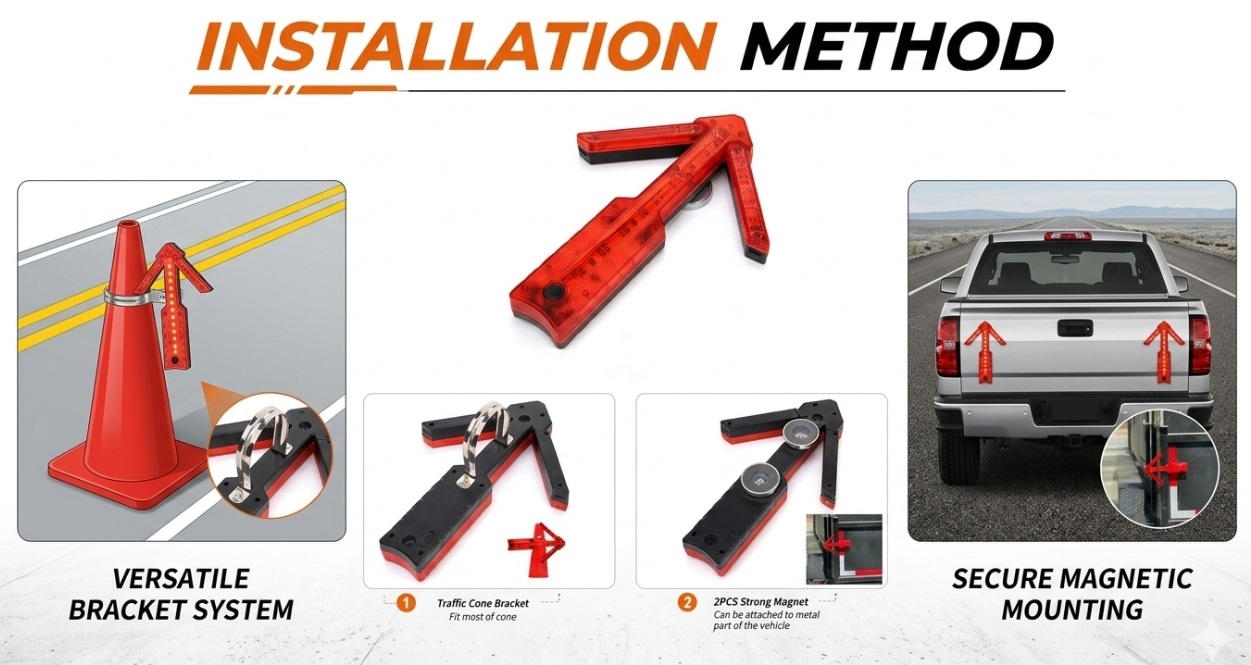
The three mounting configurations address one constraint increasingly common in modern fleet procurement: not every vehicle has a steel bumper.
Cone-Mount (Steel Ring Accessory)
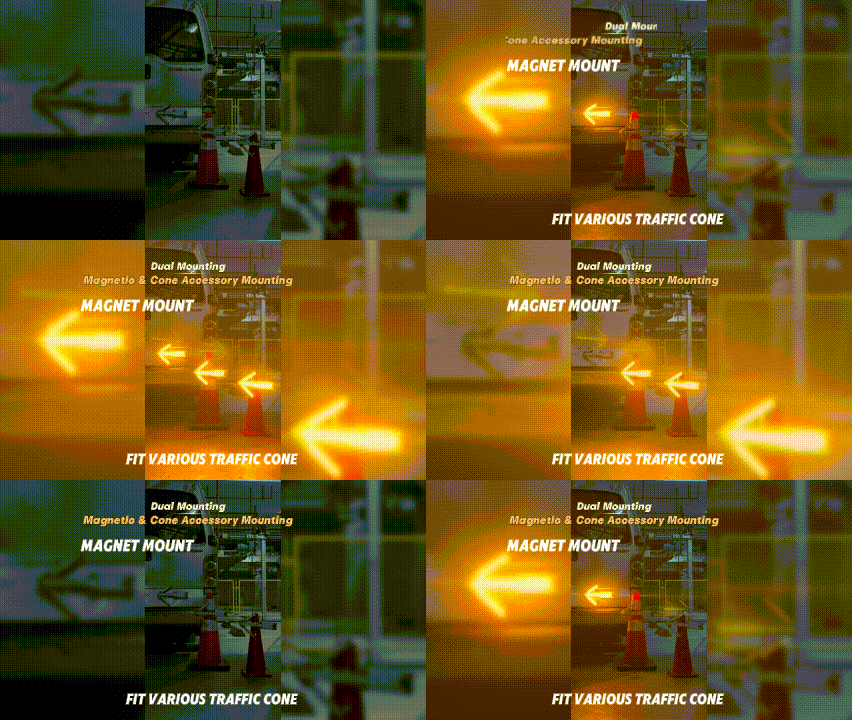
Slides onto a standard traffic cone with one motion — no adhesive, no straps, no tools. Works on wet or muddy cones. For work zones where cones are already deployed, this adds an arrow signal to the existing setup without additional hardware.
Magnetic Rear Mount
Adheres to any steel vehicle surface — truck tailgates, rear door panels, steel guardrails. Instant deployment, instant removal. No marks, no residue.
Suction Cup Mount
For vehicles with plastic or carbon fiber rear fascias — standard on most commercial vehicles and virtually all consumer vehicles produced after 2018 — where magnetic mounting fails entirely. Adheres to rear glass or any smooth painted surface with sufficient flat area.
A mixed fleet of 30 vehicles may include steel-bumper trucks, composite-bumper vans, and SUVs. A magnetic-only product covers perhaps half. All three configurations on a single SKU means one purchase order covers the entire fleet.
[VIDEO: Product demo — three mounting configurations in sequence: cone-mount, magnetic vehicle mount, suction cup on composite bumper]
OEM & Wholesale Options for Brand Buyers
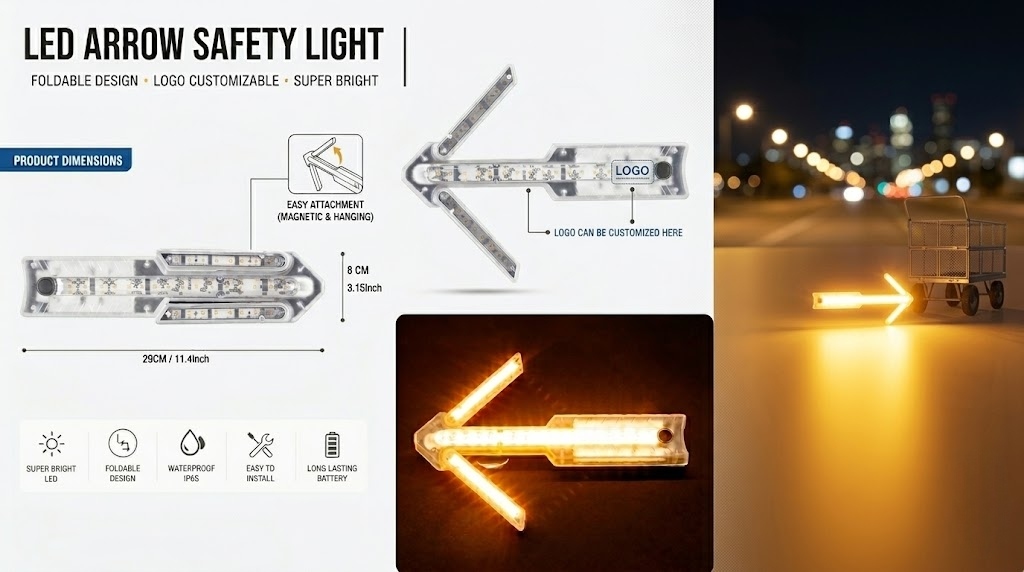
Superflare's portable arrow safety lights are CE and RoHS certified, production-ready for private label, and available for sample evaluation before bulk commitment.
Certifications
| Certification | Status |
|---|---|
| CE | Certified |
| RoHS | Certified |
Sampling & Lead Times
| Stage | Timeline |
|---|---|
| Logo effect artwork | 1 business day |
| Physical sample (logo print) | 7 days |
| Functional customization sample | ~14 days (complexity-dependent) |
| Production lead time (1,000–2,000 PCS) | 20–30 days |
OEM Tiers
| Tier | MOQ | Customization |
|---|---|---|
| Logo print | 200 PCS | Logo on product, standard neutral packaging |
| Custom packaging | 500 PCS | Custom color box + logo on product and box |
| Full OEM | Negotiable | Spec, color, feature set, accessory bundle |
Monthly production capacity: 3,000 PCS.
Product Specifications
| Specification | Detail |
|---|---|
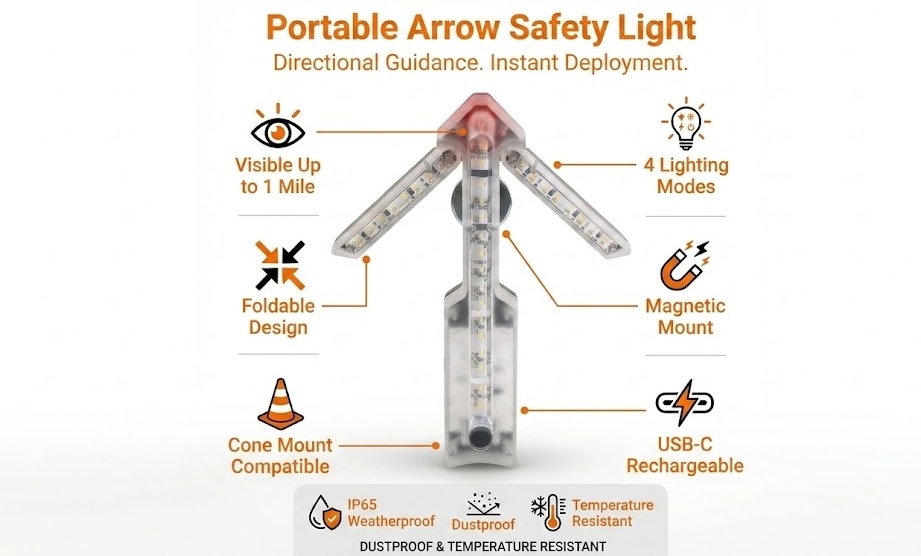
| Power output | 16W |
| Visibility | Up to 1.5 km in darkness |
| Flash modes | Slow flash (20H) / Fast flash (15H) / Chasing (18H) / Steady (8H) |
| Waterproofing | IPX4 (splash-resistant) |
| Drop test | 2-meter tested |
| Charging | Type-C direct — no proprietary cradle required |
| Custom logo placement | High-visibility area directly above the operation panel |
Performance figures represent manufacturer specifications. Actual visibility, battery runtime, and waterproof performance may vary depending on weather conditions, mounting height, ambient lighting, and operating temperature.
Sourcing 200+ units with custom branding? Submit requirements via superflare.net/ToFeedback/ — spec sheet and OEM quote returned within 24 hours.
FAQ
Are portable arrow safety lights legal on highways?
Legality depends on road type, posted speed, closure duration, and state-level implementation of the MUTCD. The MUTCD sets federal guidelines for arrow board output requirements on roads above 65 mph, but enforcement standards vary by state. Portable arrow safety lights are widely used as compliant traffic control devices on secondary roads and in short-duration operations. Verify requirements with your state DOT before deployment on contracted or regulated closures.
Do portable arrow lights replace arrow boards?
No — they serve different operational profiles. Arrow boards are required for high-speed, long-duration, and DOT-contracted highway closures. Portable arrow safety lights are the correct choice for incident response, short-duration work, and mixed-fleet deployments where trailer capacity is unavailable. In many operations, both are in use: an arrow board for the primary closure, portable units for secondary positioning or personnel marking.
What is the minimum order quantity for custom-branded portable arrow lights?
Logo printing starts at 200 PCS with standard neutral packaging. Custom color box with logo on both product and packaging starts at 500 PCS. Full OEM configurations — including spec adjustments and accessory bundles — are available at negotiated volumes. Sample lead time is 7 days for logo print, approximately 14 days for functional customization. Submit inquiries via superflare.net/ToFeedback/.
How does Type-C charging compare to cradle-based arrow lights?
Charging cradles are proprietary components. One lost or damaged cradle renders the unit unusable until a replacement is sourced — a procurement and logistics problem at fleet scale. Type-C charging uses any standard cable on any job site: phone chargers, power banks, vehicle USB ports. For a fleet of 50 units, this eliminates a category of failure and removes a recurring replacement parts cost.
Which is cheaper long-term: a portable arrow light or an LED arrow board?
For short-duration and incident response operations, the portable arrow light has a significantly lower total cost of ownership. A single arrow board at $2,000–8,000 requires a towing vehicle, generator fuel, and scheduled maintenance. A portable unit at $30–80 requires only Type-C charging. For operations that require an arrow board — high-speed highways, multi-day closures, DOT contracts — the cost is non-negotiable. The question resolves once you identify which deployment profile applies.
Can portable arrow safety lights be mounted on vehicles without steel bumpers?
Yes. Suction cup mounting accommodates plastic and carbon fiber rear fascias. A cone-mount steel ring accessory is also available for attachment to existing traffic cones without any vehicle contact. All three configurations — magnetic, suction cup, and cone-mount — are available. Accessory options confirmed on request.
Match the Equipment to the Job
An LED arrow board is the right answer for high-speed highways, multi-day closures, and DOT-contracted work where compliance is written into the spec. A portable arrow safety light is the right answer for incident response, short-duration maintenance, mixed fleets, and brand buyers supplying end users who need a deployable signal without a trailer.
Neither product replaces the other. The deployment scenario makes the decision.
Fleet buyers, wholesale distributors, and brand owners: submit requirements via superflare.net/ToFeedback/ — spec sheet and quote within 24 hours