How Rechargeable Cone-Mounted Warning Lights Support Long-Term Road Safety
Why Traffic Cone Lights Are No Longer “Temporary Tools”
How Rechargeable Cone-Mounted Warning Lights Support Long-Term Road Safety
Introduction: Are Traffic Cone Lights Still Considered Temporary?
Traditionally, traffic cone lights were viewed as temporary warning devices —
used briefly during emergencies, roadside breakdowns, or short-term traffic control.
Once the situation ended, the lights were removed, stored, and often forgotten.
However, modern road safety operations no longer fit this model.
Today, traffic cone lights are increasingly used in long-duration, repetitive, and multi-shift environments, where reliability and consistency matter far more than short-term brightness.
The Common Misconception: Traffic Cone Lights Are Only for Emergencies
Many buyers still assume that cone-mounted warning lights are designed for:
-
Short, one-time use
-
Minimal runtime requirements
-
Basic visibility only
This assumption may apply to older battery-powered or disposable warning lights, but it fails to reflect how traffic cone lights are used in real-world operations today.
The Reality: Traffic Cone Lights Are Used for Extended and Repeated Deployment
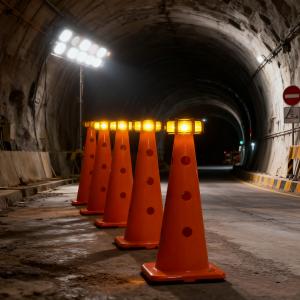
Across road construction, utility maintenance, traffic control, and emergency response, traffic cone lights are now part of continuous safety systems.
1. Long-Term Road Construction Zones
In construction and maintenance projects:
-
Traffic cone lights may remain active for entire nights or multiple shifts
-
Deployment repeats daily over weeks or months
-
Inconsistent light output can confuse drivers and reduce safety
In these cases, temporary-use products quickly become unreliable.
2. Night-Time Repetitive Setup and Removal
Many road crews:
-
Deploy cone lights every evening
-
Remove them each morning
-
Expect the same performance night after night
This usage pattern demands:
-
Predictable battery runtime
-
Fast recharging
-
Durable housing suitable for outdoor exposure
3. Multi-Shift Operations and Shared Equipment
Traffic cone lights are often shared across teams and shifts:
-
No fixed “charging owner”
-
Limited downtime between uses
-
Zero tolerance for unexpected power loss
This is where professional-grade rechargeable traffic cone lights become essential.
Why Power Management Is Critical for Traffic Cone Lights
In long-duration applications, the key performance question is no longer:
“How bright is the cone light?”
Instead, professionals focus on:
-
How long can it run consistently?
-
Will all cone lights perform uniformly across the work zone?
-
How efficiently can they be recharged and redeployed?
Consistency = Safety
A work zone where some cones are illuminated and others are dark creates:
-
Visual confusion
-
Reduced driver reaction time
-
Increased accident risk
The Industry Shift: Rechargeable Traffic Cone Lights as the New Standard
1. Rechargeable Traffic Cone Lights Replace Disposable Solutions
Rechargeable cone lights offer:
-
Lower long-term operating costs
-
Reduced battery waste
-
Stable performance over repeated use
For professional users, replacing batteries daily is no longer acceptable.
2. Uniform Light Output Across Multiple Cones
Modern traffic control relies on:
-
Multiple cones deployed simultaneously
-
Clear visual rhythm and spacing
-
Consistent brightness and flash patterns
Rechargeable traffic cone lights ensure:
-
Equal runtime across units
-
Predictable performance throughout the shift
This uniformity directly improves driver recognition and compliance.
3. Centralized and Multi-Unit Charging Becomes Essential
As the number of cone lights increases, individual charging becomes inefficient.
Centralized charging solutions allow:
-
Faster turnaround between shifts
-
Easier fleet management
-
Reduced risk of partially charged units
For contractors and road authorities, this improves both safety and operational efficiency.
Why Treating Traffic Cone Lights as “Temporary” Creates Risk
When cone lights are selected with a short-term mindset:
-
Runtime is underestimated
-
Charging logistics are ignored
-
Performance inconsistency becomes common
In traffic safety, unreliable visibility is a serious hazard, not a minor inconvenience.
Conclusion: Traffic Cone Lights Are Part of the Safety Infrastructure
Traffic cone lights are no longer simple accessories.
They are now a critical component of temporary traffic control systems.
The new baseline expectation:
-
✔ Rechargeable power systems
-
✔ Long-duration, predictable runtime
-
✔ Consistent output across multiple cones
-
✔ Efficient centralized charging
Modern road safety is not about short-term warning —
it’s about sustained, reliable visibility.