Arrow Light for Lane Closures: When Should You Use One?
When a single lane is temporarily closed on a two-lane road, choosing the right warning device is not simply a matter of finding the brightest light.
The key question is:
What information does approaching traffic actually need?
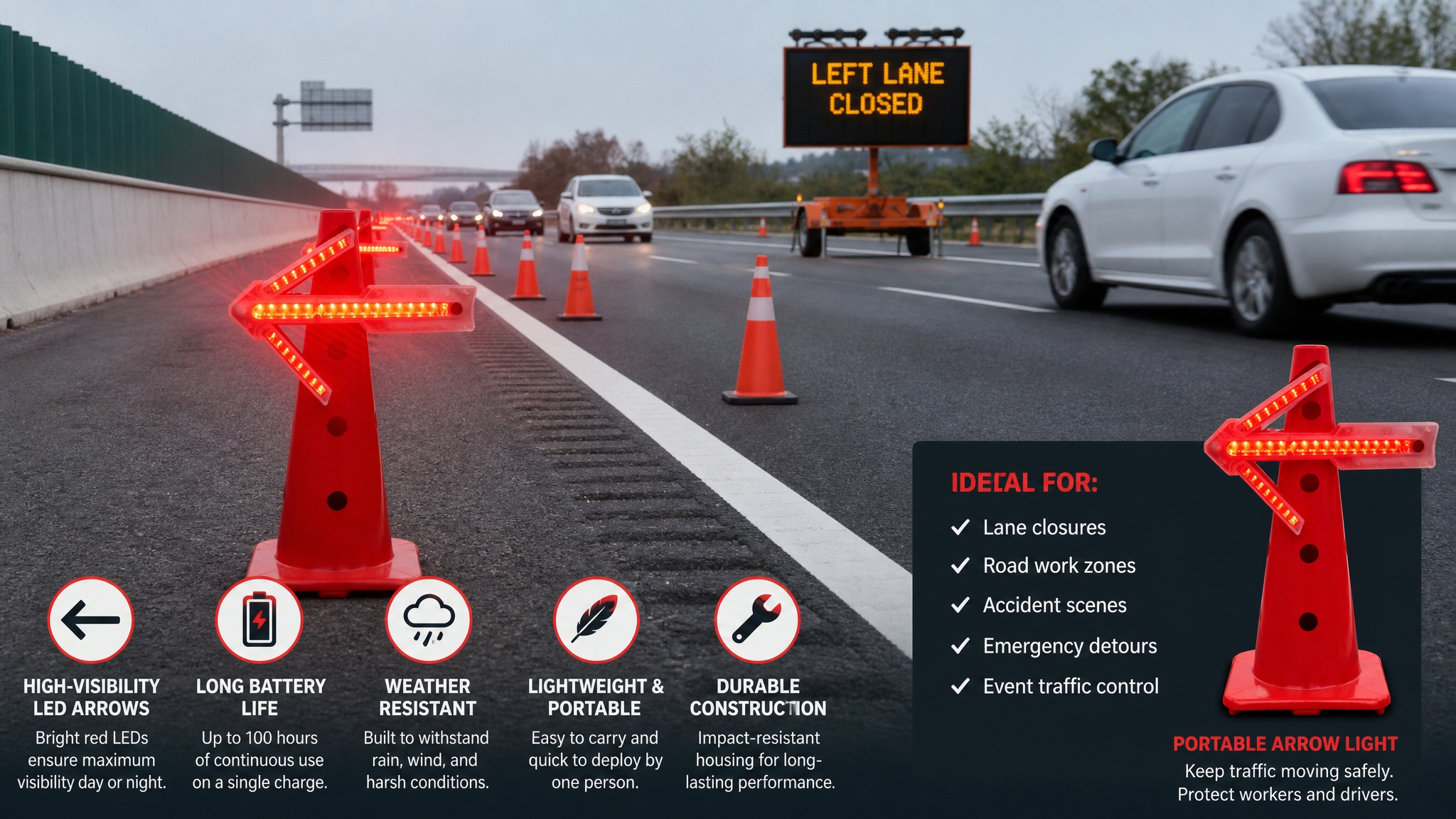
An arrow light can provide highly visible directional or warning information, but it should not automatically be treated as a device that tells drivers to move into an opposing traffic lane.
For a temporary closure on a two-lane, two-way road, the traffic-control setup, channelizing devices, signs, flaggers, sight distance, and local requirements should be considered together. Under the current U.S. MUTCD, an arrow board used for temporarily closing one lane on a two-lane, two-way roadway is limited to the caution mode, while arrow or chevron modes are intended for lane closures on multi-lane roadways. [1]
This distinction matters for traffic equipment buyers, road contractors, fleet operators, and distributors sourcing portable arrow warning lights.
If the goal is simply to alert approaching drivers that a work area, stopped vehicle, or roadside hazard is ahead, a warning light or traffic cone light may be more appropriate than a directional arrow display.
Quick Navigation
- What Is a Single-Point Closure on a Two-Lane Road?
- When Should You Use an Arrow Light for a Lane Closure?
- Why Two-Lane Roads Are Different
- Arrow Light vs Arrow Board vs Warning Light vs Traffic Cone Light
- What Does MUTCD Say About Arrow Boards?
- What Should Buyers Check Before Choosing an Arrow Light?
-
Frequently Asked Questions
What Is a Single-Point Closure on a Two-Lane Road?
A single-point closure generally means that work, maintenance, an incident, or a stopped vehicle temporarily affects one defined point of the roadway.
On a typical two-lane, two-way road, one lane carries traffic in each direction. When one lane is temporarily closed, traffic from both directions must be managed around the affected area.
Common examples include:
- Roadside maintenance
- Utility work
- Pothole or pavement repair
- Emergency vehicle stops
- Tow truck operations
- Temporary road inspections
- Short-duration construction work
The important difference is that the adjacent lane may carry opposing traffic.
That means an illuminated arrow should not automatically be interpreted as permission for drivers to move laterally into the adjacent lane.
Instead, the traffic-control setup should clearly establish where vehicles are expected to travel.
The Core Question: What Does the Driver Need to Know?
Before selecting an arrow light, ask:
Does the driver need directional information, or simply advance warning?
If the road setup already makes the vehicle path clear through signs, cones, channelizing devices, or a flagger, an additional directional display may not be necessary.
If the main requirement is to attract attention to a stopped vehicle, work area, or roadside hazard, a flashing warning light may communicate the situation more appropriately.
This is why product selection should start with the traffic-control scenario rather than the product specification sheet.
When Should You Use an Arrow Light for a Lane Closure?
An arrow light may be useful when the traffic-control plan requires a highly visible illuminated device to draw attention to the work area or provide approved directional information.
However, the appropriate display mode depends on the road configuration.
For buyers evaluating an arrow light for road work, consider these factors first:
| Evaluation Factor | Question to Ask |
|---|---|
| Road type | Is it a two-lane, two-way road or a multi-lane roadway? |
| Closure type | Is one lane, multiple lanes, or the shoulder affected? |
| Traffic direction | Is traffic moving in one direction or are opposing vehicles present? |
| Safe path | Has the intended vehicle path been clearly established? |
| Sight distance | Can approaching drivers see the traffic-control device early enough? |
| Display mode | Is the required mode warning, caution, arrow, or sequential guidance? |
| Traffic-control plan | Does the project plan specify the device and its placement? |
| Local requirements | What standards apply in the target market? |
When an Arrow Light May Be Appropriate
An arrow light can be considered when:
- A traffic-control plan calls for an illuminated warning or directional device.
- Drivers need additional visual information before reaching the work area.
- The device can be positioned where it is clearly visible.
- The display mode matches the road configuration and applicable requirements.
- Cones, signs, channelizing devices, or other traffic-control equipment establish the intended traffic path.
- The device is being used as part of a complete temporary traffic-control setup rather than as a standalone substitute for the required control measures.
For two-lane, two-way roads, buyers should be particularly careful about the display mode.
The current MUTCD specifies that when one lane is temporarily closed on a two-lane, two-way roadway, an arrow board should be used only in caution mode. Arrow or chevron modes are specified for stationary or moving lane closures on multi-lane roadways. [1]
This means that buyers should not assume that a product marketed as an "arrow light" can automatically be used in every arrow-display application.
Why Two-Lane Roads Are Different
The biggest difference between a multi-lane road and a two-lane, two-way road is the direction of traffic.
On a multi-lane roadway, several lanes may carry traffic in the same direction. A lane closure can therefore require drivers to merge into an adjacent lane traveling in the same direction.
On a two-lane, two-way road, the adjacent lane may be occupied by vehicles traveling toward the approaching driver.
This changes the traffic-control problem significantly.
A simple illuminated arrow should therefore not be treated as a universal instruction to "move left" or "move right."
Instead, the complete setup should determine:
- Where the work area begins.
- Which lane is affected.
- Where approaching vehicles are expected to travel.
- How opposing traffic is controlled.
- How cones or other channelizing devices define the path.
- Whether a flagger or other traffic-control measure is required.
- Whether the selected lighting device is being used in the correct operating mode.
Warning vs Directional Guidance
This distinction is particularly important when choosing between a warning light and an arrow light.
A warning light primarily attracts attention to a hazard, vehicle, obstruction, or work area.
A directional arrow display communicates additional information about traffic movement.
If the road situation only requires drivers to recognize that a hazard is ahead, a warning light may be the better fit.
If the traffic-control plan requires an illuminated directional display, an arrow board or arrow light may be considered according to the road configuration and applicable requirements.
A Practical Rule for Buyers
A useful purchasing rule is:
Choose the traffic-control function first, then choose the lighting product.
Do not begin with:
"Which arrow light has the most LEDs?"
Begin with:
"What does this device need to communicate to approaching drivers?"
This approach helps prevent the common mistake of selecting a product based only on brightness, LED quantity, or battery capacity without considering how it will actually be deployed.
Arrow Light vs Arrow Board vs Warning Light vs Traffic Cone Light
One of the most common mistakes in traffic safety equipment sourcing is treating every illuminated warning device as interchangeable.
An arrow light, arrow board, warning light, and traffic cone light may all improve visibility, but they serve different functions.
The right choice depends on what the traffic-control setup needs the device to communicate.
| Device | Primary Function | Typical Application | Best Use Case |
|---|---|---|---|
| Arrow Light | Visible warning or directional display, depending on configuration | Road work, temporary traffic control, roadside operations | Projects requiring a compact illuminated warning or directional device |
| Arrow Board | Advance warning and lane-direction information | Highway and multi-lane road work | Lane closures requiring approved arrow or chevron displays |
| Warning Light | Hazard awareness and vehicle visibility | Roadside emergencies, maintenance, work vehicles | Alerting drivers that a hazard or vehicle is present |
| Traffic Cone Light | 360° warning and work-zone marking | Construction zones, lane closures, traffic diversion | Marking the boundaries and path of a temporary work area |
The important point is that product names do not determine traffic-control suitability.
The road configuration and the traffic-control plan do.
Arrow Light
A portable arrow light can be useful when a project needs a compact, highly visible illuminated device that can be deployed quickly.
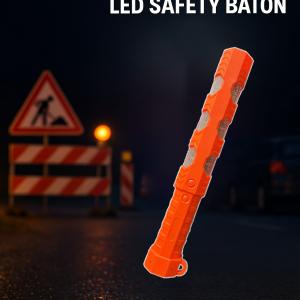
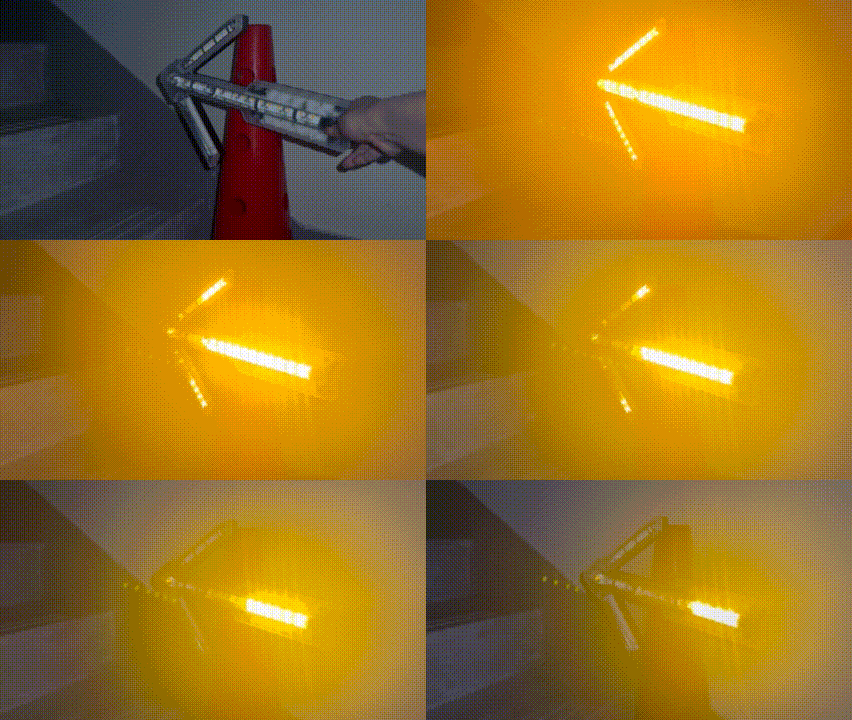
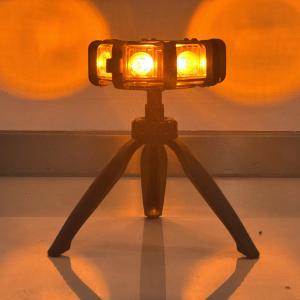
For example, Superflare's LED Arrow Warning Light is designed as a rechargeable portable warning device with multiple display modes and flexible mounting options.
For B2B buyers, this type of product can be useful when portability, quick deployment, and repeated roadside use are more important than installing a large permanent traffic-control system.
However, buyers should always verify whether the specific display mode and product configuration are permitted for the intended traffic-control application.
Arrow Board
Arrow boards are generally used when a larger, standardized directional message is required.
The current U.S. MUTCD specifies different arrow board types and minimum dimensions depending on the application. For example, the MUTCD lists Type A, B, and C arrow boards with minimum sizes of 48 × 24 inches, 60 × 30 inches, and 96 × 48 inches respectively, along with corresponding minimum legibility distances. :contentReference[oaicite:0]{index=0}
This makes a full-size arrow board fundamentally different from a compact portable arrow warning light.
A buyer should therefore avoid assuming that a small portable "arrow light" can automatically replace a MUTCD-compliant arrow board where a project specification requires one.
Warning Light
A warning light is primarily intended to attract attention.
Typical applications include:
- Stopped roadside vehicles
- Emergency response
- Maintenance vehicles
- Roadside breakdowns
- Temporary work areas
- Obstructions
- Nighttime hazard marking
If drivers simply need to recognize that something is ahead, a warning light may communicate that message more appropriately than a directional arrow.
For nighttime roadside operations, deployment position also matters. See our guide on Warning Light Placement Distance for Nighttime Highway Repair for additional considerations when planning warning-light placement.
Traffic Cone Light
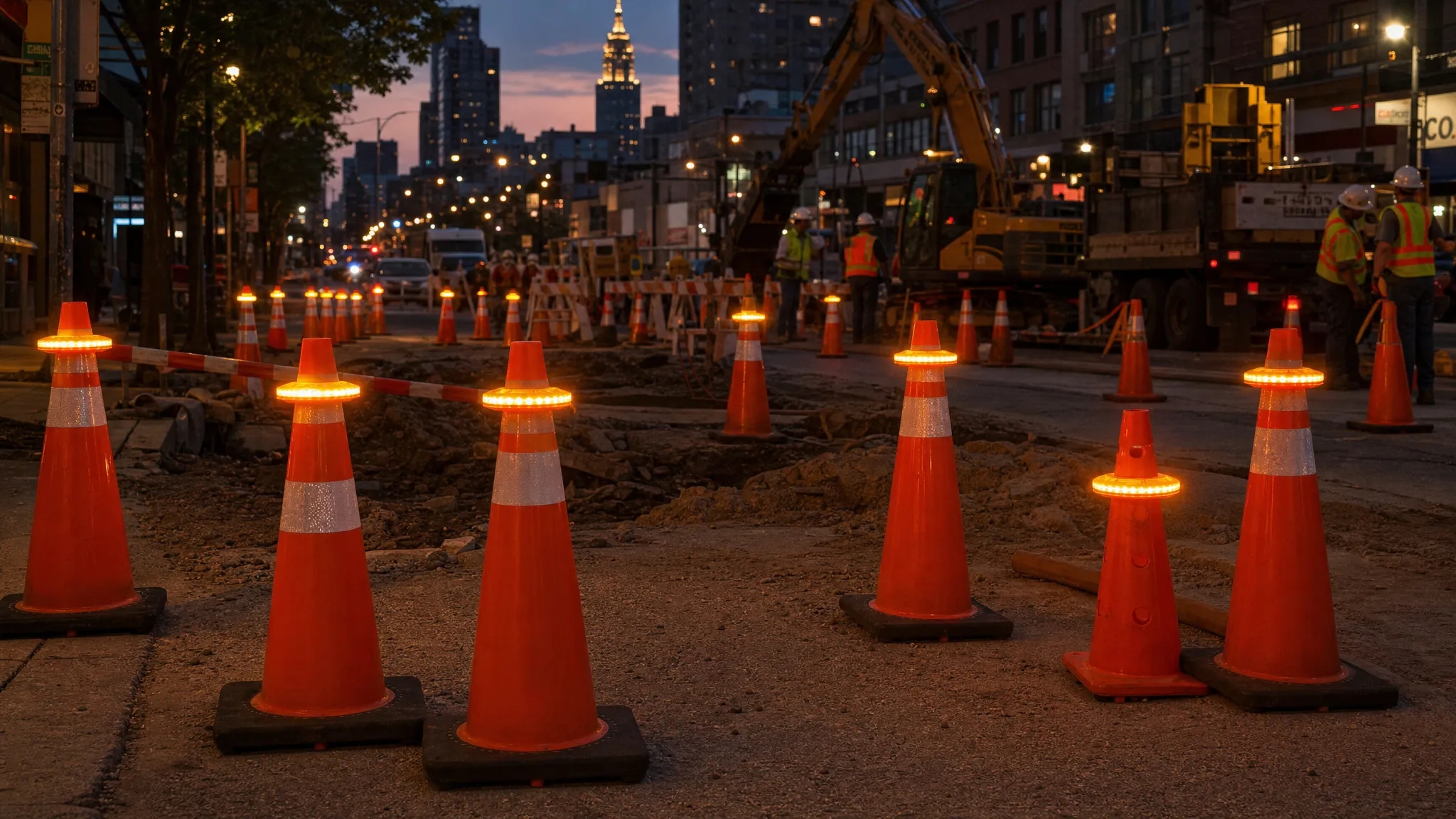
Traffic cone lights are particularly useful when the objective is to make a temporary work zone or traffic channel more visible.
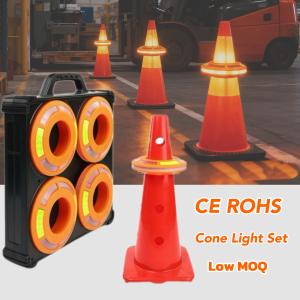
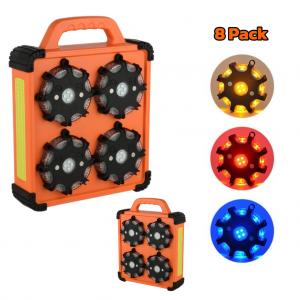
Superflare's LED Traffic Cone Lights 8-Pack is designed to mount on traffic cones and provide 360° warning illumination.
The HL76907B system uses rechargeable batteries, wireless synchronization, multiple flashing modes, and IPX7 protection. The lights can also be used on traffic cones or mounted magnetically on suitable metal surfaces. :contentReference[oaicite:1]{index=1}
This makes cone-mounted lighting particularly suitable for:
- Road construction safety zones
- Temporary lane closures
- Highway maintenance
- Utility work
- Traffic diversion
- Emergency roadside operations
The key distinction is simple:
An arrow light or arrow board communicates a specific visual message, while traffic cone lights help make the physical work zone and traffic path more visible.
In many projects, these devices can work together rather than being treated as substitutes.
What Does MUTCD Say About Arrow Boards?
For buyers supplying the U.S. market, the Manual on Uniform Traffic Control Devices (MUTCD) should be one of the first references when evaluating arrow-board applications.
The current MUTCD 11th Edition provides specific requirements and guidance for arrow boards used in temporary traffic-control zones. :contentReference[oaicite:2]{index=2}
Two-Lane, Two-Way Roadway
This is particularly important for the topic of this article.
When one lane is temporarily closed on a two-lane, two-way roadway, the MUTCD specifies that the arrow board should be operated in caution mode.
This is different from lane closures on multi-lane roadways, where arrow or chevron displays may be used to communicate a lane transition.
The reason is straightforward:
On a two-lane, two-way road, the adjacent lane may carry traffic traveling in the opposite direction.
Therefore, a directional arrow should not be interpreted as a general instruction for a driver to move into that lane.
The complete temporary traffic-control arrangement should establish the intended path of travel.
Multi-Lane Roadways
The situation changes when a roadway has multiple lanes traveling in the same direction.
For example, if the right lane of a multi-lane highway is closed, traffic may need to merge into an adjacent lane traveling in the same direction.
In these situations, an arrow board can provide directional information as part of the temporary traffic-control setup.
The MUTCD also provides different arrow-board specifications depending on application, including minimum board dimensions and legibility distances. :contentReference[oaicite:3]{index=3}
Why This Matters for Equipment Buyers
This distinction is important when sourcing products internationally.
A product may be technically capable of displaying an arrow pattern, but that does not automatically mean that every arrow mode is appropriate for every road configuration.
Before placing a bulk order, buyers should verify:
- The road type.
- The intended traffic-control application.
- The required display mode.
- Applicable national or local regulations.
- Required visibility and legibility.
- Mounting and placement requirements.
- Whether the product itself is being used as a warning device or as a regulated traffic-control device.
For regulated projects, the final application should be confirmed with the relevant project engineer, traffic-control professional, or local authority.
What Should Buyers Check Before Choosing an Arrow Light?
Once the traffic-control application has been established, product selection becomes much easier.
Instead of comparing products only by LED count or brightness, B2B buyers should evaluate the following factors.
1. Display Modes
First determine what the product actually needs to communicate.
Possible requirements may include:
- Flashing warning
- Sequential warning
- Arrow pattern
- Chevron pattern
- Steady illumination
- Multiple selectable modes
Do not assume that having multiple modes makes a product suitable for every road-control application.
The required mode should match the project specification.
2. Visibility
Visibility is not simply about the number of LEDs.
Consider:
- Viewing distance
- Ambient lighting
- Daytime vs nighttime operation
- Mounting height
- Viewing angle
- Road geometry
- Weather conditions
A device that looks extremely bright at close range may not necessarily provide the required visibility at the actual deployment distance.
3. Power Source
For temporary roadside work, rechargeable power can simplify deployment.
A portable rechargeable arrow light eliminates the need to run a power cable to every individual device.
For fleet operators and maintenance contractors, USB or Type-C rechargeable products can also simplify charging between deployments.
However, buyers should compare:
- Charging time
- Runtime
- Battery capacity
- Charging method
- Battery replacement options
- Charging accessories
4. Mounting Method
Mounting flexibility can make a significant difference in real-world deployment.
Depending on the application, buyers may need:
- Magnetic mounting
- Cone mounting
- Vehicle mounting
- Stand or tripod mounting
- Wall or temporary structure mounting
For portable products, a combination of magnetic and other mounting methods can make one device useful across several scenarios.
5. Weather Resistance
Outdoor roadwork equipment may be exposed to:
- Rain
- Dust
- Mud
- Road spray
- Temperature changes
- Repeated transportation
An IP rating can help buyers compare environmental protection, but the rating should be considered together with the actual deployment conditions.
For example, Superflare's HL76907B traffic cone light is specified with an IPX7 rating and rechargeable construction for repeated outdoor deployment. :contentReference[oaicite:4]{index=4}
6. Deployment Speed
For emergency and maintenance teams, setup time can be just as important as brightness.
A product that takes several minutes to assemble may be less practical for roadside emergency use than a device that can be removed, switched on, and deployed immediately.
This is one reason rechargeable, portable warning systems are increasingly useful for fleet and roadside operations.
For a related deployment workflow, see:
How to Deploy Road Flares in Under 10 Seconds
The principle is similar:
The easier the equipment is to deploy correctly, the more practical it becomes during time-sensitive roadside operations.
Choosing Between a Single Arrow Light and a Multi-Light Warning System
Another purchasing decision is whether the project needs one illuminated device or multiple synchronized warning points.
Single Device
A single portable arrow or warning light may be appropriate for:
- Small maintenance tasks
- Emergency roadside stops
- Service vehicles
- Short-duration work
- Mobile fleet operations
The advantage is portability and simple deployment.
Multiple Warning Lights
For a larger work zone, multiple warning points can create a clearer visual boundary.
Traffic cone lights are particularly useful here because they can be distributed along the work area.
For example, an 8-pack of rechargeable cone lights can provide multiple illuminated warning points rather than relying on a single light at the center of the work zone.
Superflare's HL76907B system supports wireless synchronization within a specified range, allowing multiple units to operate in a coordinated sequence. :contentReference[oaicite:5]{index=5}
This can be useful for:
- Construction zones
- Temporary lane closures
- Traffic diversion
- Utility maintenance
- Highway repair
- Emergency response
The decision therefore becomes:
Do you need one device to communicate a message, or multiple devices to define and reinforce the work zone?
In many applications, the answer is both.
A Practical Procurement Checklist
Before requesting a quotation for an arrow light or traffic warning system, prepare the following information:
| Requirement | Example |
|---|---|
| Target market | USA / UK / EU / Global |
| Application | Road work / fleet / emergency / construction |
| Road type | Two-lane / multi-lane / private road |
| Traffic direction | Two-way / one-way |
| Device quantity | 50 / 100 / 500+ units |
| Display requirement | Warning / sequential / arrow / custom |
| Power | Rechargeable / vehicle powered |
| Mounting | Magnetic / cone / vehicle |
| Weather protection | IP requirement |
| Branding | Logo / packaging / private label |
| Certification | CE / RoHS / market-specific requirements |
| Packaging | Standard / custom |
| OEM/ODM | Required / Not required |
Providing these details early can help manufacturers recommend the correct product configuration instead of quoting a generic model.
OEM and Wholesale Considerations for Arrow Light Buyers
For distributors, safety-equipment brands, and fleet suppliers, product selection is only one part of the purchasing decision.
Other factors may include:
- MOQ
- Logo customization
- Packaging design
- Battery configuration
- Light color
- Flashing modes
- Mounting accessories
- Charging method
- Private labeling
- Certification documentation
- Production lead time
- Sample availability
Superflare supports OEM and ODM customization for its traffic safety lighting range.
For example, its rechargeabl
Related News