Sequential vs. Non-Sequential LED Road Flares: Differences, Uses & Buying Guide
A contractor in a highway work zone ordered non-sequential flares to cut costs. The units were bright. The batteries were good. But at night, on a four-lane highway with vehicles approaching at 70 mph, a string of independently flashing lights didn't tell drivers which lane was closed — it just told them something was there. One contractor reported multiple near-miss situations during night deployment. The next order was sequential.
That's not an argument for always buying sequential. It's an argument for buying the right type for your actual situation.
Most articles on this topic give you a features list and call it a comparison. This one starts from the field — from the scenarios our customers deploy in, the mistakes we see most often, and the limitations that don't show up in spec sheets. We manufacture both types. We'll tell you honestly which one fits your use case.
Jump To
- Key Difference
- Sequential Uses
- Non-Sequential Uses
- Limitations
- Common Mistakes
- Deployment Speed
- How to Choose
- Products
- FAQ
What's the Actual Difference?
The difference comes down to one thing: communication between units.
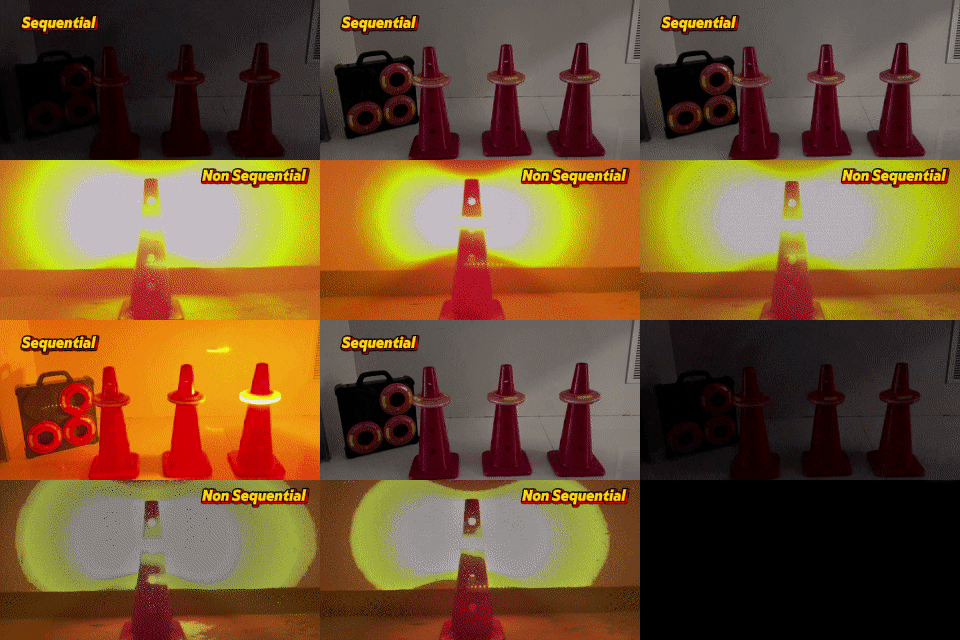
Non-sequential flares operate independently. Each unit flashes on its own pattern. There is no coordination between units. Place six of them in a line and you get six independent flashing lights.
Sequential flares are networked. Each unit communicates with the others via radio frequency, creating a synchronized, directional flash pattern — typically a flowing wave that moves in one direction, like an airport runway guiding a plane in. The movement itself carries information: slow down, and move this way.
That directional information is what changes driver behavior. A flashing light says "hazard ahead." A moving light pattern says "hazard ahead — move left."
Where Sequential Makes the Real Difference
Highway incidents and long-distance warning
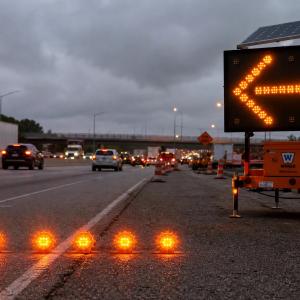
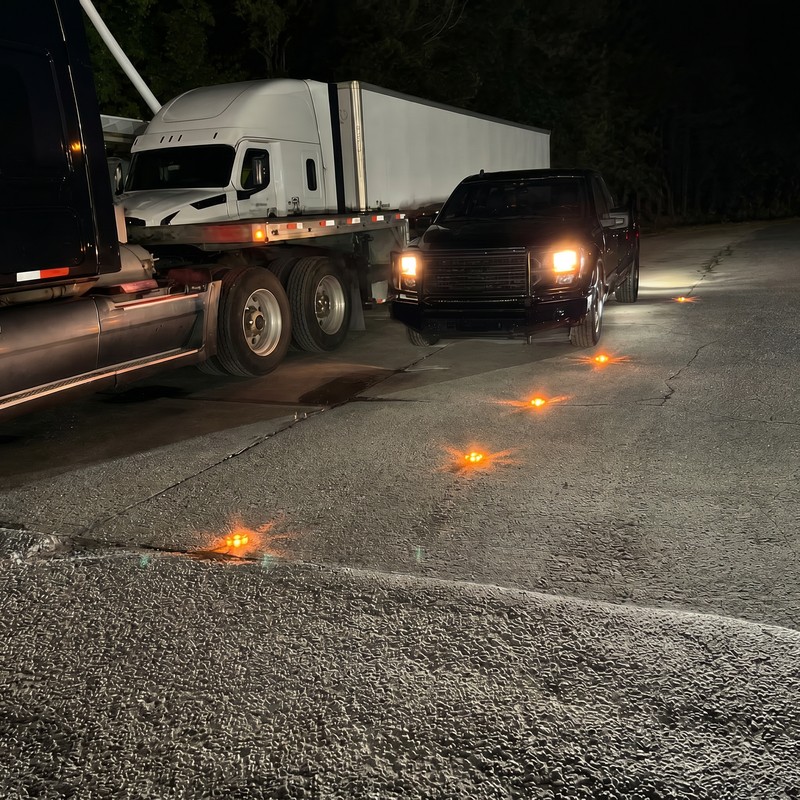
At highway speeds, drivers have seconds to process what they're seeing and change lanes safely. A sequential pattern — flowing in one direction — registers faster cognitively than a cluster of independent flashes. Customers using our HL75011 Sequential Road Flare Set in highway breakdown scenarios consistently report that drivers begin lane changes earlier compared to standard flares.
The directional pattern does the work that signage and hand signals can't do at 500+ meters.

Construction zone lane control
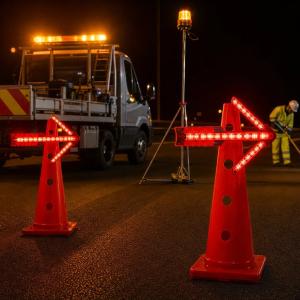
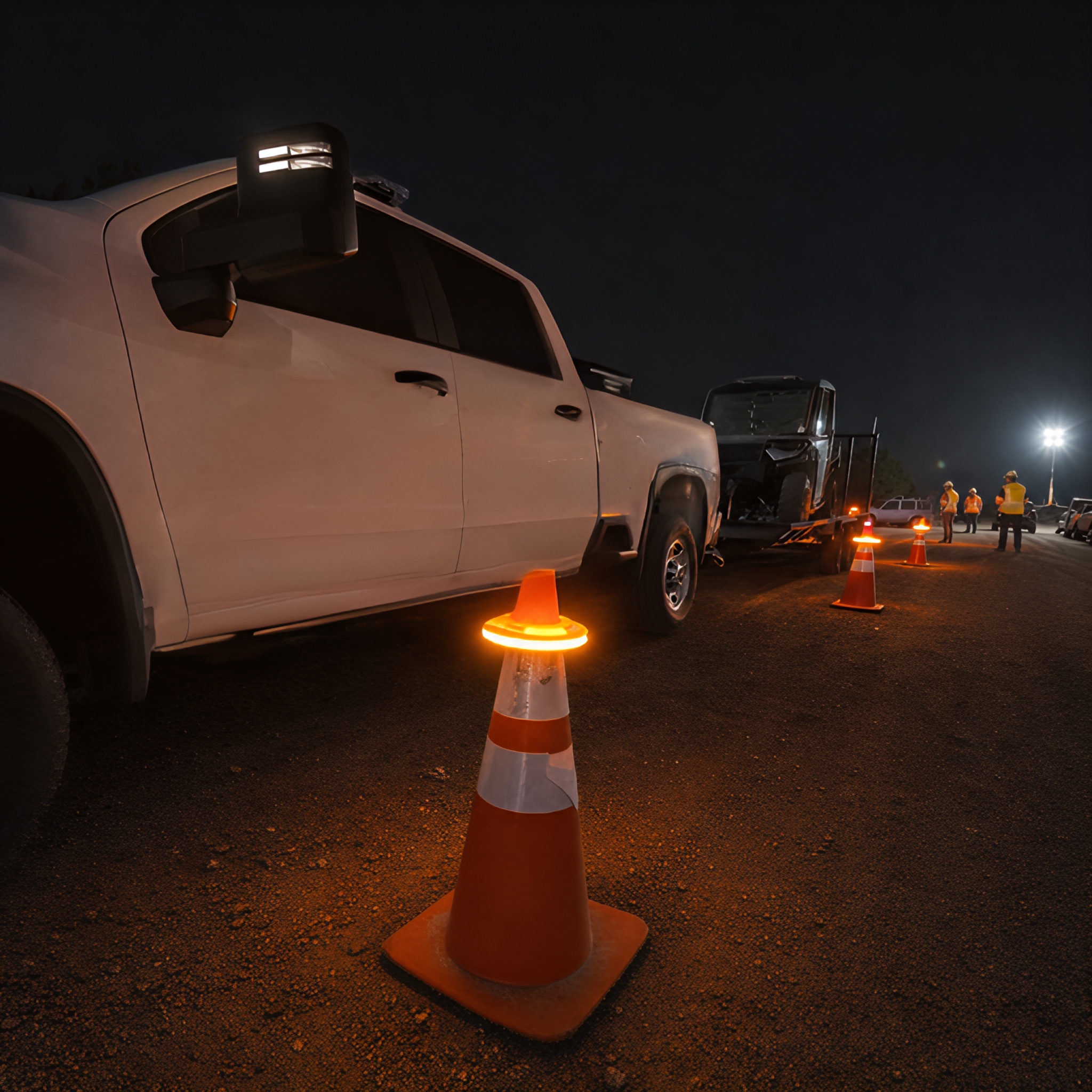
In active work zones, sequential flares do two jobs simultaneously: they warn of the hazard and they guide traffic into the correct lane. A flowing pattern from right to left tells drivers to move left — no cones required to communicate direction, though most crews use both.
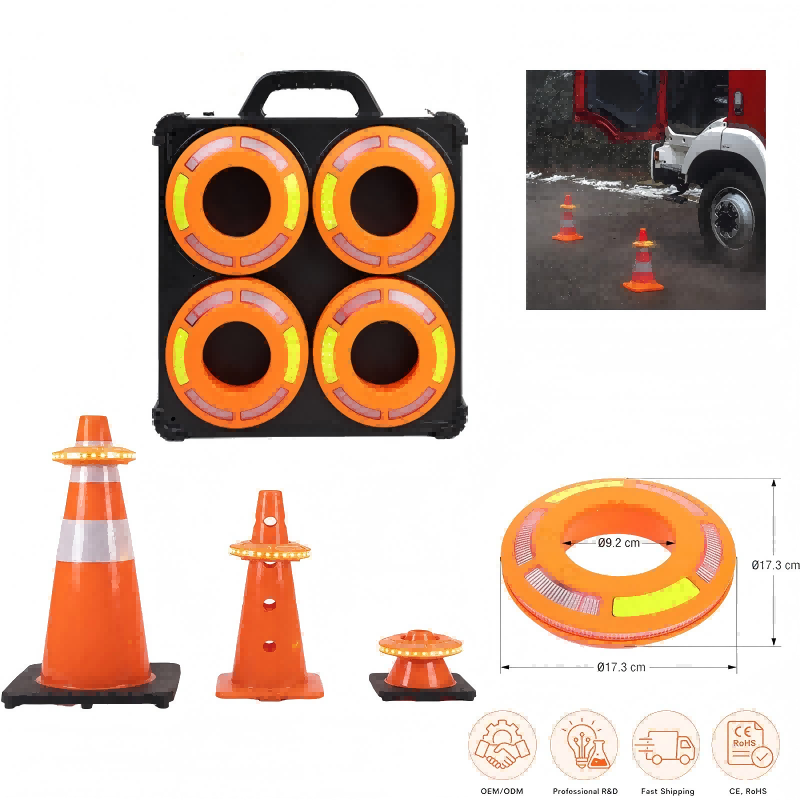
Our HL76907B Sequential Traffic Cone Light Set is specifically designed for this application. The units mount on top of standard traffic cones across multiple sizes, and the synchronized pattern creates a visible lane boundary that holds up in rain, fog, and low-light conditions.

Roadside accident scenes
This is a scenario that gets underestimated. When a vehicle is disabled on the shoulder, the immediate priority is getting other drivers to slow down and move over. A sequential pattern placed along the vehicle creates a perimeter that reads as an active scene — not just a single hazard point. Several of our customers in roadside assistance report deploying flares along the driver's side of the vehicle specifically for this reason.
Where Non-Sequential Is the Right Choice
Single-point warnings with no directional need
If the situation is a single hazard point — a pothole, a stalled vehicle in a well-lit area, a low-speed residential street — directional guidance adds no value. A bright, visible flash from a single unit or a small cluster is sufficient. Sequential technology would be wasted here, and the price difference is real.
Personal vehicle emergency kits
For the individual driver keeping a set in the trunk for emergencies, non-sequential flares are the practical choice. They are simpler to operate, more affordable, and for most personal-use scenarios — a flat tire on a local road, a breakdown in a parking area — they do exactly what's needed. The cognitive advantage of a sequential pattern matters most at highway speeds with multiple approaching vehicles. In lower-risk scenarios, a bright independent flash is enough.
Not sure which type fits your procurement profile?
Read our LED Road Flare Buyer Guide →
What Nobody Tells You About Sequential Flares
This is the part most manufacturers skip. We're not going to.
The price gap is real — here's what you're actually paying for
Sequential flares cost more than non-sequential flares at every price point. The gap exists because of the radio synchronization module inside each unit. You're not paying for a brand premium — you're paying for the hardware that makes the units communicate. When you see a significant price difference between two "sequential" products that look identical, the likely variables are: battery type (rechargeable AC/DC vs. alkaline), shell material (virgin resin vs. recycled resin), and whether the synchronization module is properly calibrated or a cost-cut version.
Our 8-unit HL76907B set with AC and DC charging is priced at $76 — that reflects genuine synchronization hardware, IP-rated construction, and charging systems that work in the field. A $30 "sequential" set on a marketplace may flash in a pattern, but that's not the same as true radio-linked synchronization.
Radio frequency interference can cause sync errors
This is the limitation that doesn't appear in any competitor's spec sheet, so we'll say it directly: sequential flares communicate via radio frequency. In environments with heavy RF interference — near broadcast towers, in dense urban areas with significant wireless traffic, or at large-scale incidents with multiple radio systems active — individual units can lose sync and display out-of-sequence patterns.
This doesn't make them unsafe. A unit that loses sync still flashes visibly. But the directional guidance benefit is reduced. If your deployment environment has known RF interference, test your units on-site before relying on the sequential pattern for traffic guidance. Our units are designed to re-sync automatically, but the sync gap, however brief, is a real-world variable worth knowing about.
The Mistakes We See Most Often
Buying sequential and using it like non-sequential. The most common and most expensive mistake. A customer purchases a sequential set, deploys one or two units rather than the full string, and loses the directional pattern entirely. Sequential flares only deliver their core benefit when deployed as a set in sequence. If your typical deployment is one or two units, you're paying sequential pricing for non-sequential performance.
Assuming non-sequential is "good enough" for highway use. Budget drives this decision more often than scenario analysis. The difference becomes apparent after an incident where non-sequential flares failed to produce early enough lane changes. By that point, the cost of the upgrade is no longer the issue.
Buying both types without a deployment protocol. Some fleet operators carry both and assign them interchangeably based on what's available. Without a clear protocol — sequential for highway and multi-lane scenarios, non-sequential for single-point or low-speed situations — the operational advantage of having both types is lost.
A Note on Deployment Speed: The Assumption That's No Longer True
A common assumption is that sequential flares take longer to deploy because they require configuration or pairing. This was true of earlier generations of sequential systems.
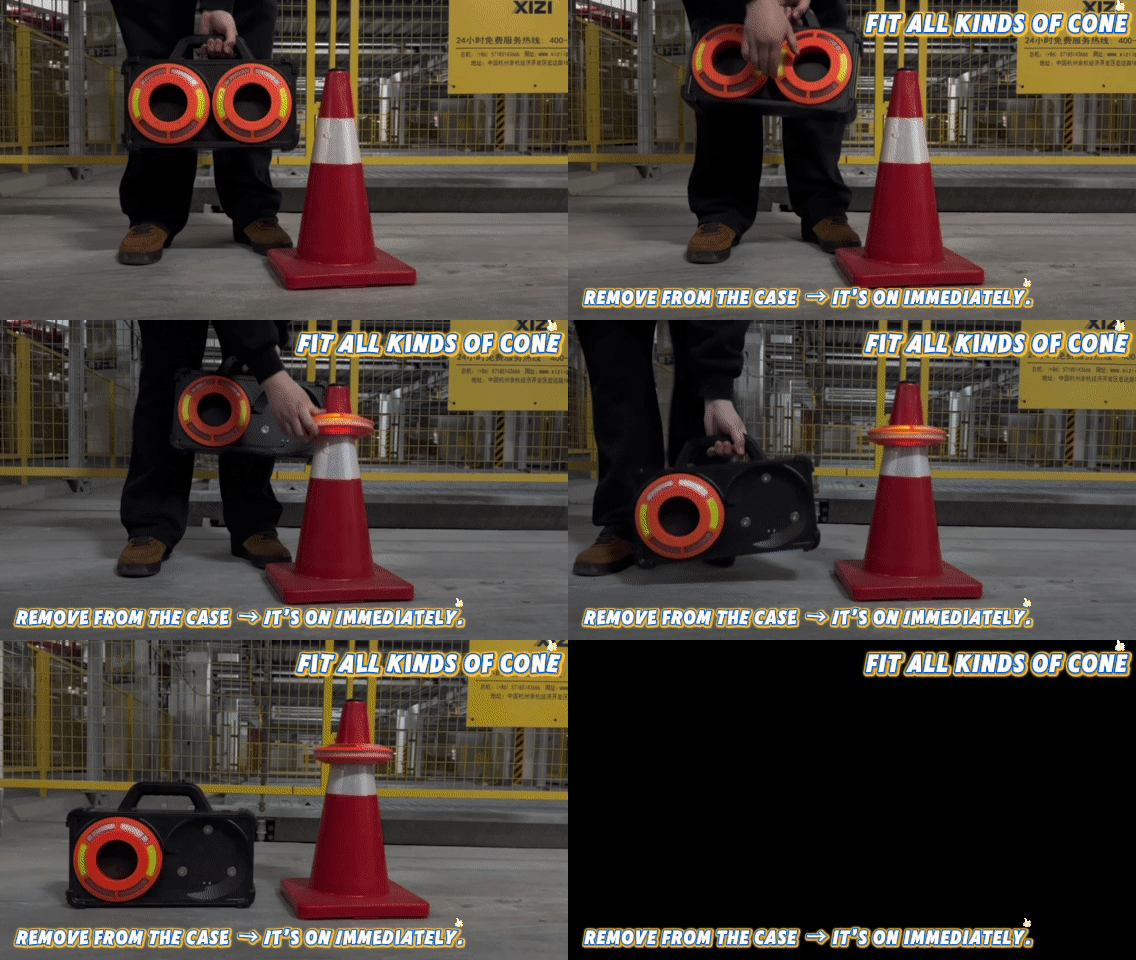
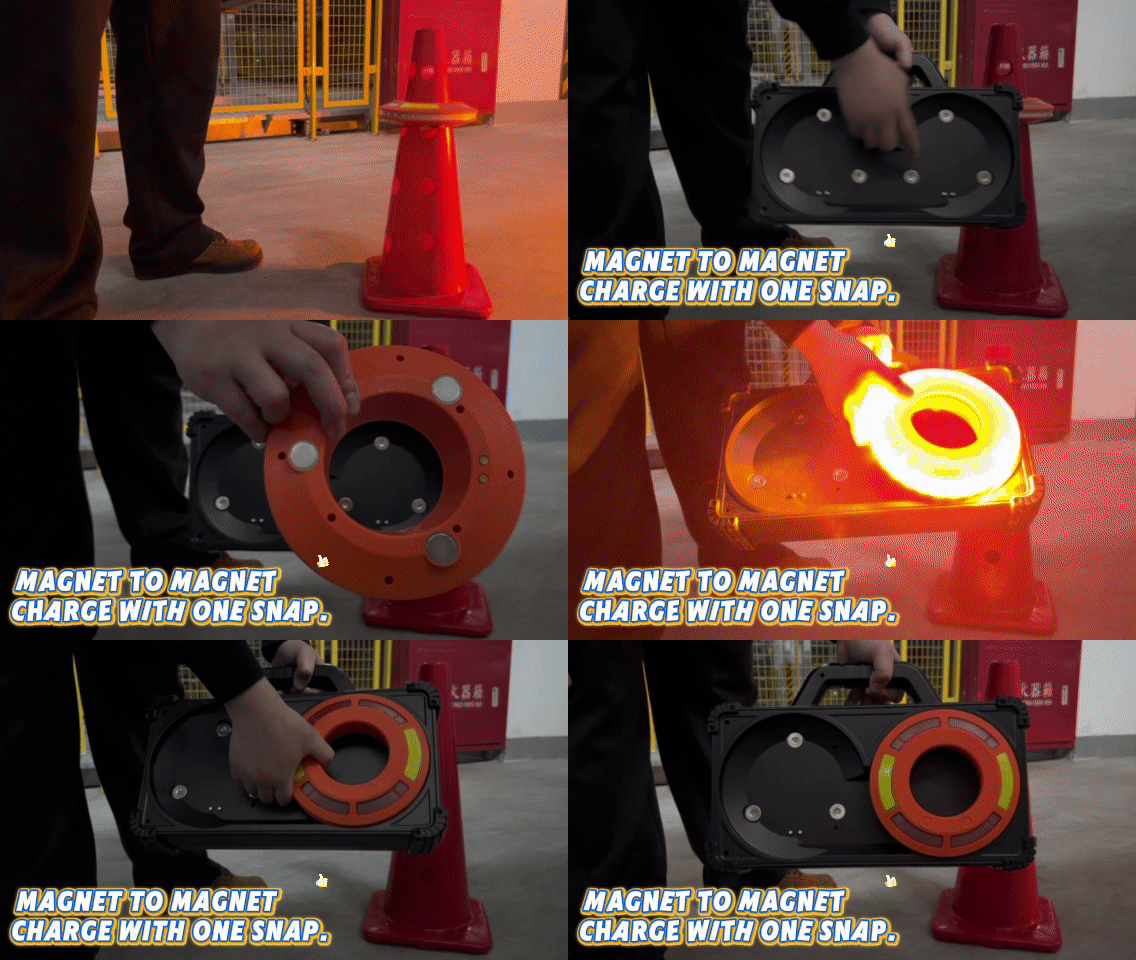
Our current HL75011 and HL76907B sets use AUTO SYNC technology: every unit activates and joins the sequence the moment it is removed from the case. There is no pairing process, no numbered deployment order to follow, no manual configuration. Remove units from the case in any order — they self-organize into the sequence automatically.
AUTO OFF works the same way in reverse: place a unit back in the case and it shuts off immediately. No hunting for buttons in the dark, no units left running after pack-up.
Deployment speed is no longer a meaningful differentiator between sequential and non-sequential. If speed was the reason you were leaning toward non-sequential, it's worth reconsidering.
How to Decide: Two Questions
Question 1: Do you need to guide traffic direction, or just signal a hazard?
If you need to tell drivers which way to move — highway breakdown, work zone lane closure, multi-lane incident — sequential. If you need to mark a single hazard point in a low-speed or controlled environment — non-sequential.
Question 2: Will you deploy multiple units as a set, or typically just one or two?
Sequential flares only deliver their core benefit as a networked string. If your typical deployment is one or two units, non-sequential is the right choice regardless of scenario.
If your answer to Question 1 is "guide traffic" and your answer to Question 2 is "multiple units" — sequential is the right investment. For everything else, non-sequential does the job at a lower cost.
Need help deciding for your specific deployment? Talk to our team or request a sample for your scenario.
Product Reference
For construction zones, highway use, and professional deployment:
| Product | Configuration | Best For |
|---|---|---|
| HL76907B Sequential Traffic Cone Light Set | 4 / 6 / 7 / 8 units | Work zones, cone-line warning, lane control |
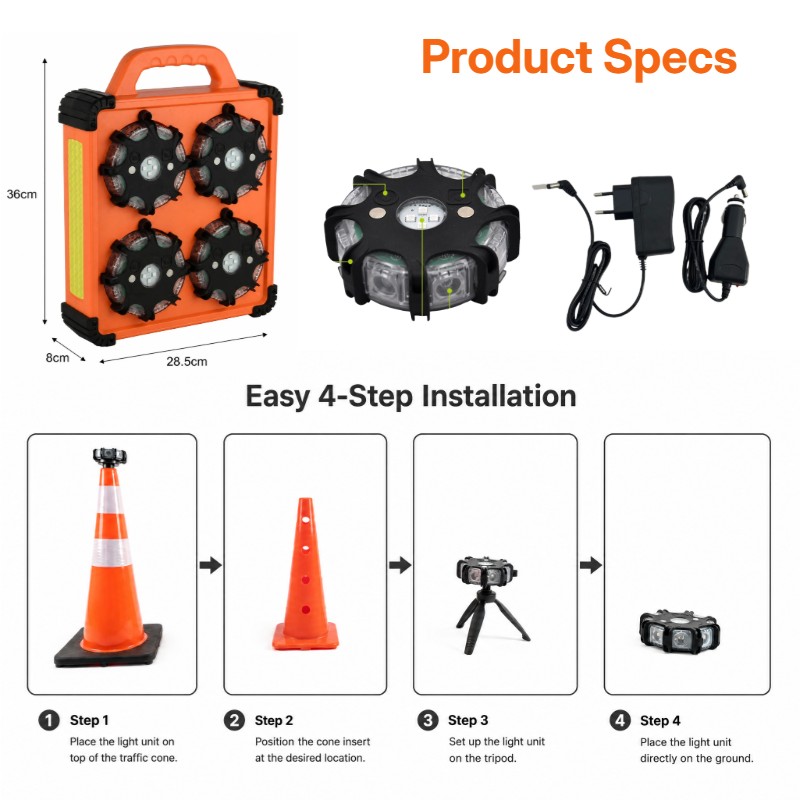
| HL75011 Sequential Road Flare Set | 4 / 6 / 8 / 10 units | Highway incidents, accident scenes, roadside assistance |
Both sets include AUTO SYNC / AUTO OFF, AC and DC charging, and 5+ synchronized flash modes.
Flash modes — HL76907B: Flowing Single Flash · Synchronous Flash · Fast Flowing Single Flash · Flowing Double Flash · Breathing Flash
Flash modes — HL75011: Pulsing Flash · Single Flash · Slow Flash · Fast Flash · Slow Double Flash · Fast Double Flash
Mounting options — HL76907B: Magnetic vehicle mount · Traffic cone top mount (multi-size compatible)
Mounting options — HL75011: Magnetic vehicle mount · Inside traffic cone · Traffic cone top mount · Ground placement
→ Request a sample for your deployment scenario
Read More:
→ Sequential Traffic Cone Lights vs Traditional Cones
→ LED Road Flare Buyer Guide
FAQ
Q: Can I mix sequential and non-sequential flares in the same deployment?
A: Technically yes, but it defeats the purpose of the sequential set. The directional pattern requires a complete uninterrupted string of synchronized units. Mixing in non-sequential units breaks the pattern. Keep the two types separate and deploy each for the scenario it's designed for.
Q: How many sequential units do I need for a highway deployment?
A: For a standard highway lane closure or breakdown scenario, a minimum of 6 units is recommended to create a readable directional pattern at approach distance. 8 or 10 units provide a longer visible string and earlier driver response. Our HL75011 is available in 4/6/8/10-unit configurations — most professional users start with the 8-unit set.
Q: Do sequential flares require any setup or programming before deployment?
A: Not with our current generation. AUTO SYNC activates and pairs every unit the moment it leaves the case. No programming, no numbered sequence, no pairing mode. Remove units in any order and the sequence self-organizes automatically.
Q: What causes sequential flares to go out of sync, and how do I fix it?
A: The most common cause is RF interference from nearby radio systems. Units will attempt to re-sync automatically. If a unit remains out of sequence, removing and replacing it in the case resets the pairing. For high-interference environments, test on-site before relying on the synchronized pattern for traffic control.
Q: Are sequential flares compliant for use as official warning devices?
A: In the US, the FMCSA has granted exemptions for certain sequential LED flare systems as alternatives to warning triangles and fusee flares. In Europe, compliance depends on CE marking and, for emergency vehicle use, ECE R65 certification. Always verify the specific requirements for your jurisdiction and end-use application before procurement.
Q: What's the realistic lifespan difference between the two types?
A: With rechargeable sequential sets, the limiting factor over time is battery capacity, which degrades with charge cycles — typically 500+ full cycles before noticeable capacity loss. Non-sequential battery-powered units have no degradation concern but have an ongoing consumable cost. For high-frequency professional use, rechargeable sequential sets have a lower total cost over 12–18 months despite the higher upfront price.
SuperFlare manufactures both sequential and non-sequential LED safety lighting for government agencies, roadside assistance operators, construction contractors, and global brand owners. All products are CE certified and available for OEM/ODM customization.
Not sure which product fits your procurement profile? Our LED Road Flare Buyer's Guide covers all buyer tiers — from government to wholesale to brand owners.
Author
Grace Gui
Product Manager – SuperFlare
15+ years experience in LED warning lighting and OEM safety products.
Specialized in road flares, traffic cone lights, warning batons and emergency lighting systems for roadside assistance, highway safety and construction industries.