LED Traffic Cone Lights vs. Road Flares: Which One Do You Actually Need?
A private-label customer came to us with an unusual request: they wanted a low-battery indicator added to their traffic cone light set.
Not a brighter LED. Not a new flash mode. A low-battery warning.
When we asked why, the answer was straightforward: their end-users — utility crews and tow truck operators — were deploying these lights on active work zones and roadside rescue operations. A light going dark mid-shift — with no warning — wasn't just inconvenient. It created a gap in the safety perimeter at exactly the wrong moment. They needed to know when to recharge before deployment, not after.
That request told us more about how professionals actually use traffic cone lights than any spec comparison could. And it points directly to the question this article answers: in a head-to-head comparison of LED traffic cone lights vs road flares, which one fits your actual deployment situation?
The short answer: both are effective warning tools, and their core performance is more similar than most buyers expect. The real differences show up in how and where you deploy them — and in a few technical details that only matter once you're in the field.
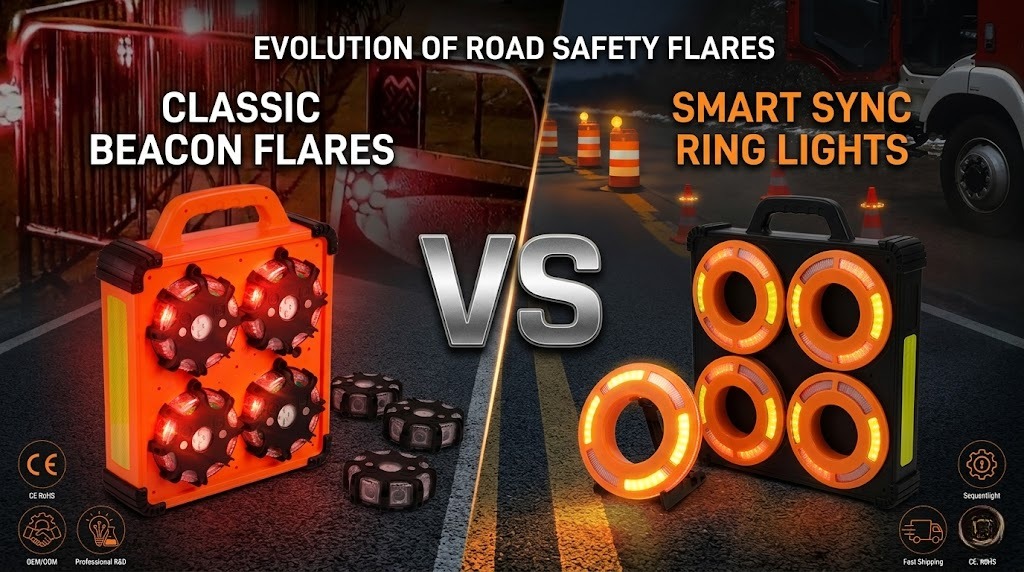
What's the Actual Difference Between the Two?
At the product level, both LED traffic cone lights and road flares do the same job: they create a visible warning zone that alerts drivers to slow down and navigate around a hazard. Both use sequential synchronized flash patterns, both are rechargeable, and both are built for outdoor use in rain, low light, and high-traffic environments.
The structural difference is in how they're deployed.
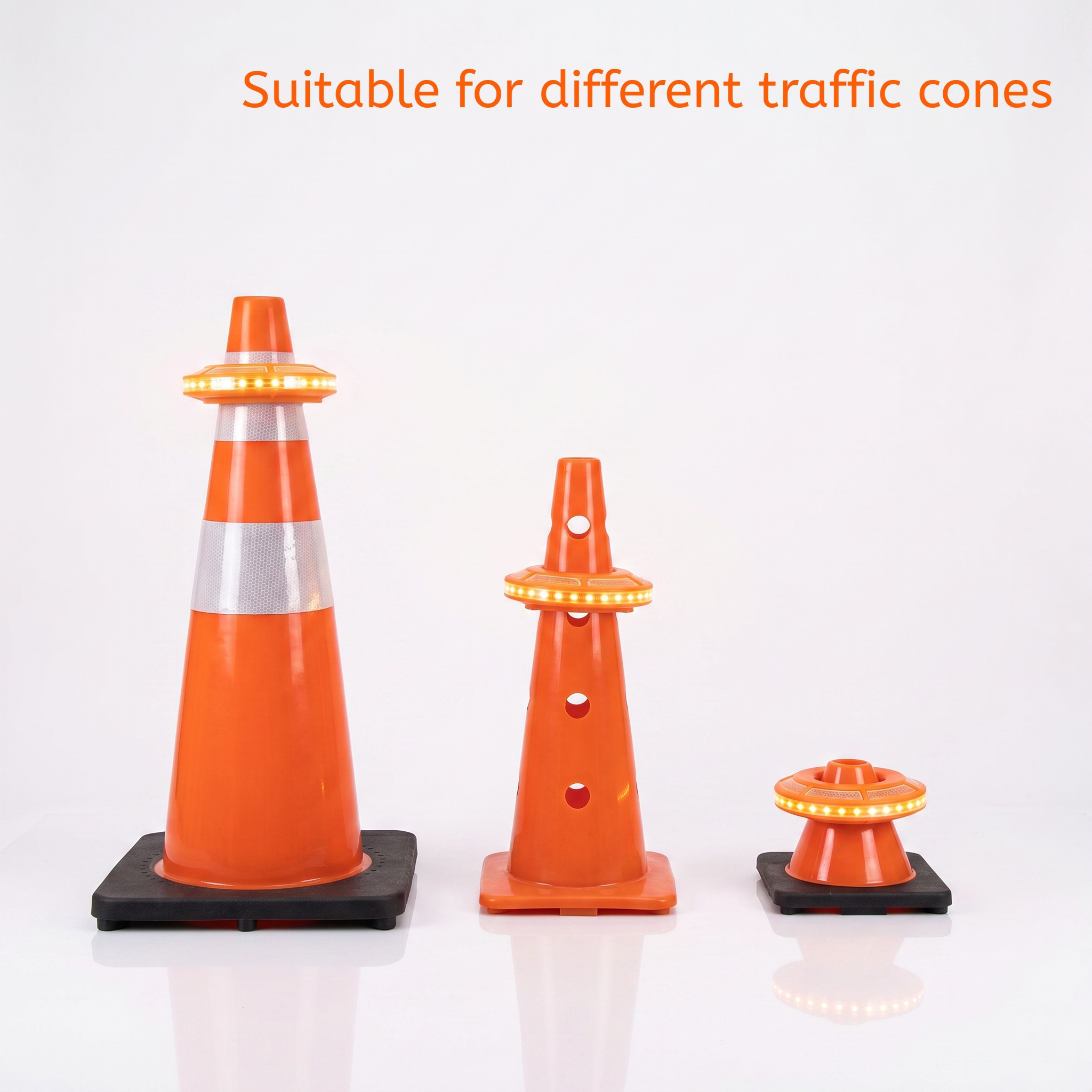
LED traffic cone lights are designed to work with traffic cones. They sit on top of or inside a cone, using the cone itself as a base and a visual anchor. The cone creates a physical barrier; the light makes it visible from a distance. Together, they define a zone. For DOT contractors and traffic management crews running scheduled work zones, this combination is standard kit.
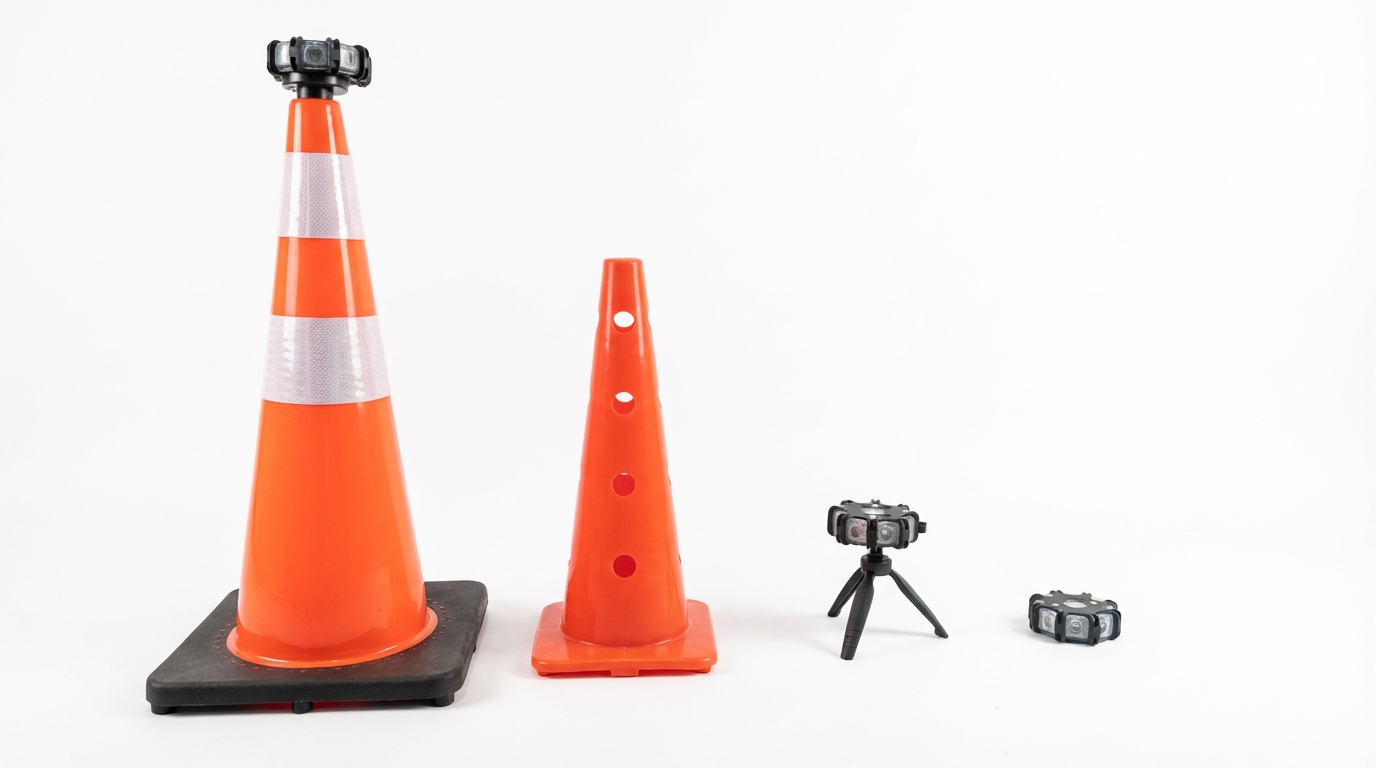
LED road flares are freestanding. They deploy independently — on the ground, on a vehicle via magnetic mount, inside a cone, or on top of a cone. They don't require a cone to function, which makes them faster to place in situations where you're working with what's available. Many DOT contractors now prefer rechargeable LED road flares over traditional fusees due to FMCSA exemptions and the elimination of fire risk on scene.
Both can be used in most of the same scenarios. The question is which one is better matched to your specific deployment pattern.
Where Traffic Cone Lights Have the Edge
Long-term and fixed construction deployments
If your crew is setting up a work zone that will be in place for hours or days — a lane closure, a utility repair, a road resurfacing project — sequential traffic cone lights are the more purpose-built choice. The combination of cone and light creates a defined, structured perimeter that reads clearly to approaching drivers and holds its position without adjustment.
For brand owners and wholesale traffic cone light suppliers building out construction supply channels, this is the use case that drives most repeat orders. The setup is intuitive: place the cones, put the lights on top, done. The sequential pattern flowing along the cone line gives drivers clear directional information from a distance.
Situations where zone definition matters more than speed
In an active work zone, the goal isn't just to warn — it's to define exactly where the hazard boundary is. A line of synchronized LED traffic cone lights does this visually in a way that standalone flares don't. The cones create a physical channel; the lights make that channel visible at night and in poor weather conditions.
When your team needs to manage battery life across a shift
This is the insight from the customer story above. Professional crews — from utility repair teams to highway construction contractors — doing multi-hour deployments need to know when their equipment needs recharging. Our HL76907B includes a low-battery indicator precisely because field operators asked for it. If your team is deploying LED road flares or cone lights for extended periods, battery visibility matters.
Where Road Flares Have the Edge
Emergency and rapid-response deployments
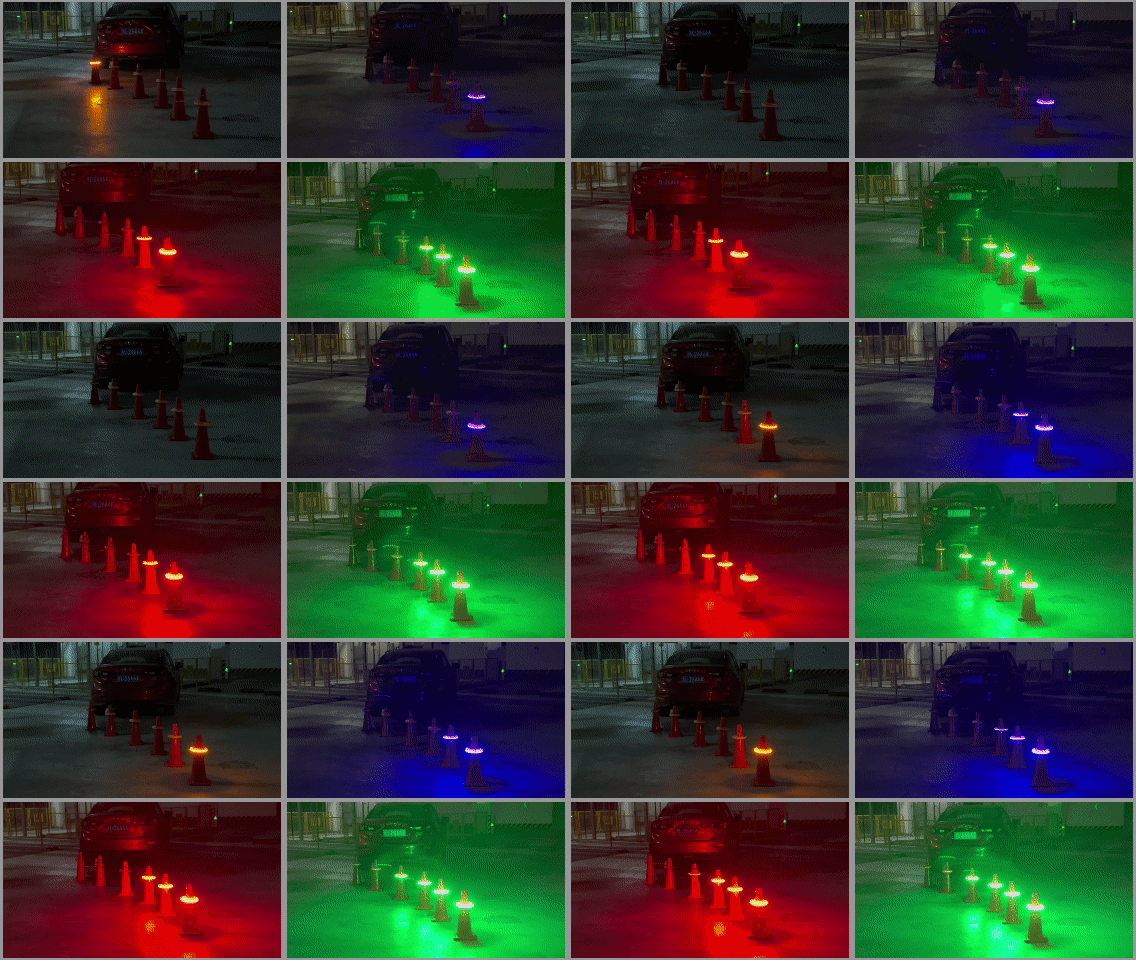
When a vehicle breaks down on a highway shoulder, time is the critical variable. LED road flares deploy faster in unstructured situations — no cones required, no setup sequence. Pull them from the case, place them along the vehicle, done. The AUTO SYNC system means every unit joins the synchronized warning pattern the moment it leaves the case.
For roadside assistance operators and emergency responders, commercial LED road flare systems are the standard choice for this reason. The flexibility of multiple mounting options — ground placement, magnetic vehicle mount, cone top, cone interior — means the flare adapts to whatever the scene looks like, rather than requiring a specific setup.
Single-operator deployments
If one person is managing a roadside situation alone, road flares require less coordination to deploy effectively. No cones to position first, no secondary equipment to manage. Place the units, step back, the perimeter is active.
When you don't have cones on hand
Road flares function fully without cones. Traffic cone lights work best with them. If your vehicle kit doesn't include a cone set, rechargeable road flares for contractors and emergency responders are the practical choice.
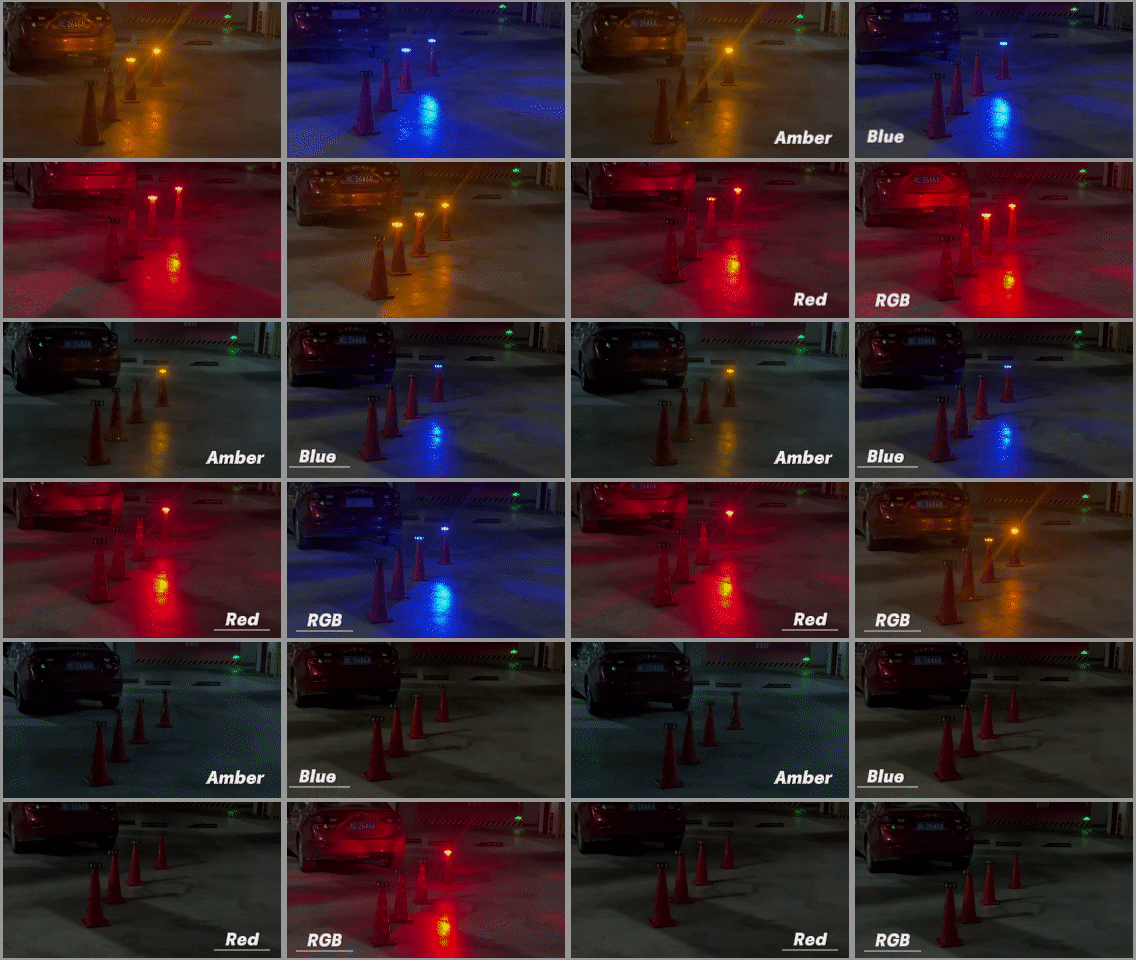
LED Warning Lights Comparison: Feature-by-Feature Breakdown
When evaluating LED traffic cone lights vs road flares side by side, the differences are more specific than most buyers expect. Here's a direct comparison across the features that matter most in the field:
| Feature | Traffic Cone Lights (HL76907B) | Road Flares (HL75011) |
|---|---|---|
| Best deployment type | Fixed work zone, long-term | Emergency, rapid-response |
| Cone required | Optimized for cone use | Optional |
| Freestanding use | Via magnetic mount | Yes, multiple options |
| RF manual re-pairing | ✅ Yes | ❌ No |
| Low-battery indicator | ✅ OEM |
✅ OEM |
| Mounting options | Cone top, magnetic | Cone top, cone interior, ground, magnetic |
| Flash modes | 5 synchronized modes | 6 synchronized modes |
| 8-unit set price | $76 | $98 |
| IP weatherproofing | Same rating | Same rating |
| AUTO SYNC / AUTO OFF | ✅ Both | ✅ Both |
| AC + DC charging | ✅ Both | ✅ Both |
The core takeaway from this LED warning lights comparison: both products share the same foundational technology. The differences are deployment-specific, not quality-based.
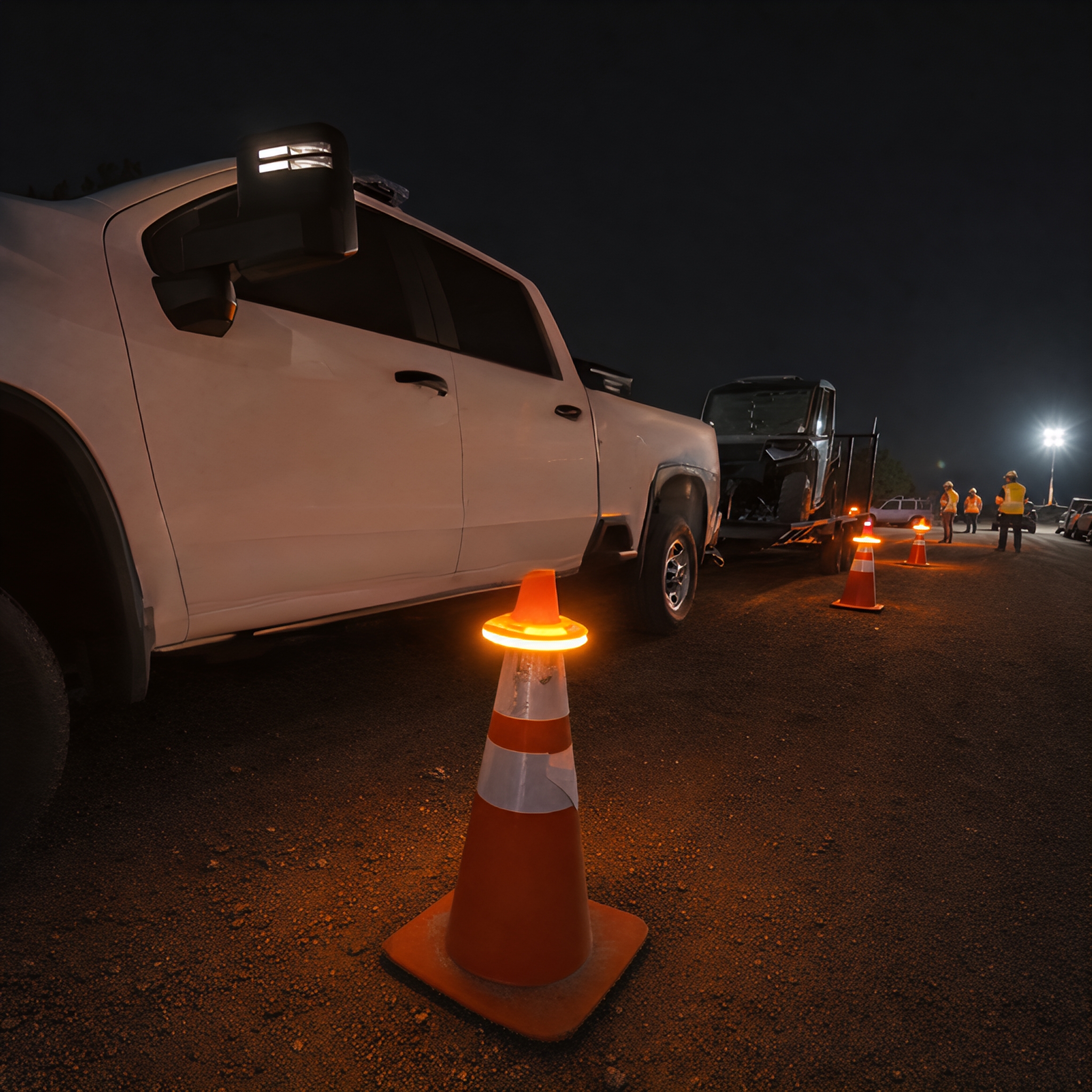
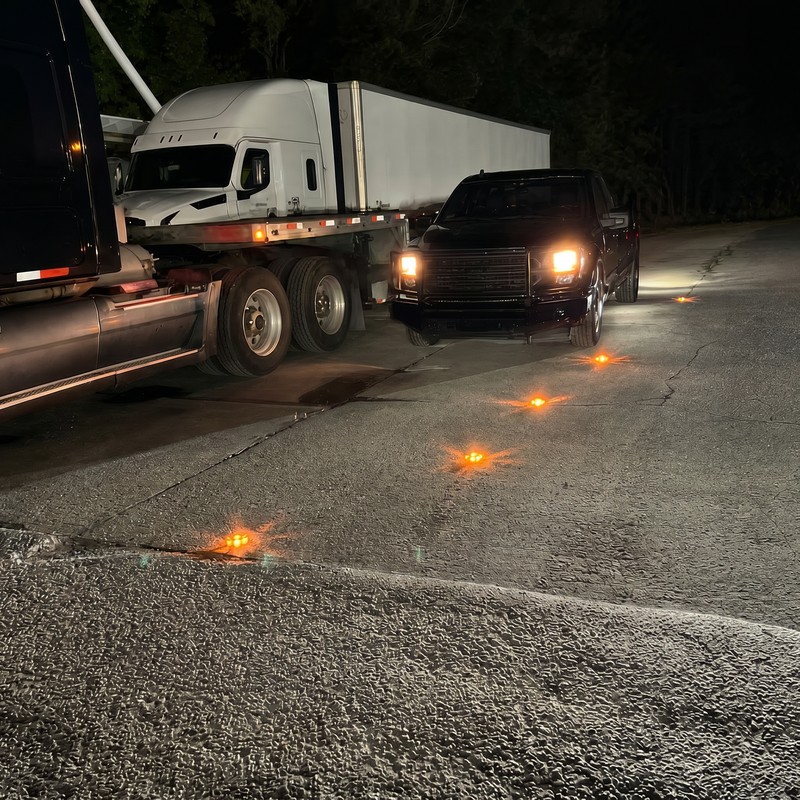
Traffic Cone Lights vs Road Flares by Deployment Type
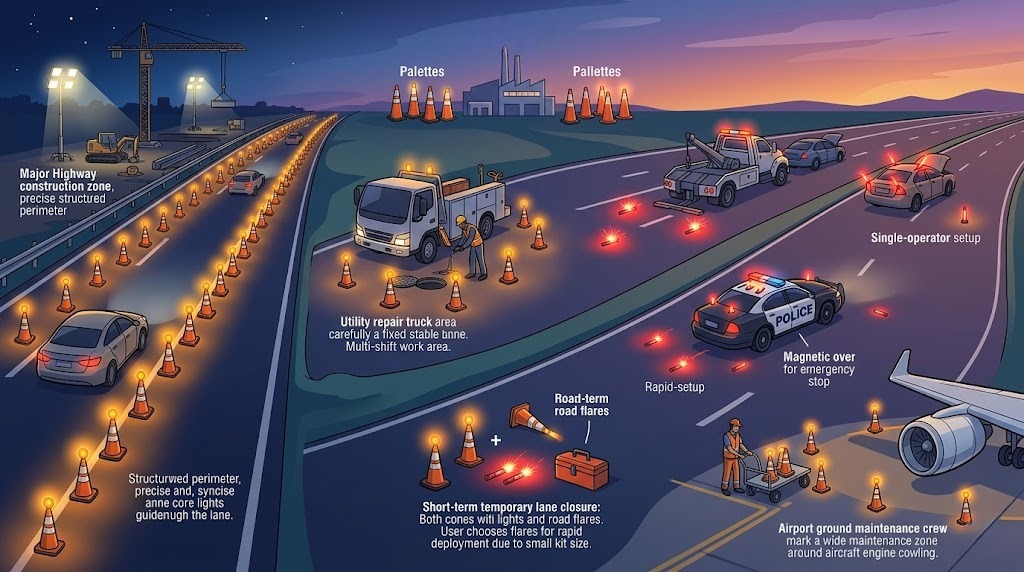
Not sure which fits your situation? Match your deployment type to the right tool:
| Deployment Type | Better Choice | Reason |
|---|---|---|
| Highway construction zone | Traffic cone lights | Structured perimeter, long-term visibility |
| Utility repair / lane closure | Traffic cone lights | Fixed position, multi-shift battery management |
| Tow truck roadside response | Road flares | Fast deploy, no cones needed |
| Vehicle breakdown on highway | Road flares | Single-operator, flexible mounting |
| Police emergency stop | Road flares | Rapid setup, magnetic vehicle mount |
| Airport ground maintenance | Traffic cone lights | Zone definition, cone compatibility |
| Temporary lane closure (short-term) | Either | Overlap scenario — choose based on kit availability |
| OEM / wholesale product line | Both | Different end-user channels, low inventory risk |
For most professional buyers — DOT contractors, traffic management crews, roadside assistance operators — the deployment type answer is clear. The overlap cases are where fleet operators often benefit from stocking both.
The Comparison Most Articles Skip
Price: what the difference actually reflects
An 8-unit sequential traffic cone light set (HL76907B) is priced at $76. An 8-unit sequential road flare set (HL75011) is $98. Same sequential technology, same AUTO SYNC / AUTO OFF system, same IP rating — different price.
The difference comes from optical design requirements. Traffic cone lights are engineered for 360-degree diffused visibility — the light needs to be seen from all angles around the cone. Road flares are engineered for directional long-distance visibility — the light needs to project farther and more intensely in specific directions. The LED chip and lens configuration for each application is different, and that's reflected in the unit cost.
This matters for brand owners and wholesale traffic cone light distributors building product lines: the price difference isn't a quality difference. It's a design difference. Both are built to the same construction standard.
Sync recovery: the technical detail that matters in the field
Sequential warning lights communicate via radio frequency. In environments with RF interference — near cellular infrastructure, at large incidents with multiple radio systems, in dense urban areas — individual units can lose sync and flash out of sequence.
Here's the difference most spec sheets don't mention: the HL76907B sequential traffic cone light supports manual re-pairing. If a unit loses sync, an operator can manually reset it back into the sequence without removing the entire set from deployment. The HL75011 road flare re-syncs automatically but does not support manual re-pairing — if a unit loses sync in a high-interference environment, the fix is to cycle it through the case.
For deployments in environments where RF interference is a known variable — near airports, broadcast infrastructure, or large emergency scenes with multiple radio systems — the manual re-pairing capability of the cone light set is a meaningful operational advantage.
IP rating and weatherproofing: the same
Both the HL76907B and HL75011 carry the same IP weatherproofing rating. Neither has an advantage in rain, humidity, or temperature resistance. If waterproofing is your primary concern, both products meet the same standard.
Portability: effectively equal
Both sets are comparable in weight and pack size relative to unit count. Neither has a meaningful portability advantage over the other. The cone lights require cones for optimal deployment, which adds to the total kit weight — but that's a deployment consideration, not a product specification.
For OEM programs, fleet deployment kits, or distributor pricing on either product line, contact our team with your target market and estimated annual volume.
The Honest Answer to "Which One Should I Buy?"
Most buyers comparing LED traffic cone lights vs road flares fall into one of three situations:
If you're managing work zones or fixed construction deployments: sequential traffic cone lights. The cone-and-light combination defines a structured perimeter, the low-battery indicator supports multi-shift operations, and the manual re-pairing capability handles RF interference without interrupting the deployment.
If you're in roadside assistance, emergency response, or any scenario where speed and flexibility matter more than structure: road flares. Multiple mounting options, full functionality without cones, and the same AUTO SYNC deployment speed as the cone lights.
If you're a brand owner or wholesaler building a product line: consider stocking both. The use cases overlap significantly, but the customers who need one type tend to need it consistently. Construction supply channels lean toward sequential traffic cone lights; automotive and emergency response channels lean toward road flares. Carrying both covers the full market without significant inventory risk given the similar price point.
The one answer that's always wrong: choosing based on price alone. At $76 vs. $98 for the same unit count and the same core technology, the difference is small enough that deployment fit should be the deciding factor, not cost.
Product Reference
| Product | Model | Configuration | Best For | Price (8-unit) |
|---|---|---|---|---|
| Sequential Traffic Cone Light Set | HL76907B | 4 / 6 / 7 / 8 units | Construction, fixed deployment, cone-line warning | $76 |
| Sequential Road Flare Set | HL75011 | 4 / 6 / 8 / 10 units | Emergency response, roadside assistance, flexible deployment | $98 |
Both sets include: AUTO SYNC / AUTO OFF, AC and DC charging, IP-rated weatherproofing, sequential flash modes.
HL76907B mounting: Traffic cone top mount (multi-size compatible) · Magnetic vehicle/barrier mount HL75011 mounting: Ground placement · Magnetic vehicle mount · Traffic cone interior · Traffic cone top mount
→ Request a sample for your deployment scenario → Download full spec sheet for HL76907B → Download full spec sheet for HL75011
FAQ
Q: Can I use traffic cone lights without traffic cones?
A: Yes — the HL76907B includes a magnetic mount that attaches to vehicle bodies and metal barriers. The sequential pattern still functions without cones. That said, the product is optimized for cone-top deployment; without cones, a road flare set offers more mounting flexibility for most scenarios.
Q: Do both sets use the same AUTO SYNC system?
A: Yes. Both the HL76907B and HL75011 activate and join the sequential pattern automatically the moment each unit is removed from the case. No pairing, no configuration, no numbered deployment order required. AUTO OFF works the same way — units shut off when returned to the case.
Q: What happens if one unit loses sync during deployment?
A: On the HL76907B cone light set, a unit that loses sync can be manually re-paired back into the sequence without interrupting the rest of the deployment. On the HL75011 road flare set, cycling the unit through the case (removing and replacing) resets the pairing. Both sets are designed to re-sync automatically in most conditions.
Q: Can the HL76907B fit any size traffic cone?
A: The HL76907B is designed to fit standard traffic cone sizes commonly used in North American and European work zones. The mounting head accommodates varying cone top diameters within that range. If you're using non-standard cone sizes, request a sample unit to confirm fit before placing a full order.
Q: Are these products available for private label or OEM customization?
A: Yes. Both product lines are available for OEM and ODM customization, including private label packaging, logo printing, and functional modifications such as custom flash patterns or indicator features. Custom color variants and new mold development are available for qualifying order volumes. Contact us with your annual volume estimate to discuss what's feasible for your program.
Q: Which product is more suitable for cold weather markets?
A: Sequential LED warning lights are broadly accepted across US states for work zone and roadside emergency use. However, specific regulatory requirements vary by state and application — for example, police and emergency vehicle use may require additional certifications such as SAE or DOT compliance. For government tenders or fleet procurement, always verify the applicable standards with your state DOT or procurement authority before finalizing an order.
Q: How far apart should road flares be placed in a work zone?
A: The MUTCD (Manual on Uniform Traffic Control Devices) recommends spacing warning devices at intervals based on posted speed. As a general field reference: at 55 mph, place flares approximately 100–200 feet apart, with the first device at least 500 feet from the hazard. At highway speeds (65–70 mph), extend spacing accordingly. Always follow your jurisdiction's specific traffic control standards — these distances are guidelines, not substitutes for local compliance requirements.
Q: Can LED road flares replace traditional incendiary flares?
A: For most road safety applications, yes. LED road flares for work zones and roadside emergencies offer equivalent or superior visibility, with the added advantages of reusability, no fire hazard, and consistent performance in wet conditions. The FMCSA has granted exemptions allowing certain LED warning light systems as legal alternatives to fusee flares for commercial vehicles. Check current FMCSA guidance and your state DOT requirements to confirm compliance for your specific use case.
SuperFlare manufactures synchronized LED traffic cone lights and LED road flares for construction contractors, DOT contractors, roadside assistance operators, emergency responders, and global brand owners. All products are CE certified and available for OEM/ODM customization.
For guidance on choosing between sequential and non-sequential systems, read our guide: Sequential vs. Non-Sequential LED Road Flares. For a complete B2B sourcing breakdown, see our LED Road Flare Buyer's Guide by Profile.