Rechargeable LED Traffic Wand vs. Battery Traffic Wand: Which One Holds Up on the Job
A distributor stocks the wrong wand for a customer's night crew. Three weeks later that customer is on the phone, because half the units went dark mid-shift and nobody had spare batteries in the size that wand actually takes. That's rarely a product defect. It's a sourcing decision that picked the wrong power type for the job.
Neither a rechargeable LED traffic wand nor a disposable-battery traffic wand is universally better. Each one wins in a different deployment pattern: rechargeable systems hold up best for daily, high-frequency use on a fixed worksite, while disposable-battery units make more sense for low-frequency, mobile, or long-storage scenarios. We manufacture the rechargeable side of that comparison, so here's the real data behind it — runtime by mode, what survives a drop, what a fleet actually pays over a year, and which buyer should be pointed toward which option.

Jump to:
- Rechargeable vs. Disposable-Battery Traffic Wands: What Separates Them
- Runtime Comparison: LED Traffic Wand vs. Battery Traffic Wand
- Which Deployment Environment Fits Which Traffic Wand
- How Durable Is a Rechargeable LED Traffic Wand?
- How Does Type-C Charging Change Fleet Deployment?
- The Real Cost Difference Over a Year of Use
- Customization and Private Labeling for Bulk Orders
- What Role Do LED Traffic Wands Play in MUTCD Compliance?
- FAQ
Rechargeable vs. Disposable-Battery Traffic Wands: What Separates Them
Most buyers treat "LED wand" and "battery wand" as two clean categories. In practice there's a third category in between, and missing it is where sourcing decisions go wrong.
A corded or dock-rechargeable LED traffic wand draws power from AC or a proprietary charging cradle. A disposable-battery traffic wand runs on AA, C, or D alkaline cells the buyer supplies separately. A Type-C rechargeable wand — the line we build — sits in its own lane: a sealed lithium-ion cell charged over a standard USB-C cable, with no proprietary dock to lose or to stop matching once a model gets discontinued.
| Power Type | Source | Best Fit | Main Risk |
|---|---|---|---|
| Disposable battery (AA/C/D) | Alkaline cells, user-supplied | Low-frequency use, emergency kits, long storage | Battery cost stacks up under daily use; cells age unevenly in the field |
| Dock-rechargeable | AC or proprietary charging cradle | Fixed worksites that already have a charging station | The cradle is a separate part that can break, get left behind, or stop fitting a newer unit |
| Type-C rechargeable (our line) | USB-C, 5V/1A | Daily, high-frequency, fleet-scale use | Needs a charging routine — not the right fit for units that sit unused for months |
If a customer base runs wands daily on a fixed site — highway crews, parking facilities, municipal yards — a rechargeable system is the better fit. If they're stocking an emergency kit that might sit untouched for half a year, a disposable-battery wand is the more dependable choice, because alkaline cells hold a shelf charge for years and a rechargeable cell doesn't get checked until someone actually needs it.
Comparing this to our Sequential LED Road Flares for the fixed-site case, or to a Traffic Cone Ring Light for lower-traffic lane closures? Tell us your deployment pattern and we'll point you to the right SKU.
Runtime Comparison: LED Traffic Wand vs. Battery Traffic Wand
A rechargeable LED traffic wand reports runtime by mode, in hours, because the battery is sealed inside and the discharge curve is fixed. A disposable-battery traffic wand reports runtime by battery type, and that number moves with brand, age, and temperature. Most disposable-battery wands on the market are rated for somewhere between 20 and 40 hours of continuous flashing on a fresh set of cells — a number that drops as the cells age, and drops further in cold weather, which is exactly when a night crew needs the light most.
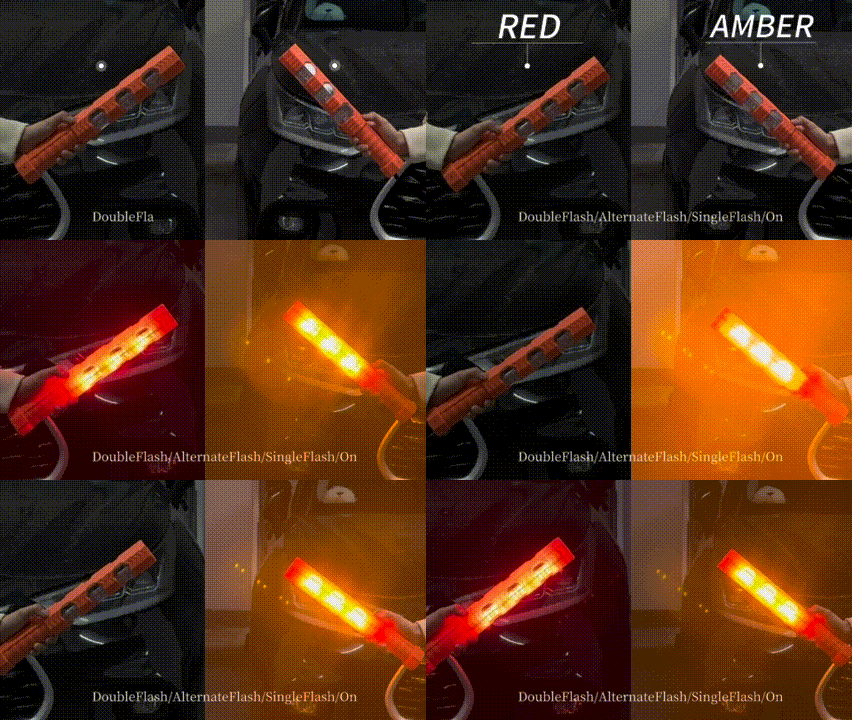
Our rechargeable LED Traffic Baton publishes runtime per mode instead of one headline number, because a buyer comparing wands should see the worst case alongside the best:
| Mode | Red/Blue Version | Single-Color (Red or Amber) |
|---|---|---|
| Steady | 3 hours | 2.5 hours |
| Single/Standard Flash | 24 hours | 12 hours |
| Fast Flash | — | 17 hours |
| Alternating Flash | — | 2.5 hours |
| Red/Blue Combined Flash | 7 hours | — |
| Top LED, High Output | 7 hours | 7 hours |
| Top LED, Low Output | 19.5 hours | 19.5 hours |
| Full Charge Time (Type-C, 5V/1A) | 3.5–4 hours | 3.5–4 hours |
Single Type
Red Blue Type
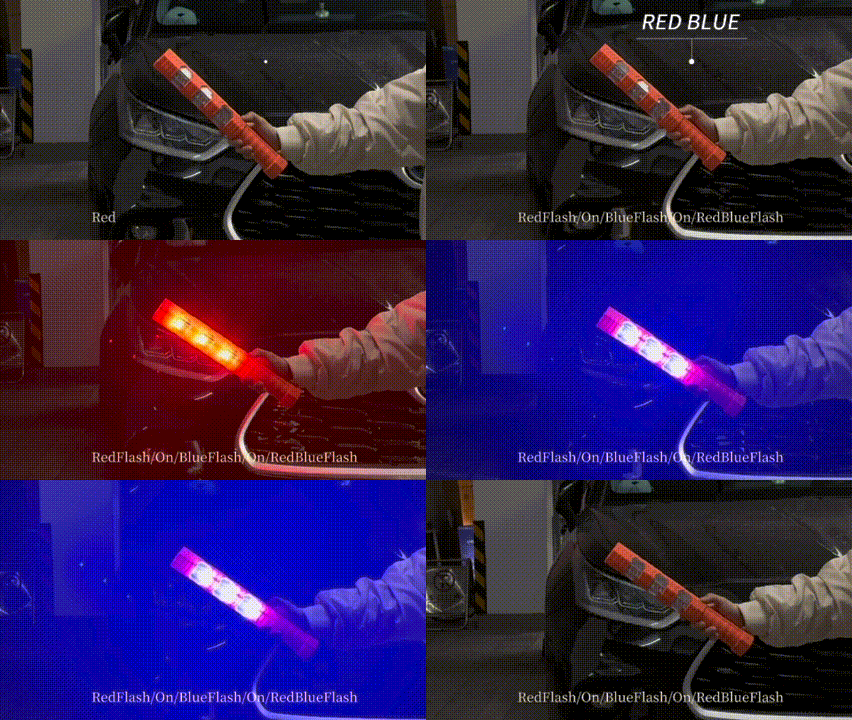
For a crew running a 10-hour shift on standard flash or Top LED Low, one charge covers the entire shift with hours to spare. That single-charge coverage matters more than the headline runtime number, because a crew working a closed lane until sunrise can't stop mid-shift to dig through a battery box.
Cold weather is where the two technologies diverge the most. Alkaline cells lose a meaningful share of usable capacity as temperatures drop, which is why a battery wand rated for 30 hours in a warehouse test often runs closer to half that on a January night shift. A sealed lithium-ion cell loses capacity too, but the drop is smaller and more predictable.
The other variable a disposable-battery wand introduces is age. A fresh set of AA cells and a set that's been sitting in a truck console for three months don't perform the same, and nothing on the unit tells a worker which one they grabbed. A rechargeable wand removes that variable: the charge level reflects how recently it was plugged in, not how long a battery has been quietly self-discharging in storage.
Which Deployment Environment Fits Which Traffic Wand
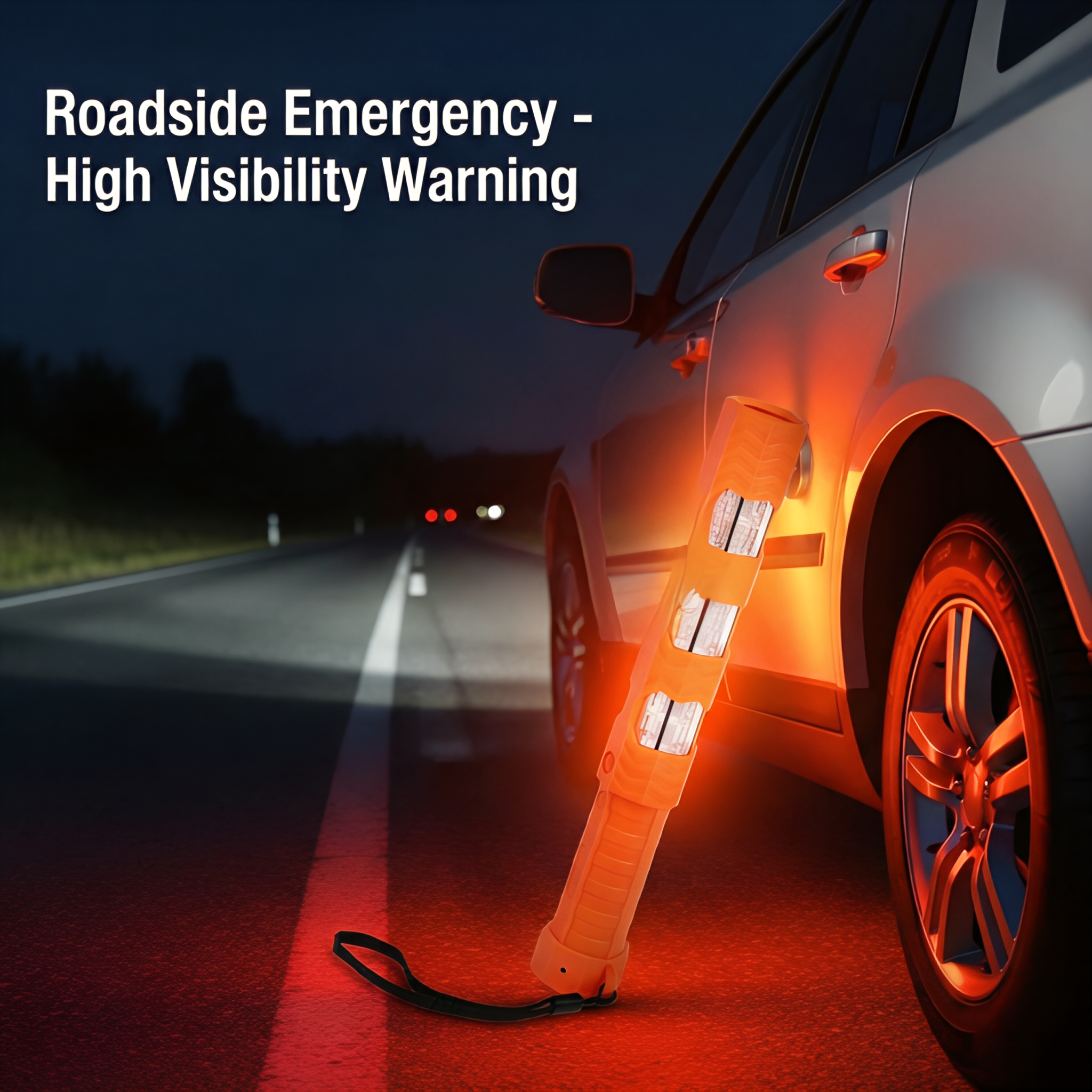

Deployment environment decides more about wand choice than any spec on a sheet. Four patterns cover most of the field, and they don't all point the same direction:
- Fixed construction and road work → rechargeable. Reliable truck power, predictable charging routine.
- Mobile flagging across multiple sites → gray zone. Rechargeable works if there's a charging point between stops; otherwise battery-powered is more forgiving.
- Emergency kits and infrequent backup stock → disposable-battery. Shelf life beats charge retention for something that might sit untouched for months.
- Event staffing and parking management → disposable-battery. No charging protocol to train a part-time worker on, and lower stakes if one dies. Here's why each one lands where it does:
Fixed construction and road work. A crew with a truck and reliable power is the clearest case for a rechargeable LED traffic wand. Wands go back on charge at end of shift, the same as a radio. Disposable batteries here become a recurring cost with no real upside, and the battery-door latch that gets opened every few days to swap cells is usually the first part to crack or let water in.
Mobile flagging across multiple sites in a week. This is the gray zone. A Type-C rechargeable wand works fine if the crew has a reliable way to charge between stops — a truck USB port covers most cases. Without that, a disposable-battery wand is actually more forgiving, because the failure mode is simple: carry spares, swap when needed, no charging schedule to track.
Emergency kits and infrequent backup stock. This is the one case where we'd point a buyer toward the disposable-battery option instead of our own product line. A rechargeable wand sitting in a kit bag for six months may not have a usable charge when it's finally needed. Alkaline cells hold shelf charge for years. For a use case built around "we hope we never need this," the lower-tech option is the more honest recommendation, not the rechargeable one.
Event staffing and parking management. Lower safety stakes, higher staff turnover. A disposable-battery wand is easier to hand to a part-time worker on their first shift with no charging protocol to explain, and a dead wand here is an inconvenience, not a safety event.
For a distributor stocking one SKU to cover several customer types, that's the real compromise being made — worth naming out loud instead of letting a single product try to fit every shelf. A wand built for road construction and a wand built for an emergency kit are solving different problems, even when they look identical on a spec sheet.
Not sure which deployment bucket your customer base falls into? Send us your use case and we'll recommend a configuration.
How Durable Is a Rechargeable LED Traffic Wand?
Our LED Traffic Baton is built for daily outdoor handling, not laboratory waterproof certification — and we'd rather say that plainly than round the rating up. The housing has everyday water resistance for rain and wash-down conditions, but it has not been submitted for an IPX test the way our Sequential LED Road Flares have (those carry a tested IPX7 rating). If a spec sheet requires a certified ingress-protection number for a traffic wand specifically, ask the supplier for the test report. A sealed-looking gasket is not the same as a documented test result.

We've recorded the unit dropped from 3 meters onto pavement, and it kept lighting on every mode afterward. That's an informal field demonstration, not a certified drop-test report, and we're labeling it that way rather than dressing it up as lab data.
Drops are routine for this product category. A parking attendant walking a row of cars sets a wand down and picks it back up dozens of times a shift. A tow truck operator climbing in and out of a cab at a roadside call drops one on asphalt more often than they'd admit. A wand on an active construction site sees the roughest handling of all — tossed into a truck bed with cones and barricades, left in direct sun on a dashboard, then picked up cold at 4 a.m.
There's also a difference in how each power type fails. A lithium-ion cell under a basic protection circuit typically dims before it cuts out, giving some warning that a charge is running low. Alkaline cells under heavy current draw in cold weather can cut out abruptly, with less notice. For a flagger working an active lane, that gap matters more than it does for someone waving cars into a parking lot.
Battery traffic wands carry an added mechanical failure point: the battery door. Every time cells get swapped, that latch flexes, and it's usually the first part to crack or let water in after months of field use — a problem a sealed rechargeable unit doesn't have, because nobody opens it to change anything. Older reflective wands without electronics have a different aging problem: the reflective sheeting dulls and yellows after enough sun exposure, so a wand that still works mechanically can stop being visible at the distance it was rated for, with no obvious sign that it's happened.
None of this replaces a certified test report, and we're not claiming it does. If a buyer's procurement checklist requires documented ingress-protection or impact-resistance numbers, that requirement should go to whichever supplier can produce the actual report, not just a rating printed on packaging.
How Does Type-C Charging Change Fleet Deployment?
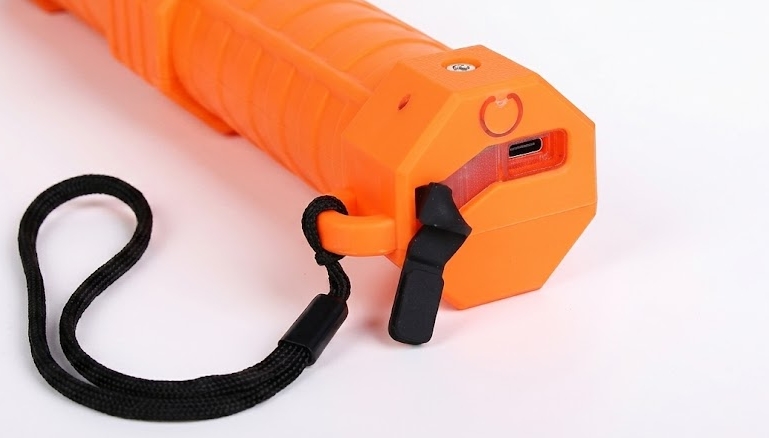
A municipal road crew running 40 traffic wands doesn't need 40 charging cradles in a supply closet. Our LED Traffic Baton charges over Type-C at 5V/1A, so each unit plugs into the same cable a crew member already uses for a phone, a dash USB port, or a shared power bank in the truck. There's no proprietary dock to lose, and no single point of failure if one charger goes missing.
A disposable-battery traffic wand at the same fleet size means stocking AA, C, or D cells in bulk, tracking which units are due for a swap, and accepting that someone grabs the wrong size battery at 5 a.m. before a shift. That tracking overhead scales with every unit added — a 10-wand fleet manages it on memory; a 100-wand fleet needs a system for it.
Some rechargeable wands on the market solve this with a proprietary charging cradle instead of a standard cable. That introduces a different problem: the cradle is one more part that can break, get left behind on a job site, or simply not fit a replacement unit ordered two years later once the original model is discontinued — and when that happens, the fleet is stuck waiting on the manufacturer to restock that specific part, with no off-the-shelf substitute. A basic USB-C cable, by comparison, is a commodity part sold everywhere for a couple of dollars, with same-day local availability if one goes missing. A Type-C port avoids the lock-in entirely — any USB-C cable and any 5V source works, including the ones a crew already carries.
This is also where fleet equipment tends to separate into two camps: crews that treat wands as disposable, low-cost tools they replace often, and crews that treat them as durable equipment they maintain on a charging schedule. A charging routine — plug in at end of shift, same as a radio — is easier to enforce than a battery-swap routine that depends on someone noticing a wand has gone dim.
The Real Cost Difference Over a Year of Use
The price on a spec sheet is the smallest line item in either wand's first year of service. The bigger cost sits in what happens after purchase.
Three line items matter more than the sticker price:
- Recurring battery spend — for a disposable-battery wand, multiply unit count by how many battery sets each one burns through per month, on whatever replacement cycle the crew actually follows.
- Charging setup cost — for a rechargeable wand, this is close to zero in practice, since it runs on cables and power sources most crews already own.
- Downtime risk — a dead wand mid-shift means a worker without a required signaling tool until someone finds a charged spare or a fresh battery, which costs more in lost time than either product's line-item price shows on paper. Illustrative example only — plug in your own numbers. Rather than quote a single dollar figure, here's the formula, with real, publicly available wholesale battery pricing dropped in so you can re-run it against your own fleet's actual replacement cycle:
Illustrative example only — plug in your own numbers. Rather than quote a single dollar figure, here's the formula, with real, publicly available wholesale battery pricing dropped in so you can re-run it against your own fleet's actual replacement cycle:
Annual battery spend = Fleet size × Cells per wand × Swaps per year × Price per cell
Wholesale AA alkaline cells in case quantities (144+ units) currently run roughly $0.20–$0.40 per cell, depending on brand and order volume. Take a fleet of 50 wands, each running on 2 AA cells, with a crew swapping cells every two weeks (26 swaps/year) — a usage rate you should adjust to match your own crews' actual habits, not ours:
50 wands × 2 cells × 26 swaps/year × $0.30/cell (mid-range) ≈ $780/year in batteries alone, before counting the labor time spent tracking and swapping them.
Move the swap frequency or cell price up or down and the total moves with it — that's the point of showing the formula instead of one fixed number.
On the rechargeable side, the actual electricity cost is small enough to calculate directly rather than wave off as "negligible": our LED Traffic Baton charges at 5V/1A for up to 4 hours, which works out to about 0.02 kWh per full charge. At the current U.S. average residential electricity rate of roughly 17.6¢/kWh, that's a full charge costing well under half a cent, even before accounting for the lower commercial rates most fleets actually pay.
| Fleet size | Disposable-battery: annual cost (formula above, $0.30/cell, biweekly swap) | Type-C rechargeable: annual charging cost |
|---|---|---|
| 10 wands | ≈ $156/year | Under $1/year |
| 50 wands | ≈ $780/year | Under $5/year |
| 100+ wands | ≈ $1,560/year and climbing | Still under $10/year |
Battery price sourced from publicly listed wholesale case pricing as of mid-2026; electricity rate from the EIA national residential average. Your actual numbers will depend on your battery brand, swap frequency, and local utility rate — swap any of these inputs into the formula above to get your own figure. This is not a quote.
The direction of that math rarely favors disposables once a fleet passes a few dozen units. For a smaller operation running two or three wands occasionally, the gap narrows enough that either option can make sense, and a battery wand's lower upfront cost may be the more practical call.
Want help running these numbers against your actual fleet size and usage pattern? Request a cost comparison and we'll work the math with you.
Customization and Private Labeling for Bulk Orders
Brand owners and distributors sourcing traffic wands for private label often inherit a problem they didn't choose: a reflective strip pre-printed with someone else's factory markings, or a logo position that's an afterthought.
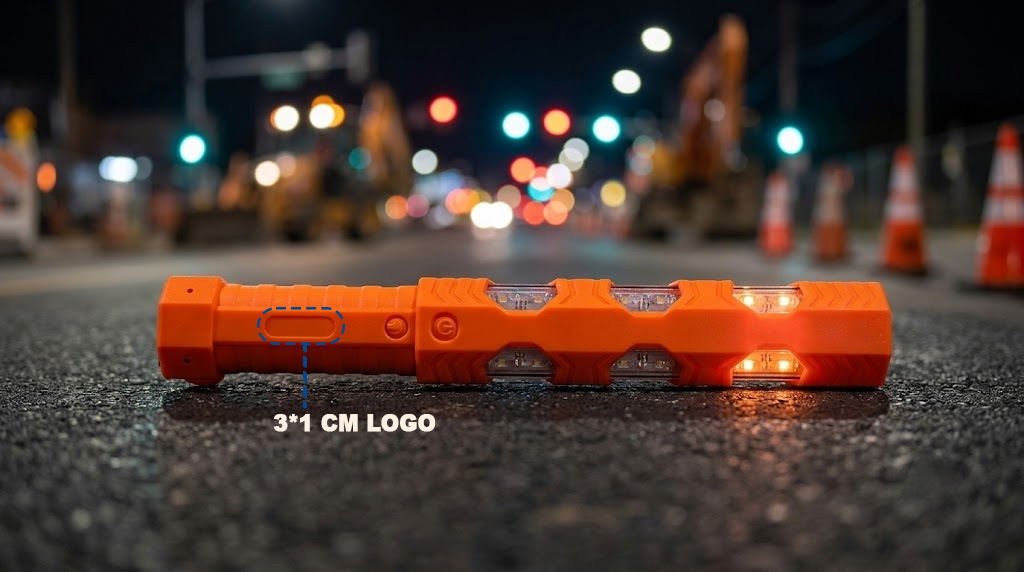
We ship the LED Traffic Baton with no reflective strip and no printed branding on it by default, with a dedicated logo position — 3 cm by 1 cm — placed directly below the control button rather than wherever there happened to be open space. LED color and flash-mode configuration can be set per order, which matters for a brand owner who wants a wand that matches an existing product line rather than a generic red-and-blue unit with someone else's name already on it. A security equipment brand might want a pure amber configuration to avoid the red-and-blue look associated with law enforcement; an events company might standardize on a single flash pattern across their entire inventory.
OEM and ODM orders run on flexible minimum order quantities rather than a fixed tier, which matters for a brand owner testing a new product line who isn't ready to commit to a container-scale order on the first run. We've worked with independent U.S. retail brands on configured runs in the low thousands of units — enough volume to justify custom branding without requiring a year of lead time to plan around. Full specs and OEM documentation are available on the LED Traffic Baton Wholesale product page.
What Role Do LED Traffic Wands Play in MUTCD Compliance?
Searches for "MUTCD compliant traffic wand" usually come from a buyer assuming a wand alone satisfies road-work flagging requirements. It doesn't, and a procurement team that assumes otherwise can end up with an audit problem.
The Manual on Uniform Traffic Control Devices requires flaggers at a temporary traffic control zone to use a STOP/SLOW paddle — at least 18 inches wide, retroreflectorized at night — as the primary hand-signaling device, with a flag permitted only as a backup. An LED traffic wand is not listed as a substitute for that paddle in road-construction flagging. (Full requirements are at the official MUTCD site.)
Where LED traffic wands do the job they're designed for is everywhere outside that specific flagging rule:
- Police and law enforcement — signaling at incident scenes, where MUTCD's flagger-paddle requirement doesn't govern the situation.
- Airport ground crews — marshaling aircraft on the tarmac, a use case with its own visibility standards entirely separate from road-work flagging.
- Parking attendants — directing vehicles through a lot.
- Tow truck operators — roadside signaling during a recovery.
- Event staff — routing vehicles around a venue during load-in and load-out. In every one of those contexts, a rechargeable or battery-powered traffic wand is the right tool, and "MUTCD compliant" simply isn't the relevant standard to ask about. The relevant standard only shows up at an actual road-construction flagging station, where the STOP/SLOW paddle rule applies regardless of how bright or well-built the wand in someone's other hand happens to be.
FAQ
Is an LED traffic wand the same thing as a traffic wand flashlight? Mostly, yes. Most LED traffic wands double as flashlights, with a forward-facing white LED built in alongside the red, blue, or amber signaling lights, so one unit covers both walking light and traffic direction without carrying two tools.
Are LED traffic wands MUTCD compliant for road construction flagging? No single LED traffic wand replaces the STOP/SLOW paddle the MUTCD requires as the primary hand-signaling device for road-work flaggers. LED wands are commonly used instead by police, tow operators, airport ground crews, and parking or event staff, in contexts where the flagger-paddle rule doesn't apply.
How long does a rechargeable LED traffic wand run on a full charge? Runtime depends on the mode selected. Our LED Traffic Baton runs up to 24 hours on standard flash and up to 19.5 hours on low-output steady mode, from a single 3.5–4 hour Type-C charge.
Is a disposable-battery traffic wand ever the better choice over a rechargeable one? Yes, in specific cases. For wands that sit in an emergency kit or backup stock for months at a time, disposable alkaline cells hold a shelf charge longer than an unused rechargeable battery does. For daily, high-frequency use, a rechargeable LED traffic wand is the more reliable and lower-cost option over time.
Can LED traffic wands be customized with a private logo for bulk orders? Yes. We ship the LED Traffic Baton with a blank, unprinted exterior and a dedicated logo position below the control button, with LED color and flash-mode configuration available for bulk and private-label orders.
Are LED traffic wands waterproof? It depends on the specific model and whether it carries a tested IP rating, not just a water-resistant build. Our LED Traffic Baton has everyday water resistance for rain and wash-down use but hasn't been submitted for IPX certification — ask any supplier for the actual test report rather than the marketing claim on the box.
A distributor who matches wand type to deployment pattern before stocking doesn't get the call about dead units on a live roadway three weeks later. That decision happens upstream, at sourcing — not after the SKU is already on a shelf.
We're Superflare, and we manufacture the rechargeable side of this comparison with documentation to back it: per-mode runtime data, an honest answer on water resistance, and OEM configuration for buyers who need their own branding on the unit.
Fleet and wholesale buyers sourcing 50+ units with custom logo placement or LED configuration can request a sample kit and OEM quote . For a full spec sheet across the LED Traffic Baton lineup, or to run the cost comparison against your own fleet size, submit your requirements at superflare.net/ToFeedback and expect a response within 24 hours.
Learn more about LED Wands for How Road Crews Use LED Traffic Wands to Reroute Night Construction Traffic
Related News