How Road Crews Use LED Traffic Wands to Reroute Night Construction Traffic
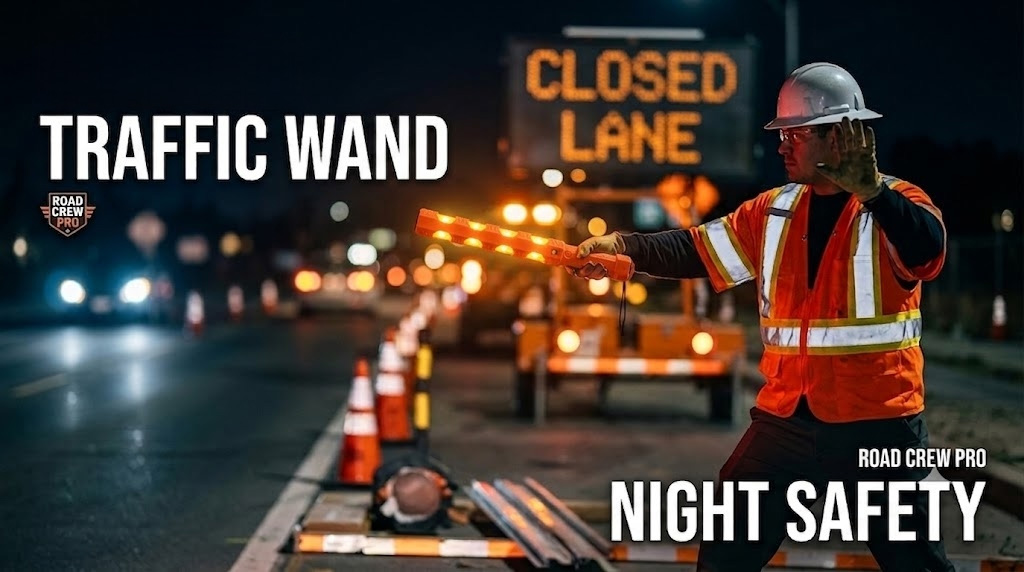
Night construction zones kill people. Not because crews aren't working hard — but because the margin for error at highway speed, in the dark, is measured in seconds, not minutes.
It's 11 PM on a two-lane resurfacing job, and the flagger has about thirty seconds to get an oncoming car into the open lane before it crests the hill. A flashlight doesn't read clearly at that distance, in the dark, through windshield glare. That's the exact gap the LED traffic wand was built to close — and it's the tool two flaggers, working opposite ends of a single-lane shift, lean on to keep cars moving through a work zone without anyone meeting in the middle.
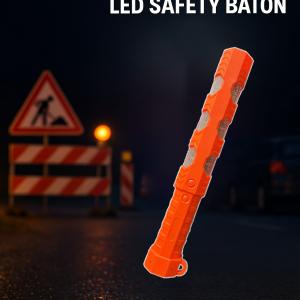
An LED traffic wand is a handheld, battery-powered signaling light used by flaggers and road crews to direct vehicles through lane closures, detours, and night work zones. Compared with a flashlight or a chemical light stick, it gives drivers a longer, brighter, more deliberate visual cue — which is why it's become standard gear on night road construction crews across the US.
The crews that end up with the wrong setup almost never paid too little for it — they bought a wand that didn't match the shift it was actually used for.
Jump to:
- Setting Up a Night Lane Closure Before the First Car Arrives
- How a Single-Lane Closure Actually Runs at Night
- When the Pattern Breaks
- Where Else This Setup Shows Up
- What the Wand Has to Survive to Keep Up With the Shift
- LED Traffic Wand vs. What Crews Used Before
- FAQ
Setting Up a Night Lane Closure Before the First Car Arrives
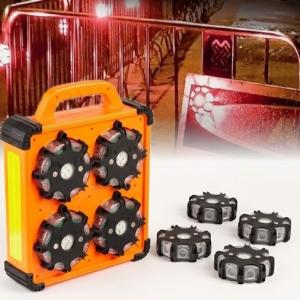
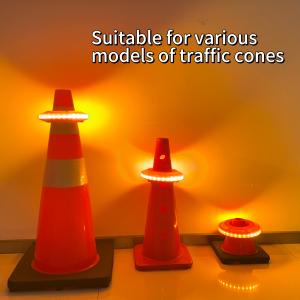
By the time the first headlights show up on the horizon, the crew has already laid out a cone taper leading into the single-lane section, set a flare or two marking the edge of the closure, and put a flagger at each end of the shift — far enough apart that neither one can see the other directly, close enough that a radio call still lines up with what's actually happening on the road. (Our Common Traffic Safety Equipment Explained? breakdown covers how cones, flares, and arrow boards typically split up that setup, and our LED Road Flare Buyer's Guide: Government, Wholesale & Brand Sourcing by Profile (2026) goes deeper on the flare side specifically.)
Each flagger carries a wand, and the first decision is which mode to leave it on. Red is the default — it's the universal flagging color, and the only one most states let a road crew use without restriction. Blue is often reserved for law enforcement and emergency vehicles, so before reaching for a dual-color mode on a public road, it's worth checking what the state actually allows. It's a useful second signal for off-road or controlled-site work, not something to default to on a highway shift.
Distance is the part crews underestimate until they've worked a night shift. A driver doing 45 mph closes 200 feet in about three seconds — not much room for a flagger to be holding a dim or ambiguous signal. That's the entire argument for a dedicated wand over a phone flashlight: it's built to be read at speed, in the dark, by someone who's looking at it for the first and only time.
How a Single-Lane Closure Actually Runs at Night
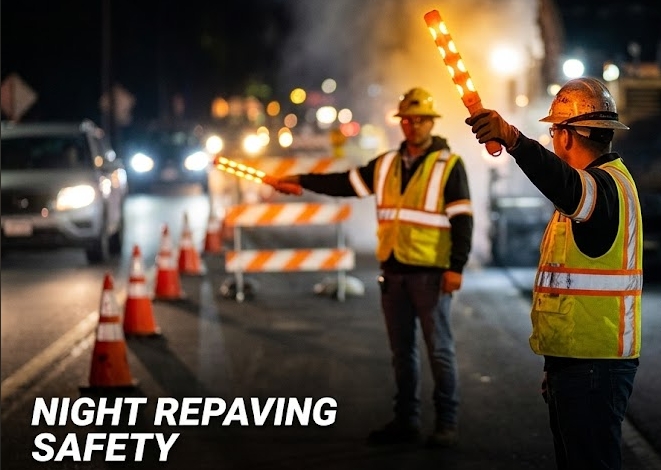
Once the closure is set, the job becomes a back-and-forth between two flaggers, not a one-person performance.
Flagger A holds a steady signal toward their direction of traffic, stopping cars at the front of the queue. Flagger B, at the other end, watches the lane for the last car coming through from the previous release, and only calls "clear" over the radio once that car has actually passed — not when it looks like it's about to. Flagger A then switches from steady to a flashing wave-through signal, and the queue moves.
The tricky part is the cars further back in the queue, not the first one. The driver at the front sees the flagger directly; the fifth or sixth car back is reading brake lights, the cone taper, and whatever light is bouncing off the wand. If the signal isn't consistent the whole way down the line, that's where a driver decides to swing around — and on a two-lane road at night, that's the failure case the entire setup exists to prevent.
Run this cycle for a full shift and it isn't constant mode-switching — it's mostly steady-hold, then flash-release, repeated for hours, with the wand left on a parked vehicle or the closure boundary in a low-brightness setting as a passive marker between active cycles.
When the Pattern Breaks
That cycle holds until something doesn't follow it — and on a night shift, something usually doesn't.
A driver not paying attention is the most common break: headlights that don't slow on approach, which means the flagger has to escalate from a calm wave to an unmistakable stop signal fast, often switching to a faster flash to grab attention before the vehicle reaches the taper.
Oversized loads change the math. A wide truck or a piece of equipment moving through the closure needs more clearance and more warning time than a passenger car, so the flagger holding it has to read the vehicle and adjust how early they signal — there's no fixed script for that, just judgment built from doing it enough times.
Emergency vehicles get priority regardless of where the cycle is. If a flagger sees lights approaching, the normal stop-and-go pattern gets overridden — the priority is getting that vehicle through immediately, even mid-cycle. That's exactly the kind of distinct, instantly-recognizable second signal a dual-color wand is useful for: one mode for routine traffic, a different one to flag "something's changed, hold everyone."
Fog and rain do the rest of the damage. Visibility on a wet night closure, with headlight glare bouncing off a wet road, is worse than dry-night visibility by a wide margin — and that's when a flagger ends up leaning on flash modes more than steady ones, since flash reads through glare and rain better than a constant glow does.
Where Else This Setup Shows Up
The same stop-and-go logic shows up outside a construction lane closure, just with different stakes. A tow operator working a recovery on the shoulder at 2 AM is running almost the same setup — wand in hand, holding traffic back from a lane temporarily blocked by a vehicle and a tow truck — except there's no flagger partner on the other end and no taper to lean on, so the signal has to do more of the work alone.
Airport ground crews and municipal fleet crews use the same wand for a different reason: consistency across a large team. A ground crew marshaling aircraft under runway lighting, or a municipal paving crew running the same lane shift every night for a multi-week resurfacing job, both need every wand on the team to behave the same way — same colors, same modes — so whoever's reading the signal gets the same cue regardless of who's holding it that night.
What the Wand Has to Survive to Keep Up With the Shift
None of the above works if the tool itself doesn't hold up for the length of the shift, in the conditions just described.
A flagger running mostly flash-release cycles for a 10–12 hour overnight closure needs a wand that's still bright at the end of the shift, not just at the start. On this model, flash mode runs up to 24 hours on a single charge, and the low-brightness top-LED setting — the one left on as a passive marker between active cycles — runs about 19.5 hours. Steady-on modes draw more current and run shorter, which lines up with how the cycle above actually works: mostly flash, occasional steady, not the other way around.
| Model Type | Mode | Approx. Runtime |
|---|---|---|
| Red/Blue | Steady (single color) | 3 hours |
| Red/Blue | Flash (single color) | 24 hours |
| Red/Blue | Red + Blue alternating flash | 7 hours |
| Red/Blue | Top LED — high brightness | 7 hours |
| Red/Blue | Top LED — low brightness | 19.5 hours |
| Red/Amber | Single flash | 12 hours |
| Red/Amber | Fast flash | 17 hours |
| Red/Amber | Alternating flash | 2.5 hours |
| Red/Amber | Steady | 2.5 hours |
| Red/Amber | Top LED — high brightness | 7 hours |
| Red/Amber | Top LED — low brightness | 19.5 hours |
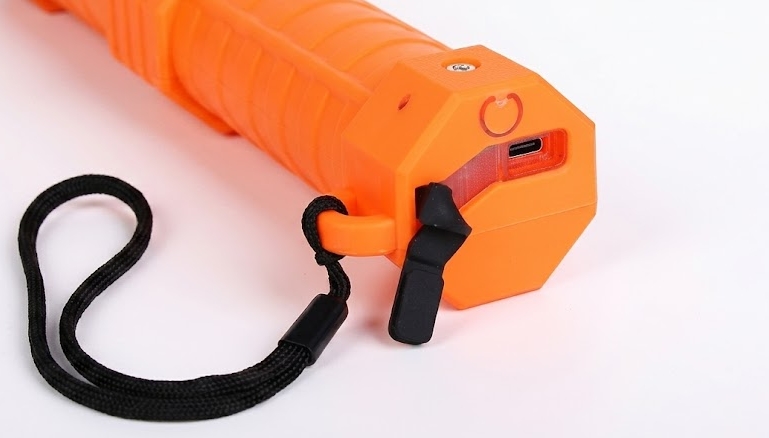
Charging is Type-C rather than a proprietary dock, which matters more than it sounds like it should. Charger bases are the most common reason a wand fleet shrinks over a season — not battery failure, but a dock that gets left at a site, falls off a truck bed, or stops working after a season of vibration and weather, and a wand that depends on that one dock becomes dead weight even though the light itself is fine. With Type-C, any cable and any USB power source — a power bank, a truck's USB port, a wall adapter — gets it charged in about 3.5 to 4 hours, so there's no single point of failure tied to one piece of equipment. That's also the supply-chain issue behind a lot of roadside equipment procurement decisions more broadly; our How Secondary Crash Risk Is Reshaping Roadside Warning Equipment Procurement article covers that side of it.
Durability matters for the same reason — a wand that gets dropped, kicked, or rolled over by a truck tire needs to keep working, not get replaced mid-shift. In an internal test, our team dropped units from about 3 meters (10 feet) onto pavement and they kept operating afterward — that's not a third-party-certified drop test, but it's been filmed and verified more than once.
On waterproofing, we'd rather be specific than impressive: this model is built for everyday splash and rain resistance, but it hasn't been independently certified to an IP rating, so we don't recommend submerging it or relying on it in standing water. If a crew works through flash flooding or heavy wash-down conditions regularly, that's worth flagging before ordering.
LED Traffic Wand vs. What Crews Used Before
Before switching to a rechargeable wand, most crews we've talked to were running some mix of chemical light sticks and basic battery-powered wands — and both run into the same problem on a multi-night job: they're built for one shift, not a season.
| Feature | Rechargeable LED Traffic Wand (Type-C) | Single-Use Light Stick / Flare | Basic Battery-Powered Wand (AA/AAA) |
|---|---|---|---|
| Power source | Built-in rechargeable battery | One-time chemical reaction | Disposable batteries |
| Typical runtime | Up to 24 h on flash, 19.5 h on low steady | Roughly 30 minutes per stick | A few hours before batteries die |
| Recharge / replace | Plug into any USB-C source | Discard after use | Swap batteries every shift |
| Covers a full 10–12 h shift on one unit | Yes | No — needs several sticks | Depends on battery stock on hand |
For a single, one-off closure, light sticks are fine. For a crew running the same lane shift five nights a week, restocking sticks and batteries every shift adds up — in cost, and in how often someone has to remember to restock the truck before heading out.
For crews ready to standardize on this setup, current specs and OEM order details are on the LED Traffic Baton Wholesale | Rechargeable Warning Light OEM product page.
FAQ
How long does an LED traffic wand run before it needs recharging? On flash mode, this model runs up to 24 hours on a single charge — more than enough for a full overnight shift. Lower-output settings extend that further, to roughly 19.5 hours on low brightness. A full recharge from any 5V/1A USB-C source takes about 3.5 to 4 hours, so units can top up during the day between night shifts.
Are LED traffic wands waterproof for night or rainy work zones? This model is built for everyday splash and rain resistance, but it hasn't been independently certified to an IP waterproof rating, so we don't recommend submerging it. In an internal drop test, units kept working after being dropped from about 3 meters (10 feet) onto pavement — that test wasn't third-party certified either, but it's been verified on camera.
Do LED traffic wands meet MUTCD requirements for flagging signal equipment? The Manual on Uniform Traffic Control Devices (MUTCD) sets general guidance for temporary traffic control and flagger signaling, but specific equipment requirements can vary by state DOT. Crews should confirm their state's current flagging standards before relying on any single wand as the sole signaling device. Documentation on this model is available on request.
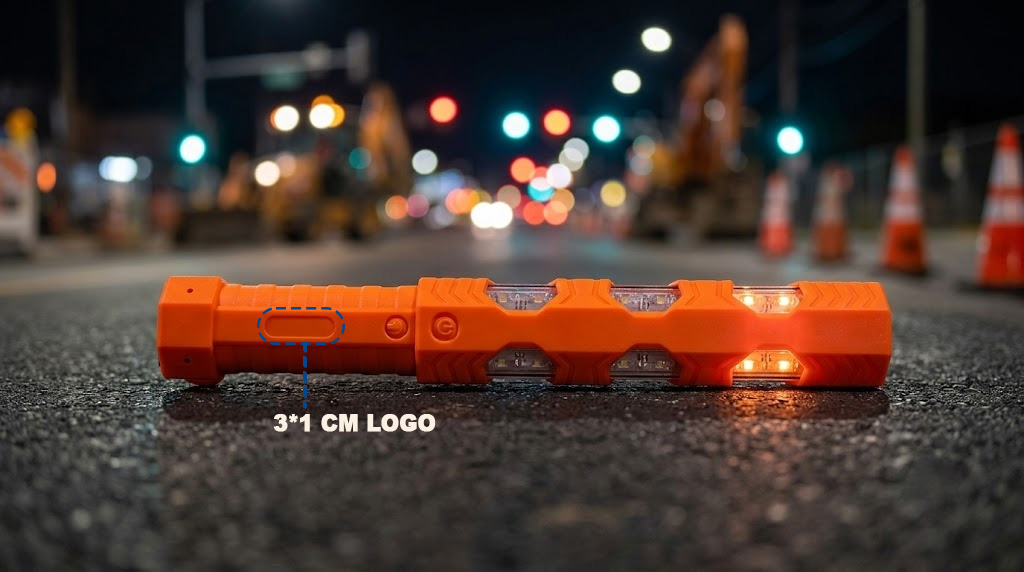
Can this wand be customized with a company logo for fleet or distributor orders? Yes — this model has a dedicated logo zone, about 3×1cm, just below the control buttons, and the LED color and flash pattern can be set to a buyer's spec. It ships OEM-ready with flexible MOQ for fleets and distributors; full specs are on the product page linked above.
What's the difference between a "traffic wand" and a "traffic baton"? Nothing functional — "traffic wand," "traffic baton," and "traffic control wand" all describe the same category: a handheld, battery-powered signaling light for directing traffic. The naming varies by supplier and region. When comparing listings, check the actual specs (modes, runtime, charging method) rather than relying on the product name alone.
Can the same LED traffic wand be used outside road construction, like for tow trucks, parking, or airport ground crews? Yes. The same signaling principle applies anywhere someone needs to direct vehicle or aircraft movement with a visible hand signal — tow operators managing traffic around a recovery, parking attendants running an event lot, and airport ground crews marshaling aircraft all use this style of wand. Each application tends to favor different modes or colors based on its own signaling conventions, not a different piece of equipment.
How many LED traffic wands does a road crew typically need per shift? At minimum, one per flagger actively directing traffic, plus at least one spare per crew in case a unit needs to charge or gets damaged mid-shift. Crews running multiple closures at once, or rotating flaggers across a long shift, often carry 2–3 units per active position so a charged one is always ready to swap in.
Do LED traffic wands replace cones, flares, and arrow boards in a work zone? No — a traffic wand is the active, in-hand signal a flagger uses to communicate with a specific driver in real time. Cones, flares, and arrow boards handle the passive, standing warnings that alert drivers to the closure before they ever reach the flagger. A night work zone typically needs both layers, not one in place of the other.
By the time the lane reopens at sunrise, the crew has cycled hundreds of cars through a single-lane shift without anyone meeting in the middle — and the wand goes back on a USB charger, not into a box of spent light sticks.
For fleet buyers or distributors looking to source this model in bulk, OEM quotes and sample kits are available — submit your requirements at superflare.net/ToFeedback for a spec sheet and quote within 24 hours.