How to Set Up a Temporary Safety Perimeter at Accident Scenes Before Recovery Vehicles Arrive
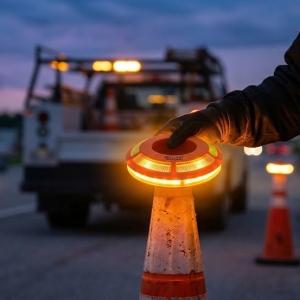
There is a window between when a vehicle stops and when help arrives. Most injuries happen in that window. The right lights close it — and for many fleet kits, that starts with a safety cone light mounted on the cone already marking the lane.
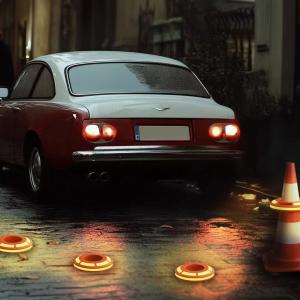
A temporary safety perimeter is a ring of active warning signals placed around a stopped or disabled vehicle to alert approaching traffic before recovery crews arrive. It requires at least one forward-facing light, one rear-facing light, and lateral coverage from a safety cone light or beacon — not just a single unit.
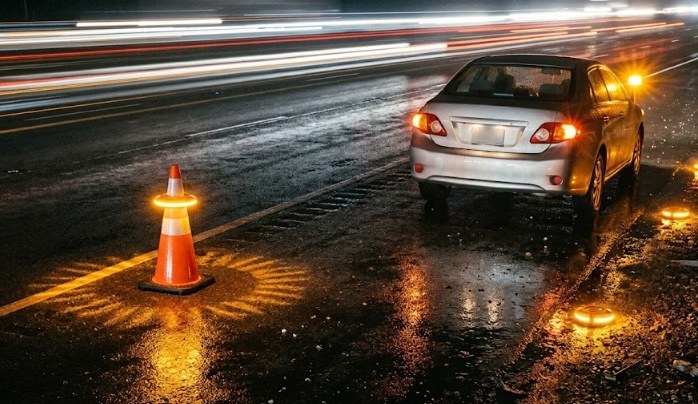
I talk to wholesalers and fleet kit distributors every week. The question they keep asking is simple: which warning light should I stock? But the real question — the one that actually protects their customers and their own product reputation — is different. It is: which light configuration covers the scene conditions my end buyer will actually face?
Those are not the same question. And the gap between them is where product returns, liability exposure, and lost repeat orders come from.
- Does One Warning Light Cover All Scene Types?
- Why Does the Pre-Recovery Window Define the Minimum Standard?
- What Is the Spatial Logic of a Safety Perimeter?
- Where Does a Safety Cone Light Fit Into the Perimeter?
- How Do Wholesalers Justify the Product to Their Own Buyers?
- FAQ
Does One Warning Light Cover All Scene Types?
Most buyers assume a warning light is a warning light. If it flashes, it warns. That assumption costs them later.
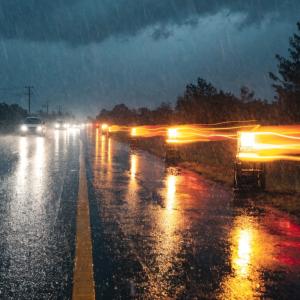
Different accident scenes have different visibility requirements. A highway shoulder at night needs long-distance throw. A foggy off-ramp at dusk needs wide-angle diffusion. An urban intersection needs multi-directional flash. No single light configuration performs equally across all three.
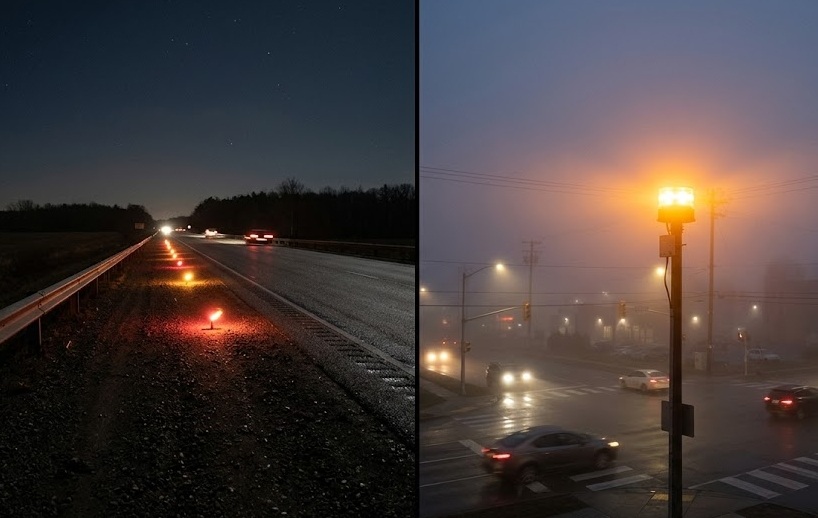
Let me break down why this matters at the product level.
What Changes Between Scene Types?
The physical variables that define a scene also define what the light needs to do. I have mapped two common scenarios below to make this concrete.
| Variable | Highway Shoulder (Night) | Urban Intersection (Dusk/Fog) |
|---|---|---|
| Approach speed | High (65–75 mph) | Low–Medium (25–45 mph) |
| Visibility distance needed | 500–1000 ft | 150–300 ft |
| Ambient light | Low | Mixed (streetlights, headlights) |
| Angle coverage priority | Rear-facing | 360° |
| Key product feature | High-candela directional flash | Wide-angle diffusion, amber dome |
| Passive reflector sufficient? | No | No |
The takeaway is not that you need a different product for every scene. The takeaway is that your product selection needs to cover the worst-case scenario your end buyer will face. Customers in the fleet management and roadside assistance categories often ask us specifically about amber lights with 360-degree visibility. That preference comes from experience with mixed urban and highway exposure. A directional blue or red beacon mounted to the rear bumper solves one angle. It does not build a perimeter.
Wholesalers who understand this can have a much stronger conversation with their buyers than those who lead with price. When your buyer asks "why this light over the cheaper one?" the answer is not "it has more lumens." The answer is "it covers the angle and distance range your drivers will actually encounter."
Why Does the Pre-Recovery Window Define the Minimum Product Standard?
The gap between when a vehicle stops and when a recovery truck or emergency unit arrives is typically somewhere between ten and thirty minutes. That number varies a lot. But during that entire period, the perimeter has to run without trained personnel managing it.
Before recovery vehicles arrive, the safety perimeter must be self-sustaining. That means the lights need to deploy fast, stay stable in wind and weather, and stay visible from multiple angles without someone standing next to them.
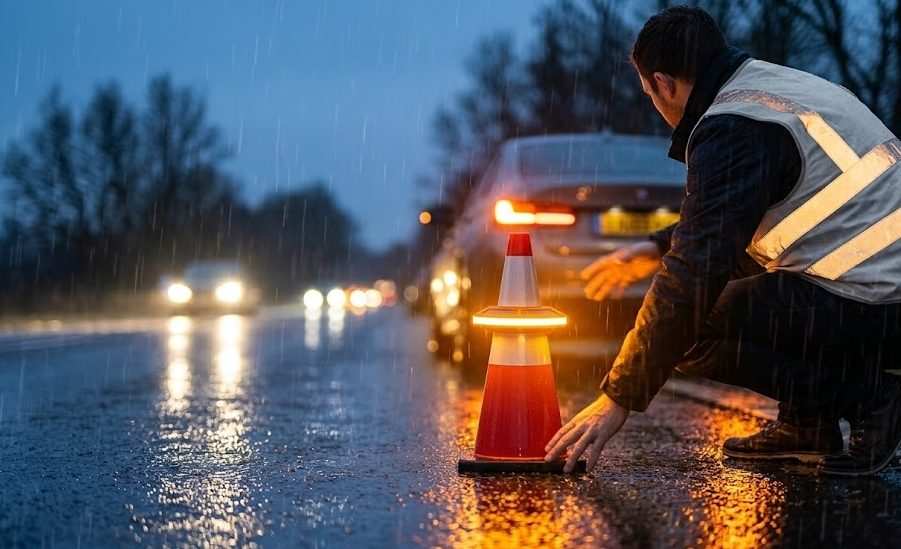
This is the part where passive reflectors fall short.
Active vs. Passive: Why the Gap Matters
A passive reflector — a triangle, a cone, a stick-on tape — does one thing. It reflects light that hits it. If a driver is not pointing their headlights at it, it does nothing. At dusk, in rain, or at an angle off the road axis, reflected visibility drops significantly.
An active LED warning light generates its own signal. It does not depend on another vehicle's headlights. It pulses or strobes to draw attention, not just return it.
Here is how I usually frame this for buyers who are building emergency road kits:
| Feature | Passive Reflector | Active LED Warning Light |
|---|---|---|
| Visibility source | Reflected light | Self-generated |
| Works in rain/fog | Poor | Good (amber diffuse especially) |
| Works at angles | Poor | Good (360° dome types) |
| Works in low-ambient light | Moderate | Strong |
| Deployment time | Fast | Fast (magnetic base, spike base) |
| Wind stability | Poor (triangles blow over) | Better (weighted or magnetic mount) |
| Battery required | No | Yes (most run 20–40 hrs on AA or Li-ion) |
The deployment speed point matters more than most buyers realize. If a driver has been in an accident, they may be shaken. The setup process cannot require tools, complicated steps, or reading a manual. Customers who buy for roadside assistance programs specifically request lights with magnetic bases or simple spike deployment because their end user may be placing the light under stress.
The pre-recovery window is not just a time gap. It is a capability requirement. Any product you stock for this application needs to meet that requirement independently.
What Is the Spatial Logic of a Safety Perimeter?
This is the most common gap I see in wholesale product conversations. A buyer orders a beacon. They call it a perimeter kit. It is not.
A safety perimeter requires coverage in at least three directions: forward of the vehicle (warning oncoming traffic), rear of the vehicle (warning following traffic), and lateral visibility. A single beacon placed behind the vehicle only covers one of those three.
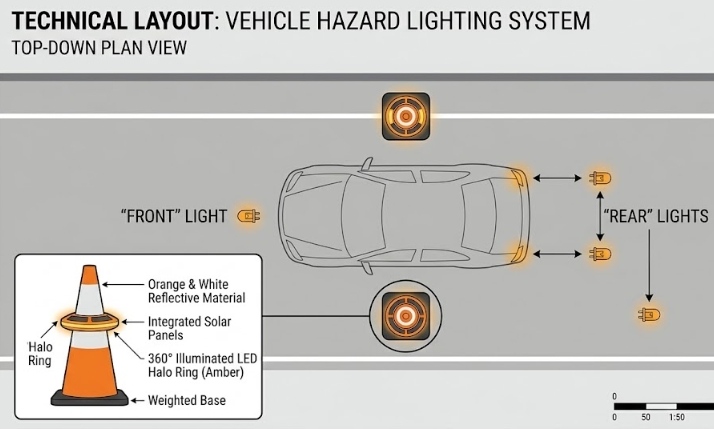
How Placement Interacts With Product Count
The geometry of a perimeter changes with scene type, but the basic logic stays consistent.
Rear warning is the most urgent because following traffic is the highest-speed threat on most roads. The light or lights at the rear need to be visible from the distance that matches the posted speed limit. At highway speeds, that means placement well behind the vehicle — not mounted to the bumper.
Forward warning is often skipped. But if a vehicle is stopped in or near a lane, oncoming traffic on a divided road can still be a hazard. A forward-facing light or a cone/flare at the front of the vehicle covers that gap.
Lateral visibility matters most at intersections, curved roads, or anywhere traffic approaches from a non-linear angle. A 360-degree amber dome light handles this well. A directional strobe does not.
Here is a basic kit configuration map that I walk buyers through when they are building SKU bundles:
| Position | Recommended Product Type | Minimum Quantity |
|---|---|---|
| Rear (distance) | High-candela directional LED flare | 2 (staggered 50–100 ft back) |
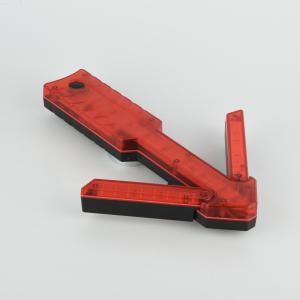
| Rear (close) | Magnetic beacon or LED road flare | 1 |
| Front | LED road flare or amber beacon | 1 |
| Lateral / all-direction | 360° amber dome beacon | 1–2 |
This is not a universal formula. Scene type, road speed, and the number of lanes all shift the answer. But this framework gives wholesalers a starting point for product bundling conversations. It also shifts the conversation from unit price to kit value — which is a much easier upsell conversation with fleet operators and emergency kit distributors.
Customers in the US market who distribute to fleet operators often ask us about SAE J845 and ECE R65 as reference points when specifying warning lights. These are commonly referenced standards in this product category. Whether a specific product meets those standards depends on the product and the manufacturer — that is something we always confirm at the product level, not assume.
Where Does a Safety Cone Light Fit Into the Perimeter?
Of the four positions in the table above, lateral coverage is the one most wholesalers get wrong — and a safety cone light is usually the fastest fix. It mounts directly on the cone already marking the lane, so deployment doesn't add a step. It gives 360° visibility without needing a separate mounting point, which matters when the person placing it is doing so under stress.
A safety cone light is not a replacement for a rear-facing directional flare — it covers the angle a directional light can't. In a full kit, it sits alongside road flares and beacons rather than instead of them.
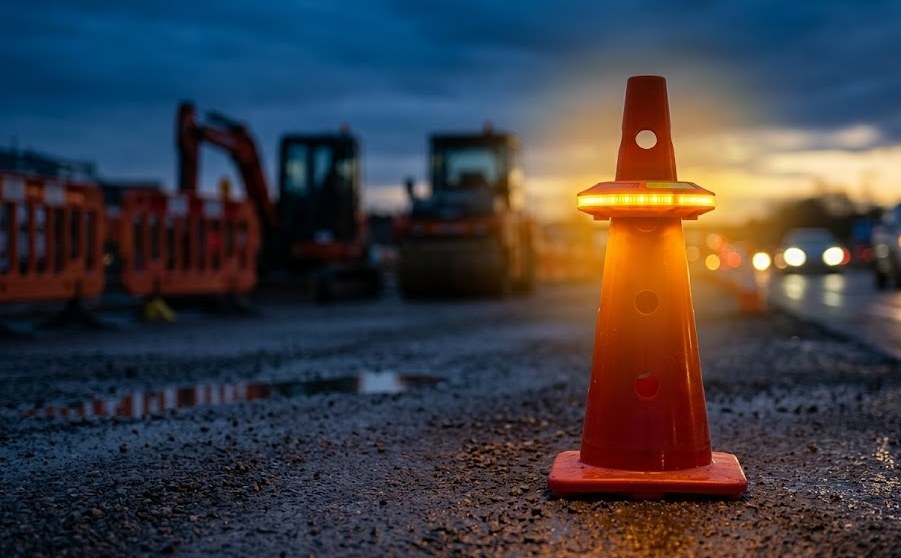
Wholesalers building fleet kits for different markets see different order patterns. A small US wholesale brand sourcing safety cone lights for regional fleet programs typically orders 200 to 300 units every six months, scaling with contract renewals. A German brand owner distributing nationally runs closer to 1,000 units a year, with private-label packaging built into each production cycle.
How Do Wholesalers Justify the Product to Their Own Buyers?
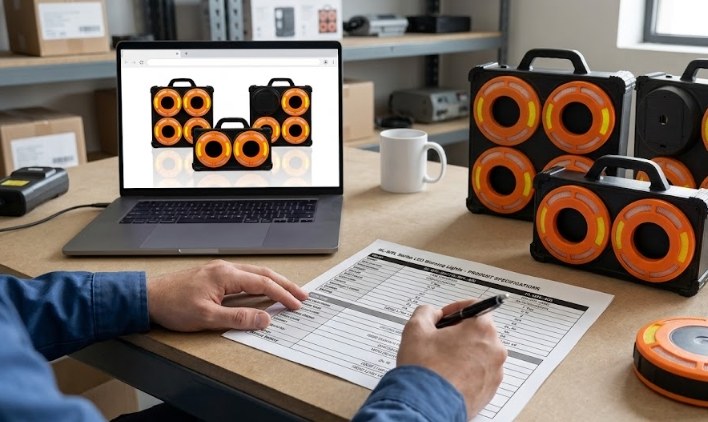
This is the question behind the question in most of my sales conversations. The wholesaler knows they need warning lights. What they actually need is a way to explain to their buyer — the fleet manager, the roadside kit brand, the emergency supply distributor — why this product is worth the price.
Wholesalers need a failure-mode story, not a spec sheet. The justification is not "this light has X lumens." It is "without this light in this position, a driver approaching at 60 mph has X fewer seconds of warning — and that is where accidents happen."
Giving Buyers Language That Holds Up
When fleet operators or emergency kit brands ask "why not the cheaper option?" there are usually three real objections underneath that question.
Objection 1: It looks the same. Cheaper lights often look identical in a product photo. The visible difference shows up in deployment conditions — battery run time under cold temperatures, flash intensity in daylight, wind stability. Buyers who have received complaints from their end users about lights that blew over or dimmed out are receptive to this conversation.
Objection 2: My customers don't know the difference. This is true until something goes wrong. Fleet managers and kit distributors carry downstream liability exposure if a product fails in a real scene. The question is not whether their customers can tell the difference on a shelf. The question is whether the product performs when a driver is standing on a shoulder at 11pm in the rain.
Objection 3: We just need something to check a compliance box. This is the most dangerous buyer mindset. Products selected only to satisfy a procurement checkbox often fail the actual use case. I tell buyers in this category: make sure the product you select actually covers the scenario, not just the document. Referencing commonly specified standards — SAE J845 in the US, ECE R65 in Europe — gives buyers a framework to evaluate products against, but it is always worth verifying the specific certification on the specific SKU.
| Buyer Objection | Response Framing |
|---|---|
| "It looks the same as the cheaper one" | Visible difference is deployment performance, not photo appearance |
| "Customers won't notice the difference" | They notice when it fails in the field |
| "We just need compliance" | Confirm the SKU actually meets the spec, not just the category |
| "One light is enough" | One light covers one direction — a perimeter covers all three |
The wholesalers who win in this category are the ones who can hand their buyers a product rationale that holds up to a downstream question. That means stocking the right configuration, knowing which scene types it covers, and being able to explain the spatial logic without sounding like they are guessing.
FAQ
What is a safety cone light used for in a warning light kit?
It provides lateral, 360° visibility by mounting directly on a road cone already placed at the scene — covering the angle a rear-facing flare or beacon doesn't reach.
How is a safety cone light different from a passive cone reflector?
A passive reflector only returns light it receives. A safety cone light generates its own signal, so it stays visible in rain, fog, or low ambient light regardless of headlight angle.
Do safety cone lights meet SAE J845 or ECE R65 reference standards?
These are commonly referenced standards in this category, but compliance depends on the specific SKU — always confirm certification at the product level rather than the category level.
What's a typical order size for custom-branded safety cone lights?
It depends on customization level. Stock units start lower; adding a logo or private-label packaging shifts the minimum higher, similar to other LED warning products in this range.
Scene type defines which lights the kit needs. The pre-recovery window sets the deployment standard. A safety cone light earns its place in the lateral position — not as a stand-in for the whole perimeter, but as one piece of a configuration that holds up when a driver is standing on the shoulder at night.
If you're specifying a safety cone light for a fleet kit or private-label program, our LED Traffic Cone Lights 8-Pack page covers current certifications and OEM options.
Related News