LED Traffic Baton MOQ Explained: Why Custom Orders Cost More Than the Listing
You asked for a custom logo on a traffic baton. The supplier came back with an MOQ five times higher than the listing. No explanation. Just a bigger number.
MOQ for LED traffic batons is not fixed. It moves based on how far your spec drifts from the factory's standard product. A stock sample might start at 50 to 100 units. Add a logo, a color change, or a modified housing, and that same factory may require 500 to 1,000 units — or more — before they'll run the line.
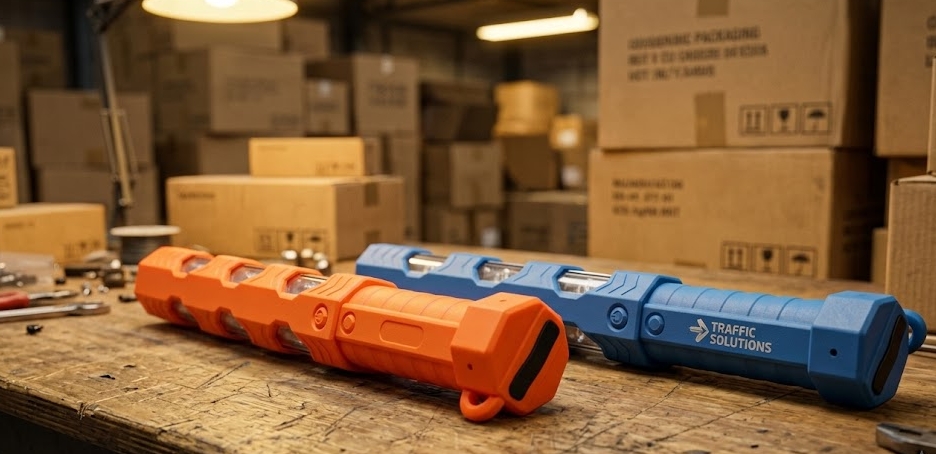
Most buyers come in having seen the headline MOQ on a listing. They assume that number applies to whatever they want to order — including custom versions. It doesn't — the same gap between what buyers expect and what a spec sheet actually requires shows up in MUTCD compliance requirements for LED traffic wands, where buyers often assume a device meets a standard it hasn't actually been tested against. The headline number is for the standard product as it sits on the shelf, and it's often even lower than buyers expect: many factories will release small sample batches of 50-100 units just to let a buyer test the market before committing to a full order. The moment you change something — a logo, a color, a feature — you're working off a different floor entirely. This article walks through what actually sets that floor, so you stop negotiating the wrong variable.It follows the same sourcing logic covered in our LED road flare buyer's guide, applied specifically to traffic batons.
Jump to:
- Why Standard MOQ Doesn't Apply to Custom Orders
- The Four Cost Drivers Behind MOQ
- Why Splitting Orders Doesn't Help
- What You Can Actually Negotiate
Why Does the Standard MOQ Not Apply to Custom Orders?
You found a supplier offering 50-100 unit samples of their standard traffic baton. You want your logo on the handle. You expect a similar minimum. But the quote comes back at 500-1,000 units. What happened?
When you ask for any change to a standard product — even just a printed logo on the packaging — the factory's cost structure shifts. They're no longer pulling from existing stock. They're running something new, and the setup cost for that run has to be spread across enough units to make sense. That's where the higher number comes from.
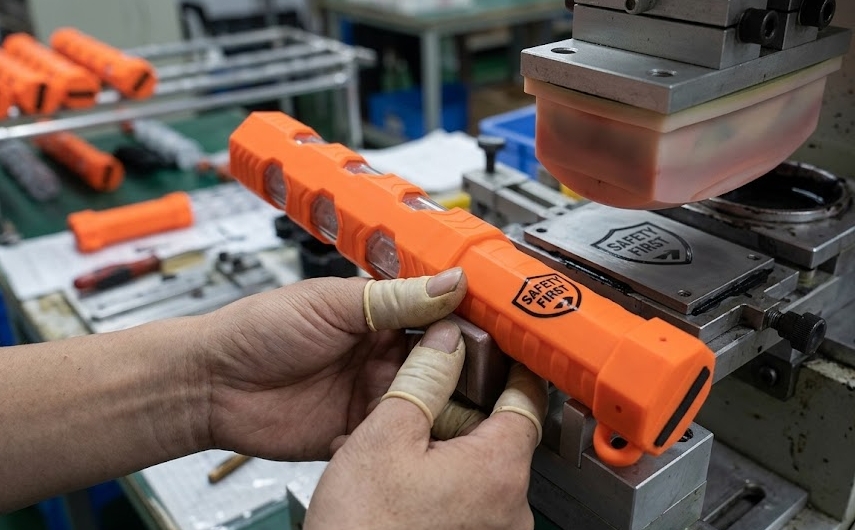
The gap between sample-level MOQ and custom MOQ is real, and it catches buyers off guard more often than anything else we see in our sourcing process. Here's the clearest way to think about it:
A standard baton uses components the factory already stocks — specific LED chips, a PCB batch they order regularly, housing molds they've already paid off, and plain bulk packaging. When you order 50-100 units of that item as a sample or small test batch, the factory isn't making decisions. They're pulling and assembling.
The moment you introduce a change, the factory has to make decisions. And every decision has a cost.
| Change Type | What It Triggers | Typical MOQ Impact |
|---|---|---|
| No change (stock sample) | Nothing new | Lowest MOQ (e.g. 50–100 units) |
| Logo on box only | Packaging print run minimum | Moderate MOQ (e.g. 500–1,000 units) |
| Logo on product body / color / sound-mode changes | Pad print setup, label tooling, or reprogramming | Moderate-to-high MOQ (e.g. 500–1,000 units) |
| New feature requiring a mold change (e.g. adding a buzzer) | New tooling, new BOM, full ODM line setup | Highest MOQ, driven by tooling amortization (e.g. 3,000+ units) |
The further you move from the factory's standard line, the more setup cost you're asking them to absorb. The MOQ is how they recover that cost.
What Are the Four Real Cost Drivers Behind MOQ?
Buyers often focus on quantity as the lever — "Can you lower the MOQ if I commit to repeat orders?" Sometimes that works. But a lot of the time, the MOQ isn't set by the sales team. It's set by constraints upstream that the sales team can't override.
Four specific cost structures independently set the floor on MOQ: component procurement minimums, tooling and mold costs, production line switchover costs, and custom packaging print minimums. Any one of these can make a lower quantity commercially unviable, regardless of what the buyer wants.
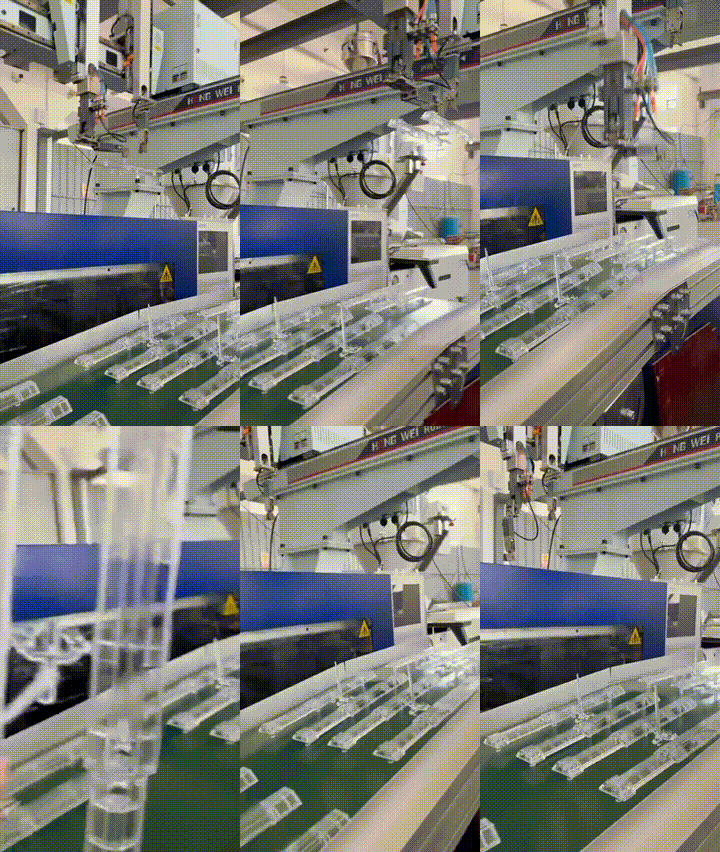
When we coordinate factory orders for clients, these are the four walls we run into. Each one operates independently.
Component Procurement Minimums
LED chips and PCBs don't come in arbitrary quantities. Component suppliers have their own minimums — often at the reel or batch level. If your custom baton spec requires a specific LED bin or a slightly different driver circuit, the factory has to order a minimum quantity of that component. We've seen cases where a single component procurement requirement pushed the floor to 500+ units for what the buyer thought was a minor spec change.
Tooling and Mold Costs
If your customization requires a new mold — for a different housing shape, an added feature like a buzzer, or a bracket modification — that mold has a one-time cost. In injection moulding, a new mold typically means new steel or aluminum tooling machined to the exact geometry of the part. Factories don't absorb that cost. They either charge it as a tooling fee upfront, or they build it into unit pricing and set a minimum run that amortizes it.
We've handled exactly this scenario: a customer asked for a buzzer to be added to a standard LED traffic baton, which required a housing mold modification to fit the new component. The resulting order came in at 3,000 units — not because the customer wanted that volume, but because that's what it took to make the tooling investment and the new BOM worthwhile for the factory.
Production Line Switchover
A factory running a large batch of their standard traffic baton today doesn't want to pause that run to set up a small custom batch. The switchover cost — time, material waste, quality checks — is real. This is a direct application of economies of scale: fixed setup costs get spread across fewer units on a small custom run, which raises the cost per unit and pushes factories to require a higher minimum before they'll disrupt an existing line.
Custom Packaging Print Minimums
This one surprises buyers who think "logo on the box" is cheap and easy. Carton printing has its own minimum — typically at the print plate level. A custom-printed box can require several hundred units minimum from the packaging supplier, regardless of what the product MOQ would otherwise be. This is the most common reason a "logo-only" customization request still results in a meaningfully higher MOQ than the buyer expected.
Can You Split the Order to Get Around the MOQ?
A lot of buyers try this. Place two orders of 250-500 instead of one order of 500-1,000. Or split a shipment across two months. The logic is that the factory gets the same total volume, just in smaller pieces.
Splitting an order does not reduce the factory's setup cost per batch. Every new production run triggers the same line setup, the same component procurement minimum, and the same packaging print run. Two smaller orders cost the factory more to produce than one larger order of the same total quantity.
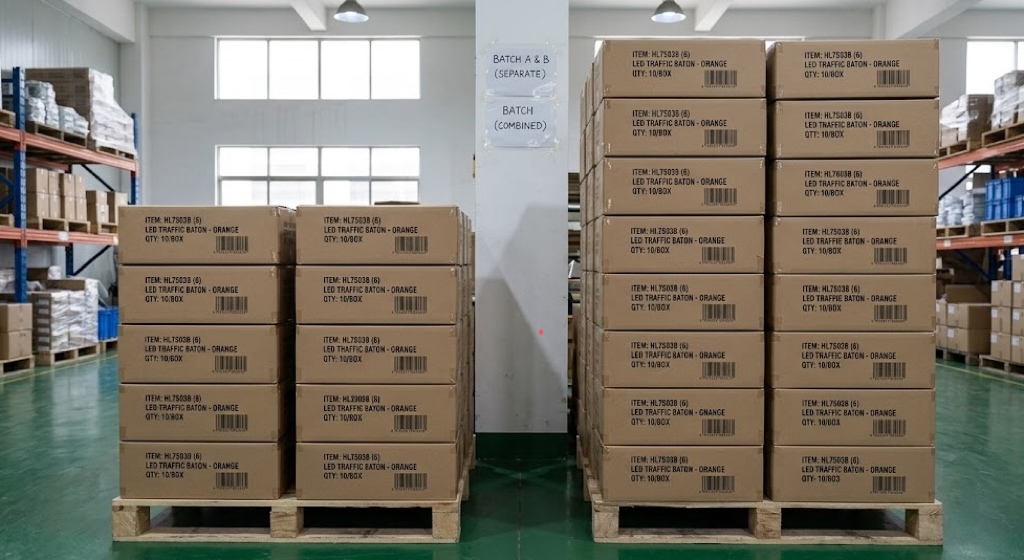
Here's what actually happens when a buyer splits a custom order:
The factory has to run a setup twice. Two separate line changeovers. Two separate quality check points. If the packaging is custom-printed, they may need to run two separate packaging batches, which defeats the purpose of a print run minimum entirely. In some cases, the second run ends up with slight color or component variation from the first, because the factory sourced materials in two separate procurement windows.
From the factory's perspective, two small custom runs are more expensive and more difficult than one larger one. So when buyers come to us asking about splitting as a workaround, we're honest about it: splitting doesn't lower the MOQ. It often raises the total cost per unit and creates consistency risk across the two batches.
What Can You Actually Negotiate?
Understanding why MOQ is set the way it is opens up a few real levers — not ways around the floor, but ways to make the floor lower or more affordable for your specific situation:
- Offer to cover the packaging print run cost separately. If your product MOQ concern is really a packaging print minimum, some factories will quote the product itself at a lower quantity if you agree to pay the tooling/print setup fee upfront rather than having it amortized into a large unit order.
- Start with logo-only, no mold change. If you're testing a new market, a logo-on-box or pad-print order (typically 500-1,000 units) validates demand without triggering tooling costs. Save the mold-level customization for once you have order history with the factory.
- Ask what's already in their active mix. Factories are more flexible on MOQ for customizations that overlap with product lines they already run. A feature or color close to something they already produce for another client costs them less to add.
- Accept a higher unit price for a smaller batch, if the numbers work. Some factories will run below their stated MOQ if you pay a premium per unit that covers the setup cost directly, rather than relying on volume to amortize it. This isn't always offered, but it's always worth asking. For buyers in the logo-only or small-batch custom range, our ongoing ODM factory relationships have allowed us to negotiate starting points as low as 300-500 units in some cases — specifically because the factory already has our client's product categories in their active mix. That's not a universal offer, but it's a real one for the right buyer profile.
Which Scenario Are You Actually In?
The practical question isn't "what's the MOQ?" It's "what kind of order am I placing, and what floor does that category realistically start at?"
| Buyer Scenario | Main Cost Driver | Typical MOQ Range (Our Arrangements) |
|---|---|---|
| Stock sample, no changes | None — pulling from existing line | 50–100 units |
| Logo / packaging / color / mode only | Packaging print run or reprogramming | 500–1,000 units |
| New feature requiring mold change (ODM) | Tooling + component procurement | 3,000+ units |
Scenario 1: Stock Sample, No Changes
You want the factory's standard traffic baton, as-is, to test quality or market fit. Plain packaging, standard color, existing housing.
This is where the lowest MOQ applies — typically 50 to 100 units. Lead time is short. There's no tooling conversation. The main variable is price per unit relative to quantity.
This scenario suits buyers who are testing a new market, need fast stock replenishment, or don't yet have the volume to justify custom development — for example, a contractor stocking up for night construction rerouting work before deciding whether a branded or custom version is worth the higher MOQ.
Scenario 2: Logo, Packaging, Color, or Mode Customization
You want your brand name or logo on the box or on the product handle, or you want a color variation or a different flash/sound mode within what the existing hardware supports. The underlying product spec — mold, components — stays the same. This is the same tier where a choice like rechargeable vs. battery-powered operation usually falls — a functional difference that doesn't require new tooling, but still shifts the MOQ away from the stock baseline.
This is the most common entry point for small brand owners. It feels like a small ask. But it immediately triggers the packaging print minimum and, if it's a product-body print, a pad printing setup cost. In our sourcing process, this tier typically starts at 500 to 1,000 units.
Buyers who understand this plan their first branded order accordingly. Buyers who don't often discover the real minimum after samples are approved — which is a worse time to find out.
Scenario 3: New Feature or Full ODM Requiring a Mold Change
You want a physical change that the existing mold can't accommodate — adding a component like a buzzer, a modified bracket, a different beam pattern, or a product built from a new spec sheet.
MOQ at this level is set by amortization logic. The factory needs to recover tooling cost, custom component procurement, and line setup across enough units to make the project worthwhile. In a real case we handled, adding a buzzer to a standard LED traffic baton required a housing mold modification, and the resulting order came in at 3,000 units.
For buyers with genuine volume and a specific product vision, this is the right path. For buyers who are still in early-stage market testing, it's usually better to validate with a stock or logo-only product first before committing to custom tooling.
FAQ
What is a typical MOQ for LED traffic batons?
It depends entirely on how far the order is from the factory's standard product. A stock sample with no changes typically starts at 50 to 100 units. A logo, color, or packaging customization usually moves that to 500 to 1,000 units. A change that requires a new mold — like adding a buzzer — can push it to 3,000 units or more.
Why does adding a logo increase the MOQ so much?
A logo triggers a packaging print run minimum, and if it's printed directly on the product body, a pad-printing setup as well. Both have their own minimums set by the packaging or printing supplier, independent of what the base product MOQ would otherwise be.
Can I order a small sample batch before committing to a bulk order?
Yes. Most factories will release 50 to 100 unit sample batches of their standard product so buyers can test quality and market fit before deciding whether a branded or custom version is worth the higher MOQ that comes with it.
Does changing the LED color or flash mode raise the MOQ?
If the change works within the existing hardware and mold — a different color option or flash/sound pattern the driver already supports — it falls into the same tier as logo customization, typically 500 to 1,000 units. It only moves into ODM-level MOQ if it requires a new mold or new components.
Does ordering in smaller, split batches lower the MOQ?
No. Splitting one large custom order into two smaller ones doesn't reduce the factory's cost — it duplicates the line setup, component procurement, and packaging print run twice instead of once, which usually raises the total cost per unit rather than lowering it.
Conclusion
MOQ moves when your spec moves. A stock sample can start as low as 50-100 units. A logo or color change typically lands at 500-1,000 units. A feature that requires a new mold — like adding a buzzer — can push the floor to 3,000 units or more. Understand which customization scenario you're in before you negotiate, and you'll know exactly what floor you're working from, and which levers are actually available to move it.