LED Traffic Wand MUTCD Compliance: What Flagger Devices Actually Require
LED Traffic Wand MUTCD Compliance: What Flagger Devices Actually Require
Quick answer: An LED traffic wand has exactly one MUTCD-recognized role — as a flashlight or baton with a red glow cone that may supplement the STOP/SLOW paddle during nighttime emergency flagging at an unlit station, nothing more. Beyond that one clause, MUTCD sets no brightness or durability standard for an LED traffic wand. Screening one for real fieldwork is the buyer's job, not a compliance label's.
That last point is the one that catches wholesale buyers off guard. An LED traffic wand can clear every line on a spec sheet and still fail on a live site — not because it was mislabeled, but because MUTCD never set a product-level bar for it to clear in the first place. If you're sourcing for resale, that gap is exactly where your due diligence has to live.
Jump to:
- Is an LED Traffic Wand MUTCD Compliant?
- LED Traffic Wand Use Cases: Where Crews Actually Deploy Them
- How to Choose an LED Traffic Wand: Specs Worth Screening For
- What an LED Traffic Wand Can't Replace — and Why You Should Stock One Anyway
- FAQ
- Conclusion
Is an LED Traffic Wand MUTCD Compliant?
Short answer: only in one narrow, specific sense — as a nighttime supplement to the STOP/SLOW paddle, never as a stand-alone "MUTCD-certified" product. Here's where that answer actually comes from.
OSHA doesn't write its own signaling spec. 29 CFR 1926.201(a) simply requires that flagger signaling — including the apparel flaggers wear — follow Part 6 of the Manual on Uniform Traffic Control Devices (MUTCD). All of the actual detail lives in MUTCD, not in OSHA's text.
MUTCD's detail is concentrated almost entirely on one device: the STOP/SLOW paddle. In the current 11th Edition, the requirement sits in Chapter 6D – Flagger Control (states on an earlier edition will find the same language under Chapter 6E). The paddle carries hard, testable specs:
- Octagonal shape, at least 18 inches wide, letters at least 6 inches tall
- White letters and border on a red background for the STOP face
- Black letters and border on an orange background for the SLOW face
- Retroreflective when used at night A flag is the only other primary device MUTCD names, and only as a fallback until a paddle is available.
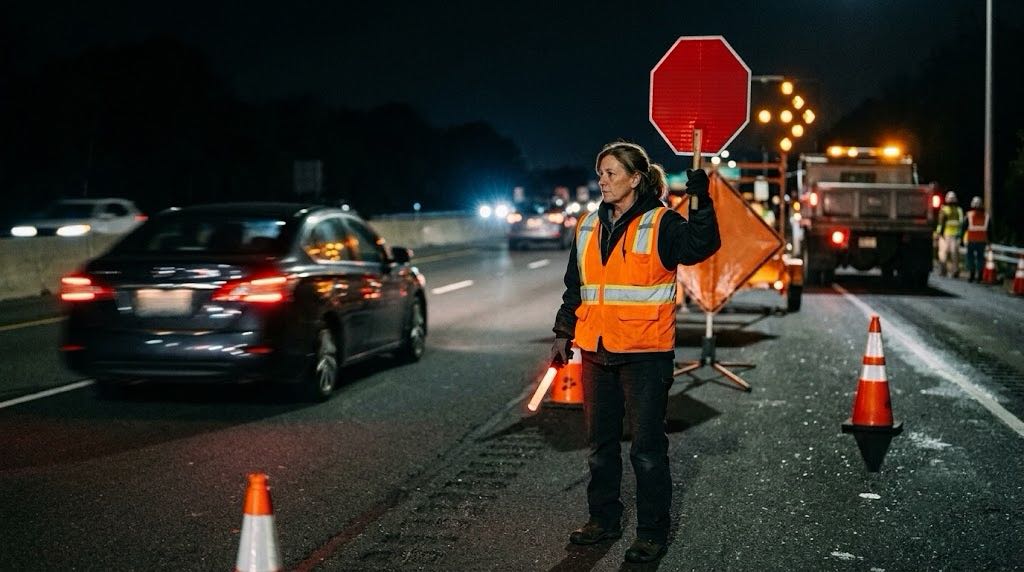
A lighted wand gets exactly one mention, and it's conditional: when a flagger station has no fixed lighting and an emergency comes up at night, the flagger may carry a flashlight or baton with a red glow cone in addition to the paddle or flag — held in the left hand while the paddle or flag stays in the right. That's the entire product-level rule. MUTCD doesn't set a lumen minimum, a candela-at-distance requirement, or a durability test for the wand itself, the way it does for the paddle's size and reflectivity.
That asymmetry is the whole story. The paddle has a hard spec because it's the device MUTCD is willing to make mandatory. The wand doesn't have one because MUTCD never assigned it that role — it's a supplement, used at the flagger's discretion, in a narrow set of conditions. A product can be a perfectly legitimate "MUTCD-recognized" supplemental device and still have no compliance number printed anywhere, because there isn't one to print.
LED Traffic Wand Use Cases: Where Crews Actually Deploy Them
Most LED traffic wands sold in the U.S. never touch a formal MUTCD flagger station at all. The emergency-supplement clause above is real, but it's a narrow slice of total demand. The broader job a wand does is visibility and gesture clarity in situations that don't have a flagger station, a paddle, or a traffic control plan attached to them:
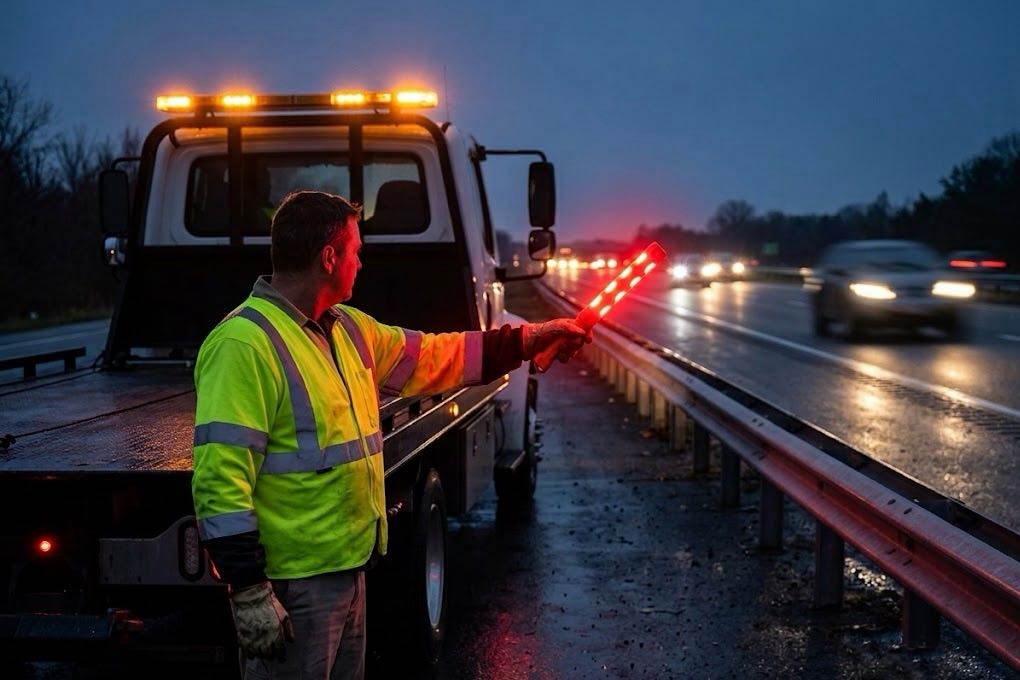
- Tow operators and roadside assistance crews wave following traffic wide while hooking up a vehicle on the shoulder — no formal flagger station, just one person and a hazard. [IMAGE: Tow truck operator using an LED traffic wand at night roadside]
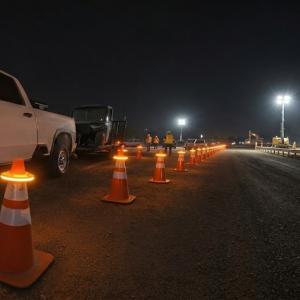
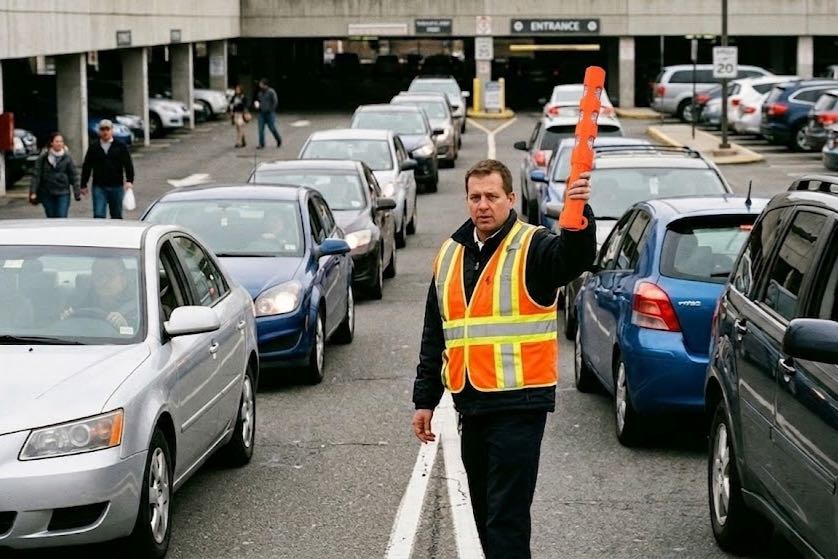
- Parking attendants and event staff use steady or slow-flash modes to move vehicles through a lot without shouting over engine noise. Crews running wands for lot or event duty often pair them with traffic cone top warning lights for static lane delineation. [IMAGE: Parking attendant using an LED traffic wand to direct vehicles in a lot]
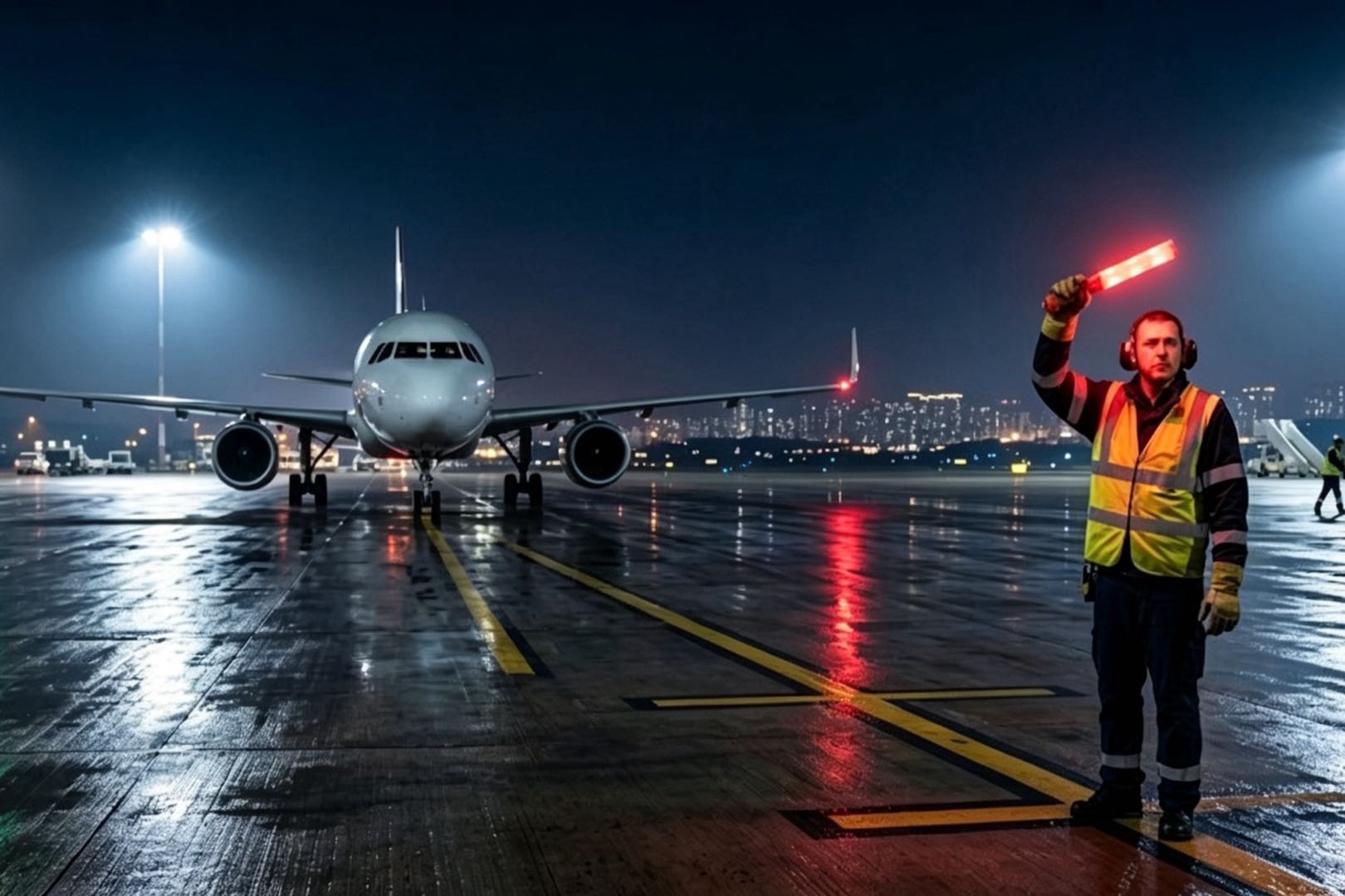
- Airport ground crews use the same form factor for ramp and aircraft marshaling, where hand signals need to read clearly against runway lighting at night. [IMAGE: Airport ground crew member marshaling with an LED traffic wand at night]
- Security and police personnel carry one as a backup signal at checkpoints and incident scenes, typically alongside a flashlight rather than a paddle.
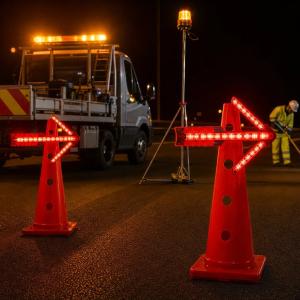
- Municipal and highway crews keep a few in the truck for short-duration, low-volume jobs where a full paddle-and-signage TTC setup isn't proportionate to the risk — and often run portable arrow warning lights for the same short-duration lane shifts. Day and night impose genuinely different visual demands on the same device, and it's worth screening for both if your customers run both. At night, a unit that's too intense creates glare that actually makes a flagger's hand position harder to read at distance — diffused, adjustable output beats raw brightness. In daylight, ambient light washes out anything underpowered, so a steady mode that looked plenty bright in a warehouse test can disappear against noon sun on open highway. A wand built for one condition doesn't automatically perform in the other, which is reason enough to ask a supplier how a unit was actually tested, not just what its rated output is.
How to Choose an LED Traffic Wand: Specs Worth Screening For
Because MUTCD doesn't set a product spec for the wand itself, the screening burden sits with whoever sources it — and that's exactly where a generic spec sheet stops being useful. A few questions are worth asking before any bulk order, regardless of supplier:
| What a spec sheet usually shows | What's actually worth asking |
|---|---|
| "Bright LED" / total lumens | Was visibility tested at distance, in daylight and at night, or just measured in a lab? |
| "Long battery life" | What mode and brightness level was that runtime measured at — steady, or the longest flash mode? |
| "Waterproof" / an IP code | Is that a third-party lab result, or a manufacturer's own description? What does the specific IP number actually cover? |
| "MUTCD compliant" | Compliant with which clause — the nighttime emergency-supplement rule, or no specific clause at all? |
On that last row: IP ratings are a useful example of why the literal code matters more than the word "waterproof." IP54 means dust-protected and splash-resistant; IP65 means dust-tight and resistant to a low-pressure water jet. Neither one is a drop-test rating, and neither says anything about performance after repeated cold-weather handling. A product can be honestly described as IP-rated and still not be the right fit for a crew that drops gear on pavement daily — the rating and the field condition are two different questions.
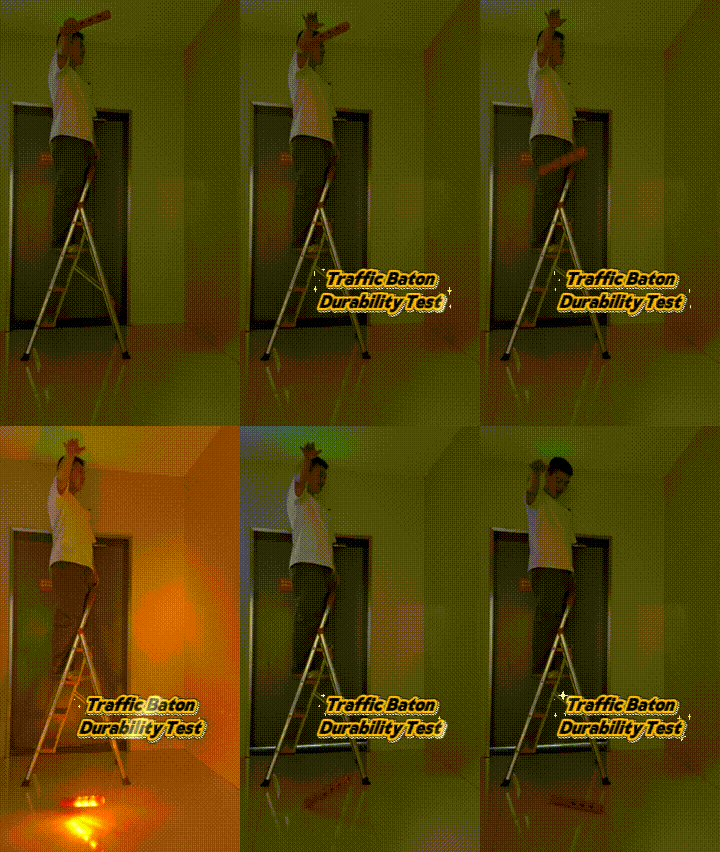
We'd rather answer this for our own product directly than make you guess: runtime is documented per mode (see the table below), charging is Type-C, and durability is backed by a self-filmed 3-meter drop test rather than a third-party certificate. We haven't run or claimed a formal IP test on this unit, and we're not going to imply one — it's built and tested for everyday outdoor water exposure, not submersion-rated.
| Unit type | Mode | Runtime |
|---|---|---|
| Red/Blue dual-color | Steady | 3 hours |
| Red/Blue dual-color | Flash | 24 hours |
| Red/Blue dual-color | Alternating flash | 7 hours |
| Red/Blue dual-color | Top LED — high | 7 hours |
| Red/Blue dual-color | Top LED — low | 19.5 hours |
| Single-color (Red/Amber) | Steady | 2.5 hours |
| Single-color (Red/Amber) | Alternating flash | 2.5 hours |
| Single-color (Red/Amber) | Single flash | 12 hours |
| Single-color (Red/Amber) | Fast flash | 17 hours |
| Single-color (Red/Amber) | Top LED — low | 19.5 hours |
The steady mode used for active hand-signaling runs out well before a 12-hour shift does; the flash modes used for static warning comfortably outlast it. A buyer planning for night-shift fleets should size recharge cycles around the steady-mode number, not the flash-mode one on the box. Charging itself runs on 5V/1A input and takes roughly 3.5–4 hours from empty.
Charging method is also where a lot of the real cost difference between products shows up:
| Rechargeable (Type-C) | Disposable battery | |
|---|---|---|
| Recurring cost | None after purchase | Ongoing battery spend |
| Mid-shift top-up | Any USB power bank, phone charger, or truck USB port | Needs spare batteries on hand |
| Best fit | Daily-use, multi-unit fleets | Infrequent, emergency-kit-only use |
A proprietary charging dock that gets left at a depot or breaks turns a wand into dead weight until a replacement dock is found. Type-C removes that single point of failure, which matters more to a fleet running 15–20 units of our LED Traffic Baton than another few hundred lumens would.
What an LED Traffic Wand Can't Replace — and Why You Should Stock One Anyway
MUTCD's flagger-control framework recognizes three categories of device: the STOP/SLOW paddle (and its flag fallback), an Automated Flagger Assistance Device (AFAD) for unattended or remote-controlled lane control, and the narrow lighted-baton supplement described above. A wand sits only in that third, smallest category. It doesn't satisfy the paddle requirement, it isn't an AFAD, and it doesn't substitute for required flagger-station lighting at night.
That's a limit, not a flaw. The honest pitch for a wand isn't "this replaces your paddle" — sellers who say that are setting their customers up for exactly the jobsite-inspection problem that prompted this guide. The honest pitch is redundancy: a low-cost, battery-independent backup signal that a flagger, tow operator, or ground crew can use the moment formal lighting or signage isn't where it should be. A wand that's cheap enough to keep two of in every truck buys real safety margin on the nights when something in the plan didn't go as drawn up — even though it was never meant to be the plan itself.
For wholesale buyers, that distinction is also a liability question. A distributor who lets "MUTCD compliant" stand in for "replaces your paddle" is the one who absorbs the return call when a contractor's flagging setup gets flagged on inspection — the factory shipped on spec, the importer passed it along, and the claim that actually caused the problem was made somewhere in between. Selling the wand for what it actually does protects the margin you're trying to build with that customer relationship.
For documentation, samples, or a formal quote on the LED Traffic Baton / Warning Light line, reach our team directly: sales001@brilliant-dragon.net. A full product catalog is available for procurement teams who need something to circulate internally: Download the catalog (PDF).
See full specs on the LED Traffic Baton / Warning Light product page.
FAQ
Is an LED traffic wand MUTCD compliant? There's no MUTCD certification process for wands as a product category. MUTCD recognizes a lighted baton as a narrow supplement for nighttime emergency flagging at an unlit station — used alongside, not instead of, a STOP/SLOW paddle. "Compliant" in that specific sense, yes; a substitute for the paddle, no.
Can an LED traffic wand replace a STOP/SLOW paddle or an AFAD? No. MUTCD names the paddle (or emergency flag) and the Automated Flagger Assistance Device as the recognized primary control methods for flagging. A lighted wand may supplement either for nighttime visibility but doesn't meet the paddle's shape, size, or retroreflectivity requirements, and it isn't a remote-controlled AFAD.
What IP rating should I look for in an LED traffic wand? It depends what the crew actually does with it. IP54 covers dust and splash protection; IP65 adds resistance to a low-pressure water jet. Neither covers drop resistance or extended cold-weather handling, so ask a supplier for the specific test standard behind any IP number rather than taking "waterproof" at face value.
How long does the battery last on a rechargeable LED traffic wand? It depends on the mode. Steady mode, used for active hand-signaling, runs roughly 2.5–3 hours per charge; flash modes run anywhere from 7 to 24 hours depending on the pattern. A full recharge from 5V/1A input takes about 3.5–4 hours.
What's the minimum order quantity for custom-branded LED traffic wands? MOQ depends on the level of customization requested — logo-only orders typically run lower than full color- or mode-custom builds. Share your target unit count and we'll confirm an exact MOQ and lead time rather than quote a flat number that may not fit your order.
Conclusion
MUTCD draws a hard line only where it means to: the STOP/SLOW paddle carries a mandatory shape, size, and reflectivity standard, and the lighted baton gets exactly one narrow role beside it — a nighttime-emergency supplement, nothing more. Everywhere else that actually matters in the field — brightness under real conditions, charging reliability, drop and water resistance — the standard goes silent, which puts the screening work on whoever sources the product for resale.
That's the gap this guide is meant to close. A wand that publishes honest runtime numbers by mode, charges without a proprietary dock, and says plainly what's been self-tested versus third-party certified will hold up on a live job site — and won't hand a distributor a return call six months later because a label overpromised.
If you're sourcing LED traffic wands, flagging equipment, or related warning lights for a U.S. fleet or resale program, send us your customer's actual use case and we'll confirm specs, MOQ, and lead time against it directly: *sales001@brilliant-dragon.net