LED Warning Light vs Road Flare: What's the Difference
LED Warning Light vs Road Flare: What's the Difference?
When buyers search for LED warning light vs road flare, they may be comparing two products that look similar but are designed for different deployment needs.
A conventional LED warning light is typically used as a standalone warning device. It creates a visible warning point around a vehicle, work area, roadside hazard, or traffic-control location.
A road flare, in this article, refers specifically to a rechargeable LED road flare system such as the Superflare LED Road Flares 8-Pack. Instead of relying on one warning point, the system uses multiple LED flare units that can work together through wireless synchronization.
That difference matters.
For a driver or operator who only needs one visible warning point, a standard warning light may be sufficient. For fleet operators, emergency-response teams, traffic-management companies, and B2B buyers who need to establish a larger warning area, a multi-unit road flare system can provide a different deployment approach.
Quick answer: A conventional warning light is generally a standalone warning device, while a rechargeable LED road flare system can use multiple synchronized units to create a coordinated warning area.

Table of Contents
- LED Warning Light vs Road Flare: The Basic Difference
- What Is a Conventional LED Warning Light?
- What Is an LED Road Flare?
- LED Warning Light vs Road Flare: Key Differences
- Why Multi-Unit Synchronization Matters
- LED Road Flare Deployment: Ground and Vehicle Mounting
- Battery Life and Charging
- Warning Light vs Road Flare for Fleet Emergency Kits
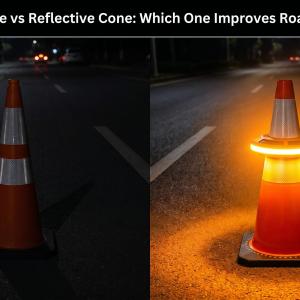
- LED Road Flare vs Traffic Cone Light
- B2B Procurement: What Should Buyers Compare?
- OEM and Private-Label Road Flare Options
- Frequently Asked Questions
- Conclusion
LED Warning Light vs Road Flare: The Basic Difference
The most important difference is not simply brightness.
It is how the warning is deployed and communicated.
A conventional LED warning light can function as an individual warning beacon. It is useful when the operator needs to make a vehicle, hazard, or specific location more visible.
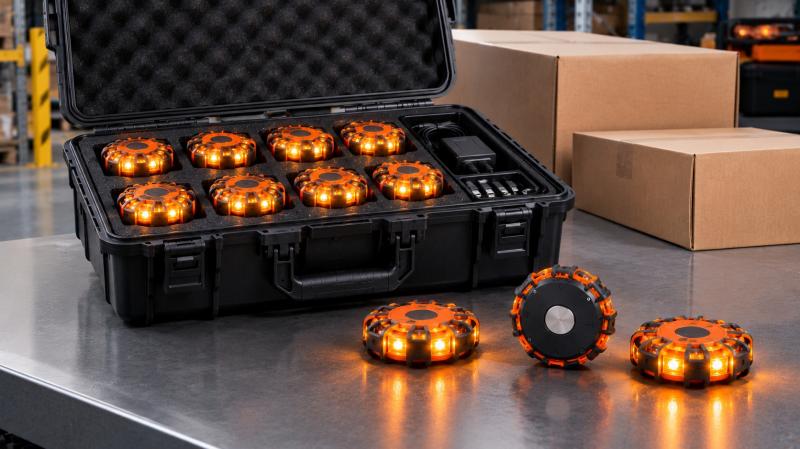
A rechargeable LED road flare system is designed around multiple warning units. For example, the Superflare HL75011 8-pack includes eight LED road flare discs and a rechargeable carrying case. The units can automatically activate when removed from the case and synchronize wirelessly within 10 meters.
This allows the buyer to create multiple warning points instead of relying on a single light.
| Feature | Conventional LED Warning Light | Rechargeable LED Road Flare System |
|---|---|---|
| Basic configuration | Usually standalone | Multiple coordinated units |
| Main purpose | Create a visible warning point | Establish a multi-point warning area |
| Deployment | Individual placement | Multiple units placed around a hazard |
| Synchronization | May be unavailable or product-dependent | Wireless auto-sync |
| Flash pattern | Product-dependent | Multiple coordinated flash modes |
| Mounting | Product-dependent | Ground placement + magnetic mounting |
| Storage | Individual unit or small kit | Rechargeable multi-unit carrying case |
| Best suited for | Single warning point | Roadside emergencies, fleets, traffic control |
| B2B value | Individual warning equipment | Complete multi-unit warning solution |
The important point is that a road flare system is not simply another name for a regular warning light.
It is a different product configuration built around multiple coordinated warning units.
What Is a Conventional LED Warning Light?
A conventional LED warning light is a broad category of electronic safety lighting.
Depending on the product design, it can be used for:
- Vehicle warning
- Roadside visibility
- Traffic control
- Construction areas
- Security operations
- Parking areas
- Emergency response
- Industrial safety
The key characteristic is that the light itself provides the warning signal.
For example, a single warning light placed on or near a vehicle can increase the visibility of that vehicle or hazard.
However, a single light also creates a single primary warning point.
That can be appropriate when the application is simple.
When Is a Single Warning Light Enough?
A conventional warning light may be appropriate when:
- Only one location needs to be marked.
- The operator needs a compact warning device.
- The warning area is relatively small.
- There is no need to create a sequence between multiple lights.
- The product will be mounted on a vehicle or fixed surface.
- The buyer wants a simple individual warning solution.
For many applications, simplicity is an important consideration.
The question changes when the operator needs to mark a larger area or establish several warning points.
That is where a multi-unit road flare system becomes more relevant.
What Is an LED Road Flare?
An LED road flare is an electronic warning device designed to improve visibility around roadside incidents, vehicles, temporary hazards, traffic-control areas, and other safety zones.
In this article, the term road flare specifically refers to a rechargeable LED road flare system rather than a traditional disposable flare.
The Superflare HL75011 8-pack is a good example.
The system includes:
- 8 LED road flare discs
- Rechargeable carrying case
- 3.7V 3000mAh lithium batteries
- Up to 60 hours of battery life, depending on operating mode
- 6 flashing modes
- Wireless synchronization within 10 meters
- Magnetic mounting
- IPX7 waterproof protection
- 3-ton crush resistance
- Amber, red, blue, and RGB color options
The units automatically activate when removed from the charging case and can synchronize with other units within the specified range.
When returned to the case, they automatically shut off and begin charging.
For professional buyers, this means the product can be treated as a complete warning system, rather than simply eight independent lights.
Learn more about the LED Road Flares 8-Pack
LED Warning Light vs Road Flare: Key Differences
The difference becomes clearer when looking at deployment.
Imagine a roadside vehicle breakdown.
With a conventional warning light, an operator may place one light at the vehicle or hazard location.
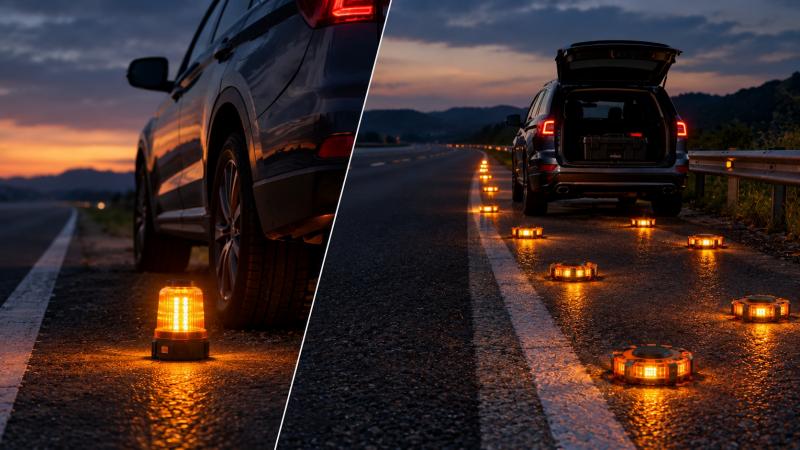
With a multi-unit road flare system, the operator can place several lights at different points around the vehicle or along the roadside.
The purpose is not simply to make one object brighter.
The purpose is to create a larger and more coordinated visual warning area.
1. Single Warning Point vs Multiple Warning Points
A conventional warning light is generally used as one warning point.
A road flare kit can distribute multiple warning points around a hazard.
This can be useful when the buyer needs to define an area rather than identify only one object.
2. Independent Operation vs Synchronization
One of the key differences is synchronization.
The HL75011 road flare system supports wireless synchronization between units within 10 meters.
The lights can flash in a coordinated sequence, creating a more structured visual warning pattern.
This is particularly relevant when multiple units are deployed along a roadside.
3. Individual Device vs Complete Kit
A conventional warning light may be purchased and stored as an individual unit.
The HL75011 is supplied as an eight-unit system with a rechargeable carrying case.
That changes the procurement conversation.
Instead of asking:
"How many warning lights do I need?"
a B2B buyer can ask:
"How many complete warning kits do my customers or vehicles need?"
This distinction is particularly useful for fleet, emergency-equipment, and traffic-safety distributors.
Why Multi-Unit Synchronization Matters
A single flashing light provides a warning.
Multiple synchronized lights can create a visual pattern across several positions.
This is one of the main reasons to consider a road flare system instead of relying only on a conventional standalone warning light.
The HL75011 supports wireless synchronization within 10 meters. Once the units are removed from the charging case, they can activate and synchronize without requiring manual pairing of every individual unit.
The six available flashing modes include:
- Pulsing Wave
- Single Flash
- Slow Flash
- Fast Flash
- Slow Double Flash
- Fast Double Flash
This gives buyers flexibility depending on the application.
For example, several units can be positioned along a roadside to create a coordinated warning sequence rather than several unrelated flashing points.
Why Is This Useful for B2B Buyers?
Synchronization can be especially relevant for:
- Fleet emergency kits
- Roadside assistance
- Emergency response equipment
- Traffic-management equipment
- Construction safety
- Law enforcement equipment
- Parking and event management
- Utility and maintenance fleets
The important factor is not simply that the lights flash.
It is that multiple lights can operate as a coordinated system.

LED Road Flare Deployment: Ground and Vehicle Mounting
Deployment flexibility is another major difference between a standard warning light and a multi-unit road flare system.
The HL75011 road flare can be placed directly on the ground to mark a roadside hazard.
Its magnetic mounting capability also allows the unit to attach to suitable metal vehicle surfaces.
This provides two basic deployment methods:
Ground Deployment
Ground placement is useful when the operator needs to create a warning perimeter or several warning points around:
- A disabled vehicle
- A roadside incident
- A temporary hazard
- A work area
- A traffic-control location
Multiple units can be positioned at different points and synchronized.
Magnetic Mounting
The magnetic base allows the road flare to attach to compatible metal surfaces.
This can be useful for:
- Emergency vehicles
- Fleet vehicles
- Maintenance vehicles
- Utility vehicles
- Roadside assistance vehicles
The product page specifies a magnetic force of 2,200 GS per unit.
For B2B buyers, mounting flexibility can be an important procurement factor because the same kit may need to support different deployment methods.

Battery Life and Charging
Battery and charging design are important when comparing ordinary warning lights with rechargeable road flare systems.
The HL75011 uses a 3.7V 3000mAh lithium battery and provides up to 60 hours of battery life depending on the flashing mode.
The charging system is built around the carrying case.
The deployment workflow is simple:
- Remove the units from the charging case.
- The units activate automatically.
- Select the required flashing mode or color if needed.
- Deploy the units around the vehicle or hazard.
- Units within the specified range synchronize wirelessly.
- Return the units to the case after use.
- The units shut off and begin charging.
For fleet operators, this type of workflow can reduce the number of separate charging components that need to be managed.
The carrying case also provides a dedicated storage solution for the complete eight-unit kit.
Warning Light vs Road Flare for Fleet Emergency Kits
Fleet operators have different requirements from individual vehicle owners.
A single warning light may be enough when the primary requirement is simply to make a vehicle visible.
A multi-unit road flare kit becomes more relevant when the fleet needs to establish multiple warning points around an incident.
For example, a roadside assistance vehicle may need to:
- Mark the disabled vehicle.
- Establish a visible perimeter.
- Place warning points at different positions.
- Mount a light on the vehicle.
- Deploy several lights quickly.
- Store all units together after the incident.
An eight-unit road flare kit provides a configuration designed around this type of deployment.
This is one reason multi-unit road flare systems can be attractive for fleet emergency kits.
Instead of carrying several unrelated warning devices, the operator can carry a dedicated rechargeable warning-light kit.
What Should Fleet Buyers Consider?
Before purchasing, compare:
- Number of units per kit
- Synchronization capability
- Battery capacity
- Runtime
- Charging method
- Storage case
- Magnetic mounting
- Waterproof protection
- Impact resistance
- Flashing modes
- Light colors
- Replacement and spare-unit availability
- OEM/private-label requirements
For a broader discussion of road safety equipment, see:
Road Safety Equipment: Flare vs Arrow Board vs Cone vs Baton
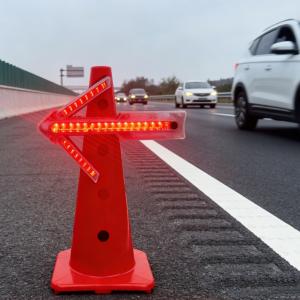
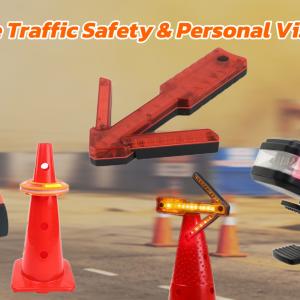
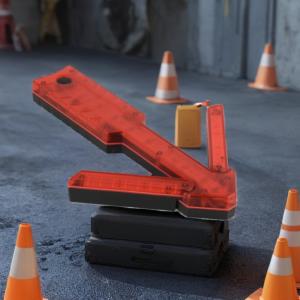
LED Road Flare vs Traffic Cone Light
Road flares and traffic cone lights can appear similar because both can use rechargeable LED warning technology and synchronization.
However, the deployment method is different.
A road flare is designed as a standalone warning unit that can be placed directly on the ground or magnetically mounted to a vehicle.
A traffic cone light is designed to work with a physical traffic cone.
Superflare's HL76907B traffic cone light is an example of this different form factor.
See the Rechargeable LED Traffic Cone Light
Road Flare
Best suited to:
- Vehicle breakdowns
- Emergency response
- Roadside hazards
- Fleet emergency kits
- Situations where traffic cones are not available
- Fast multi-point deployment
Traffic Cone Light
Best suited to:
- Construction zones
- Temporary work zones
- Lane-control areas
- Traffic-management operations
- Applications where traffic cones already define the physical boundary
The distinction is simple:
Road flare = portable warning point.
Traffic cone light = illuminated traffic-control marker.
For B2B buyers, the choice should therefore start with the deployment environment rather than only the LED specifications.
B2B Procurement: What Should Buyers Compare?
When sourcing warning lights or road flares for commercial use, product brightness is only one part of the evaluation.
A better procurement checklist includes the following.
1. Deployment Method
Ask where the light will be used.
Will it be:
- Placed on the ground?
- Mounted to a vehicle?
- Installed on a traffic cone?
- Used by emergency personnel?
- Stored inside a fleet emergency kit?
The deployment method should determine the product configuration.
2. Number of Warning Points
If customers need only one warning point, a standalone warning light may be sufficient.
If they need multiple warning points around a vehicle or hazard, a multi-unit road flare system may be more appropriate.
3. Synchronization
For multi-unit systems, ask:
- Can the units synchronize automatically?
- What is the synchronization range?
- Are the flash patterns coordinated?
- Is manual pairing required?
The HL75011 supports wireless synchronization within 10 meters.
4. Battery and Runtime
Compare:
- Battery capacity
- Expected operating time
- Charging method
- Charging-case design
- Charging indicators
- Replacement battery requirements
The HL75011 uses a 3.7V 3000mAh lithium battery and specifies up to 60 hours of runtime depending on operating mode.
5. Weather Resistance
Outdoor warning equipment may be exposed to rain and other demanding conditions.
The HL75011 is rated IPX7 and uses ABS + TPR construction.
It is also specified with 3-ton crush resistance.
6. Mounting
Consider whether the product supports:
- Ground deployment
- Magnetic mounting
- Vehicle mounting
- Cone mounting
- Other application-specific accessories
7. Storage and Transportation
For multi-unit systems, the carrying case is part of the solution.
A good storage configuration should make it easy to:
- Transport multiple lights
- Charge the units
- Store the equipment
- Deploy the lights quickly
- Return the units after use
8. OEM and Private Label
For distributors and brands, product customization can be just as important as technical specifications.
The HL75011 supports logo printing and OEM/ODM customization. The product page specifies free logo printing from 50 sets and broader packaging/product customization from 200 sets.
OEM and Private-Label Road Flare Options
For B2B buyers, the product itself is only part of the procurement decision.
Distributors may need:
- Private-label packaging
- Custom logos
- Different light colors
- Customized flashing modes
- Custom packaging
- Different order quantities
- Sample orders
- OEM/ODM development
The Superflare HL75011 supports several of these requirements.
The product is available with amber, red, blue, and RGB color options, while flashing modes and sequence timing can be customized for specific deployment requirements.
For bulk procurement, the listed standard MOQ is 50 sets, with each set containing eight road flare units.
This makes the product suitable for buyers who are looking beyond individual retail purchases and are developing:
- Fleet safety kits
- Emergency equipment product lines
- Traffic safety product ranges
- Roadside assistance kits
- Private-label safety products
- Distributor catalogs
View the LED Road Flares 8-Pack product page
LED Warning Light vs Road Flare: Which One Fits Your Application?
The answer depends on the deployment requirement.
Choose a Conventional Warning Light When:
- You need one primary warning point.
- The application is relatively simple.
- You do not need multiple synchronized units.
- You want an individual warning device.
- The warning light will be permanently or semi-permanently mounted.
Consider a Rechargeable LED Road Flare System When:
- You need multiple warning points.
- You want several lights to work together.
- Wireless synchronization is important.
- You need fast deployment around a roadside hazard.
- You want ground placement and magnetic mounting.
- You are building fleet emergency kits.
- You need a rechargeable multi-unit system.
- You are sourcing warning equipment for commercial distribution.
The important distinction is therefore not:
"Which light is brighter?"
A more useful question is:
"Do I need one warning point or a coordinated warning system?"
That question can make the procurement decision much clearer.